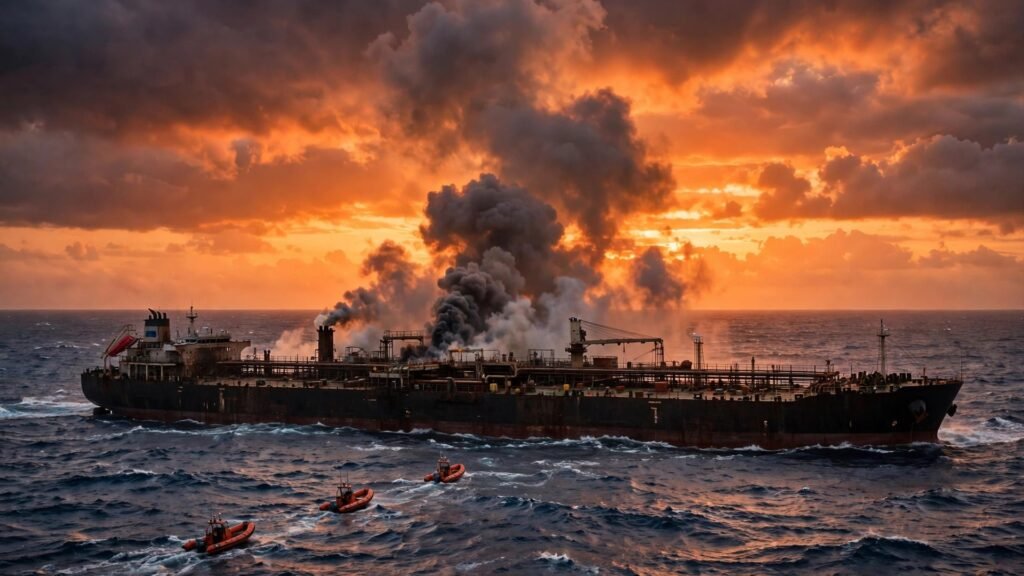
Oman has said its navy rescued 25 sailors from a merchant ship that caught fire after being targeted in the Gulf of Oman, in the latest incident to raise alarm about the safety of shipping near the Strait of Hormuz. The rescue, reported on Friday, October 30, came on the same day Iran said three oil tankers had been halted while crossing the strait, underlining how quickly maritime incidents in the region are now piling up.
Key Takeaways
- Oman said its navy evacuated 25 crew members from the merchant ship RITI after it was targeted and caught fire, and gave them medical care.
- Iran’s Revolutionary Guards said three tankers were halted in the Strait of Hormuz, including a supertanker it said struck a naval mine on an unauthorised route.
- Who attacked the RITI has not been publicly identified, and the mine claim is Iran’s account, not an independently confirmed finding.
Oman’s Maritime Security Centre said the navy carried out the evacuation for the crew of the RITI, a Panamanian-flagged vessel that ship-tracking site MarineTraffic described as a crude oil tanker. The Omani statement said the ship was targeted, which led to a fire breaking out on board, and that the rescued crew members were provided with medical care, without giving further details about their condition or the nature of the attack.
What Happened to the RITI
The incident was also flagged by the British maritime security agency UKMTO, which said a ship about 40 nautical miles, or 74 kilometres, south of Lavan Island in Iran was struck on Friday by an unknown projectile, causing a fire on board. That account does not name an attacker, and no public statement in the reporting so far has attributed the strike on the RITI to a specific party.
The distinction matters because the waters around the Strait of Hormuz are now a contested information space as well as a shipping route. Claims about mines, projectiles and unauthorised routes are being made by different sides, and the public record so far leaves key questions open: who struck the RITI, with what weapon, and whether the vessel will be towed, repaired or declared a loss. What is confirmed is narrower but still significant: a tanker was hit, it caught fire, and 25 people were taken off it by Oman’s navy.
Oman’s navy carried out an evacuation operation for 25 crew members of the merchant ship RITI, flying the Panamanian flag, after it was targeted, which led to a fire breaking out on board.
Iran Says Three Tankers Were Halted in the Strait
Separately on Friday, Iran said three oil tankers had been halted as they crossed the blockaded strait. The Revolutionary Guards said two vessels attempting to pass through an unauthorised route encountered incidents and were brought to a halt in waters south of the strait after ignoring radio warnings. A third vessel, a supertanker carrying two million barrels of oil, exploded and caught fire after striking a naval mine while on an unauthorised route, the Guards said, adding that it was the third oil tanker to have exploded and caught fire that day as a result of attempting to pass through an unauthorised route.
Those claims are Iran’s account of events in the strait. They have not been independently confirmed in the reporting available so far, and they sit alongside the separate, better-documented rescue by Oman in the Gulf of Oman. Readers should therefore treat the two strands differently: the rescue is confirmed by Oman’s own maritime security statement, while the mine explanation for the supertanker comes from the Revolutionary Guards.
- Oman rescued 25 crew members from the Panamanian-flagged merchant ship RITI after it was targeted and caught fire.
- UKMTO reported a ship 40 nautical miles south of Lavan Island was struck by an unknown projectile on Friday, causing a fire.
- Iran said two tankers were halted after ignoring radio warnings on an unauthorised route through the Strait of Hormuz.
- Iran said a supertanker carrying two million barrels of oil struck a naval mine on an unauthorised route and caught fire.
- The Strait of Hormuz normally carries about a fifth of global oil consumption, according to reporting on the blockade.
Why the Strait Matters So Much
The Strait of Hormuz is one of the world’s most important oil chokepoints, and Tehran has restricted maritime traffic through it since the West Asia war erupted on February 28 with United States-Israeli strikes on Iran. That war, now in its eighth month, began with strikes that killed the former supreme leader, Ayatollah Ali Khamenei, according to reporting on the conflict, and Iran retaliated with attacks on Israel and United States assets before blocking ships from using the strait.
Because about a fifth of global oil consumption normally passes through the strait, any incident there moves beyond a local shipping story. Traders watch for disruption to crude flows, insurers reassess risk for vessels in the Gulf, and governments weigh whether to reroute ships, increase naval patrols or press for a diplomatic opening. The events of Friday touched all three concerns at once: a rescue, a disputed mine claim, and a blockade that is already reshaping how oil moves.
Diplomacy Continues in the Background
Even as incidents at sea multiply, mediation efforts have continued. A Qatari delegation arrived in Tehran on Friday for talks with senior Iranian officials, as mediators press efforts to revive peace talks with the United States amid rising fears of a return to hostilities. Qatar and Pakistan have mediated talks since an April ceasefire, and the latest visit was described as covering bilateral relations as well as regional developments.
The diplomatic track is also connected to wider proposals for ending the war. Reporting this week has described a draft framework that would reportedly propose uranium transfer and Hormuz reopening, a reminder that the strait’s future is part of any settlement, not a side issue. Until such a framework is agreed, however, shipping in the region remains exposed to the pattern seen on Friday: incidents first, explanations disputed, and rescue operations filling the gap.
The Hormuz incidents also follow earlier tanker claims in the strait. Iran previously said three oil tankers caught fire after hitting mines, a claim that set the context for Friday’s reports and for the caution now shown by shipowners and crews operating near the waterway.
What to Watch Next
What to watch next is whether Oman or other authorities release more detail about the RITI, including the condition of the rescued crew and the state of the vessel, whether the attacker behind the strike is identified, and whether Iran provides evidence for its mine claim about the supertanker. The other tests are whether tankers keep attempting unauthorised routes through the strait, whether mediators in Tehran make progress toward reviving talks with the United States, and whether the blockade that has restricted traffic since February eases or tightens further. Until those questions are answered, Friday’s rescue stands as both a humanitarian operation and a warning sign for one of the world’s busiest oil routes.