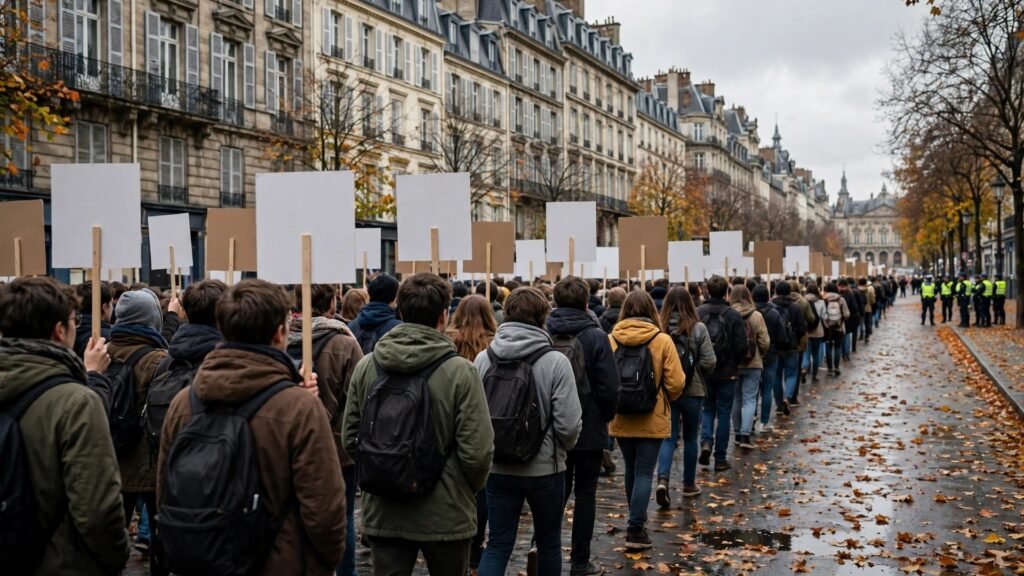
German police were deployed across the country on Saturday, October 31, 2026, and some shops boarded up their windows ahead of protests expected to draw tens of thousands of young demonstrators onto the streets. Organisers of the “GenZ regelt!” movement — the name translates roughly as “Gen Z has got this!” — say more than 170,000 people could turn out in over 30 cities, including Berlin, Frankfurt and Cologne.
The demonstrations are among the largest youth-led protests Germany has seen in recent years, and they arrive at a moment when young Europeans are increasingly taking to the streets to challenge political leaders they say have ignored them. While the movement stresses that it rejects all violence, authorities are taking no chances, deploying thousands of officers and preparing for crowds in city centres across the country.
Key Takeaways
- Organisers expect more than 170,000 young demonstrators in over 30 German cities, including Berlin, Frankfurt and Cologne.
- Protesters cite the high cost of living, poorly maintained schools, government spending cuts and sharply increased military spending.
- Police have deployed thousands of officers, and some shops have boarded up windows, though authorities say they have seen no evidence of concrete plans for violence.
What the protesters want
The movement’s complaints range from the high cost of living to poorly maintained schools and government spending cuts. More broadly, protesters say politicians are making decisions with apparently little regard for the younger generation — the people who will live longest with the consequences.
“The situation of young people is precarious, and yet they still aren’t being heard,” said Veronika Dinter, a spokeswoman for the movement. “The institutions that are supposed to prepare young people for life are being starved of funds.”
The situation of young people is precarious, and yet they still aren’t being heard.
Protesters are also unhappy with sharply increased military spending and a new voluntary service model aimed at boosting troop numbers. Many fear the model is a step towards bringing back conscription, a prospect that has sharpened anger among school leavers and university students.
- More than 170,000 people expected across over 30 cities
- Berlin, Frankfurt and Cologne among the main protest locations
- Cost of living, schools and spending cuts top the list of grievances
- Opposition to higher military spending and fears over a return to conscription
A movement inspired by Europe’s youth wave
The German demonstrations have been inspired by similar movements across Europe, including in France and Italy, where young protesters have voiced anger at political elites they accuse of ignoring their concerns. The cross-border inspiration is visible in the timing: major protests are also expected in France on Saturday, after nationwide demonstrations there on October 17 degenerated into some of the country’s worst rioting in years.
Berlin is in contact with officials in France and Italy amid fears that radicals from overseas could seek to join the German protests. Authorities say, however, that they have not seen evidence of concrete plans for violence.
The “GenZ regelt!” movement has sought to distance itself from extremism, stressing that “extremist groups, anti-constitutional symbols, racism and hate speech have no place with us — no matter from which side”. That message is central to its pitch: a youth protest that is loud, but peaceful.
The protests also unfold against a busy diplomatic backdrop for Germany. Chinese President Xi Jinping held talks with German President Frank-Walter Steinmeier in Beijing this week, while G20 foreign ministers met in Atlanta against a tense international backdrop — a reminder that the generation marching on Saturday is coming of age in a period of war, economic strain and geopolitical upheaval.
Police prepare as Halloween adds to concerns
Authorities are worried the protests, coinciding with Halloween, could be marred by the same kind of violence seen elsewhere in Europe. Some luxury jewellery shops and clothing stores have boarded up their windows to ward off potential looters, even as organisers insist the marches will be peaceful.
The heavy police presence reflects that tension: a state determined to protect the right to protest, and determined to prevent a day of youth anger from tipping into disorder. For the demonstrators, the police lines are part of the point — proof, they argue, that the state is quicker to deploy officers than to fund their schools.
Whether the turnout matches the organisers’ expectation of more than 170,000 will be the first test of the movement’s reach. Even a smaller crowd spread across 30 cities would mark a significant moment for a generation that has often been described as disengaged from politics.
What to Watch Next
Attention now turns to how large the crowds are across Berlin, Frankfurt, Cologne and the other protest cities, and whether the marches stay peaceful as organisers have pledged. Police deployments and any incidents through the day will show whether the authorities’ preparations were warranted. The movement’s next steps — and whether its message about the cost of living, schools and military spending gains traction with political leaders — will depend on what happens on the streets on Saturday.