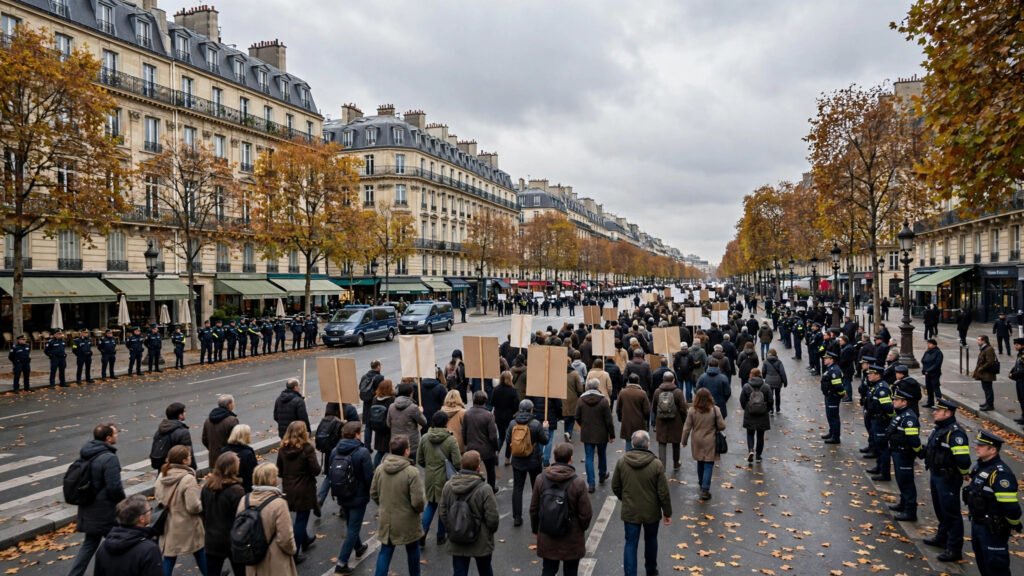
A Third Weekend on the Streets
France prepared on Saturday, October 31, 2026, for a third consecutive weekend of protests over living costs and education, with a heavy security presence and marches pushed to the edge of Paris. Around 70,000 police and gendarmes were deployed across the country, as authorities sought to prevent a repeat of the street violence that swept France two weeks earlier.
The demonstrations bring together Yellow Vest activists, labour unions, and high school and university students. What began with high school students protesting school conditions has broadened into wider anger over the rising cost of living and inequality, and the movement has now become a recurring weekend test for the French government.
Interior Minister Laurent Nuñez warned of a very high risk of disorder, especially after dark on Halloween. Shops in parts of Paris boarded up ahead of the marches, and the political backdrop added to the tension, with presidential elections about six months away.
Key Takeaways
- France deployed about 70,000 police and gendarmes for a third consecutive weekend of protests over living costs and education.
- Paris police banned union and Yellow Vest marches through the city centre, ordering a single route along the capital’s outer boulevards.
- The youth-led movement, which began over school conditions, has spread to similar demonstrations in Germany and Spain.
Paris March Pushed to the Outer Boulevards
Paris police banned union and Yellow Vest marches through the city centre, ordering demonstrations to follow a single route along the capital’s outer boulevards, from Porte de Bagnolet to Porte de Charenton. The Paris police prefecture authorised only a march on the outskirts of the capital, even though protesters had sought to rally in central Paris.
France’s highest administrative court, the Conseil d’Etat, on Saturday overturned a lower court decision that had approved the route through central Paris proposed by organisers of the main demonstration. President Emmanuel Macron said on Monday, October 26, that marches would stay out of city centres to protect shops.
Police also barred entry to Place de la Republique and Les Halles, both hit by rioting and looting on October 17, from 11 p.m. to 6 a.m. on Saturday and Sunday nights. Unaccompanied minors face a separate 9 p.m. curfew around the Champs-Elysees.
France prepared on Saturday for a third consecutive weekend of protests over living costs and education, with a heavy security presence and marches pushed to the edge of Paris.
How the Movement Grew
The movement began with high school students protesting school conditions and broadened into anger over living costs. Authorities counted about 550,000 protesters nationwide on October 17, when rioters looted hundreds of shops. At the previous weekend’s rallies, authorities counted about 410,000 marchers, with protests largely peaceful but police making more than 1,300 arrests.
That contrast — large, mostly peaceful crowds alongside episodes of looting and clashes — is central to how the authorities are handling this weekend. The heavy deployment, the rerouted Paris march, and the overnight restrictions around two previously affected squares are all aimed at keeping the demonstrations themselves lawful while limiting the scope for disorder after dark.
- About 70,000 police and gendarmes deployed nationwide, matching the previous weekend’s mobilisation.
- Paris march confined to the outer boulevards, from Porte de Bagnolet to Porte de Charenton.
- Place de la Republique and Les Halles closed from 11 p.m. to 6 a.m. on Saturday and Sunday nights.
- About 550,000 protesters were counted on October 17, and about 410,000 at the previous weekend’s rallies.
Youth-Led Rallies Spread Across Europe
The demonstrations are not confined to France. Similar youth-led demonstrations have been seen across Europe in recent weeks, with marches also planned on Saturday in Germany. In Germany, a youth initiative called “Gen Z regelt” — roughly “Gen Z’s got this” — urged protests in some 30 cities for education, health, climate protection and an affordable life, and against any return of military conscription. Berlin police expected about 10,000 people at the Brandenburg Gate.
In Barcelona, Spain, Catalan police planned their highest-level alert after an anonymous TikTok network called Blocus urged new gatherings. The spread of the protests, and the way they are organised in part through online networks, has made them harder for authorities in each country to predict, even as the underlying grievances — living costs, education and the cost of everyday life — remain similar.
As with other strike and protest actions across Europe this weekend, the French demonstrations are part of a wider wave of public mobilisation. The political stakes are also rising in France itself, where the protests are unfolding months before a presidential election, and in Poland, where a constitutional court standoff has sharpened political confrontation. At the same time, European governments are trying to hold together on wider questions, as seen in the new Canada-EU alliance announced in Montreal, which underlines how much of Europe’s politics is now being shaped at once.
What to Watch Next
What to watch next is whether the third weekend passes with the largely peaceful character of the previous weekend’s rallies, or whether disorder returns after dark on Halloween, when the interior minister has warned the risk is very high. Also to watch are the turnout figures authorities report for Saturday, how the rerouted Paris march and the overnight restrictions around Place de la Republique and Les Halles work in practice, and whether the youth-led demonstrations planned in Germany and Spain grow into a sustained European movement over the coming weekends.