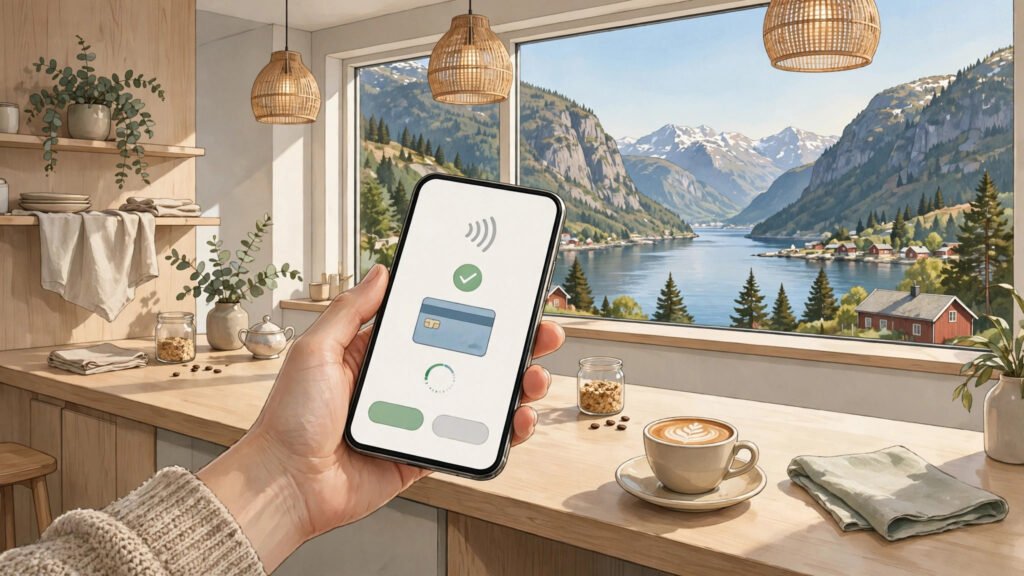
In Norway, paying for a coffee, a bus ticket, or a second-hand sofa often starts the same way: someone reaches for a phone instead of a wallet. Visitors notice it quickly, because cash is rarely asked for and cards are not always the first choice either. The question that follows is a natural one: why do Norwegians pay with Vipps instead of cash and cards?
Vipps is a Norwegian mobile payment app that lets people send money using a phone number rather than an account number. That simple idea explains much of its appeal. In everyday life, people usually know each other’s phone numbers, while few people carry around bank details. Sending money becomes as easy as sending a message, and that ease has shaped how Norwegians think about paying.
Key Takeaways
- Vipps lets Norwegians send money with a phone number instead of long bank details.
- Phone payments fit everyday moments, from splitting a meal to paying a small seller.
- Cash has faded because phones and cards already cover most daily payments, while cards remain useful for larger and more formal purchases.
What Vipps Actually Does
At its core, Vipps is a way to move money between people and to pay businesses without handling notes and coins. A person opens the app, chooses a contact or scans a code, enters an amount, and confirms the payment. The receiver gets the money in their own account, and both sides have a record of the transfer inside the app.
That record matters more than it might seem. When friends split a restaurant bill, there is no need to work out change or remember who paid whom. When a neighbour sells a used bicycle, the buyer can pay on the spot and the seller can see the payment arrive. The phone keeps a simple history, which makes small, informal payments feel settled rather than awkward.
Vipps also works for many businesses, from cafés and market stalls to online shops and organisations collecting payments. Instead of setting up a separate payment terminal for every small sale, a seller can accept a phone payment and move on to the next customer. For small businesses, that simplicity is a real advantage.
Why a Phone Number Changed Everything
Before mobile payment apps, sending money to another person usually meant exchanging account numbers. That process was slow, easy to get wrong, and poorly suited to casual payments. Few people wanted to ask a friend for a long string of digits just to repay a coffee.
A phone number solved that friction. Contacts are already stored in the phone, and a number is something people can share without hesitation. That single change turned money transfers from a banking task into an everyday action, and it is the reason phone payments spread so naturally among friends, families, and colleagues.
The same idea explains why similar apps took hold in other countries too. In Finland, for example, people also turned to a phone-first way of paying, as explained in why Finns pay with MobilePay instead of cash and cards. The app names differ, but the habit is the same: when paying is as easy as messaging, people do it more often and with less fuss.
Everyday Moments Where Vipps Wins
Vipps fits the small, social payments that make up much of daily life. Splitting a taxi fare, chipping in for a birthday gift, paying a babysitter, or settling up after a shared meal are all moments where cash would be clumsy and a card transfer would feel formal. A phone payment takes seconds and ends the conversation cleanly.
It also fits informal selling. Norway has a lively market for second-hand goods, and many of those deals happen between people who have never met. Paying by phone on the spot gives both sides confidence: the buyer does not need to visit a cash machine, and the seller does not need to trust a promise to pay later.
For clubs, teams, and small community groups, phone payments simplify collecting money. A coach collecting training fees or a parent group sharing the cost of an event can ask everyone to send the same amount to one number, rather than chasing cash in envelopes. The result is less admin and fewer forgotten payments.
Sending money becomes as easy as sending a message, and that ease has shaped how Norwegians think about paying.
Why Cash Faded First
Cash faded in Norway not because it was banned, but because it stopped being the easiest option. Carrying notes and coins means visiting a cash machine, keeping change, and handling money that can be lost. A phone, by contrast, is already in the pocket, already charged, and already connected to the bank.
Shops and services followed the same logic. Handling cash takes time at the till, needs secure storage, and adds work at the end of the day. When most customers prefer to pay digitally, accepting cash becomes an extra chore rather than a convenience. Over time, many everyday places simply stopped expecting it.
That shift was helped by trust in digital systems. Norwegians are used to managing much of daily life online, from banking to public services. Estonia offers a useful comparison: there, people also run much of daily life through digital services, as described in how Estonians run their lives online with e-services. Where digital habits are already normal, a phone payment feels like a small step rather than a leap.
What About Cards?
Cards have not disappeared in Norway. They remain a practical choice for larger purchases, for shopping in stores, and for situations where a phone payment is not offered. Many Norwegians carry both options and choose whichever fits the moment.
The difference is one of habit rather than replacement. A card is excellent at a checkout counter, but it is less natural for paying a friend or a small seller. A phone payment fills that gap, which is why it became the default for person-to-person payments while cards stayed strong for retail.
In other countries, the same gap was filled in different ways. In Kazakhstan, for example, QR codes became the everyday shortcut, as explored in why Kazakhstanis pay with Kaspi QR instead of cash and cards. Norway’s answer was Vipps, but the underlying story is shared: people adopt the payment method that removes the most friction from daily life.
The Limits Worth Knowing
Phone payments are not perfect for every situation. A dead battery, a lost phone, or a weak signal can leave someone temporarily unable to pay. Older people and visitors may also be less comfortable with an app-based system, and some still prefer cash or a card for privacy or habit.
- Vipps works best for everyday, person-to-person, and small business payments.
- Cards remain a strong choice for larger purchases and store checkouts.
- Cash still has a place for people who prefer it, even as it becomes less common.
- A phone payment needs a charged phone and a connection, so a backup method is still wise.
These limits do not undo the convenience, but they explain why Norway’s payment landscape is a mix rather than a single method. The phone leads for casual payments, cards hold their ground in shops, and cash lingers for those who want it.
What to Watch Next
The story of Vipps in Norway is ultimately a story about friction. A phone number replaced a long account number, and that small change made paying friends and small sellers feel effortless. Cash faded because the phone was already in every pocket, and cards stayed useful for larger and more formal purchases. As payment habits keep evolving, the methods that survive will likely be the ones that stay simplest in everyday moments: quick to send, easy to confirm, and settled without a second thought.