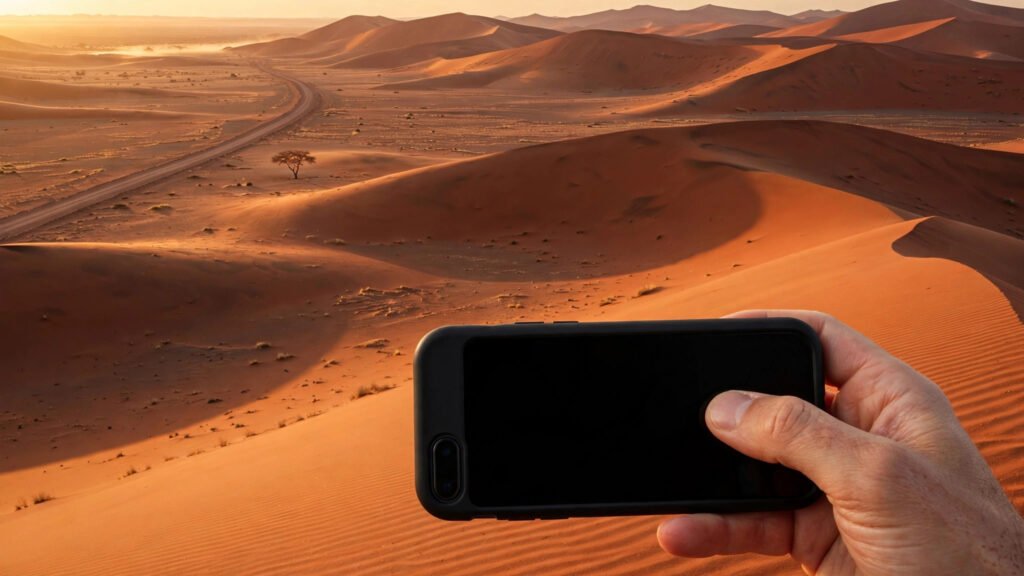
Namibia is a country of long horizons. Red dunes roll toward the Atlantic in the west, dry savanna stretches east toward the Kalahari, and towns are often separated by hours of gravel road rather than minutes of traffic. It is one of the most thinly populated countries in the world, which means that for many Namibians, the nearest bank branch, government office, market, or hospital is not around the corner — it is a journey away.
That single fact explains why the phone matters so much here. In Namibia, a smartphone is not mainly a gadget for passing time. It is the way people bank, talk to family, check the weather, sell a product, book a guest, find help on a remote road, and keep a business running when the next town is far away. Distance shaped this habit, and daily life keeps reinforcing it.
Key Takeaways
- Namibia’s towns are far apart, so the phone often replaces a long trip to a bank, office, or market.
- Mobile banking, messaging, weather checks, and online selling help farmers, traders, lodge workers, and families stay connected across desert distances.
- Charging and signal remain real challenges in remote areas, so phones are used carefully and solar charging matters.
Distance Is the First Reason
Start with a map and the pattern becomes clear. Windhoek, the capital, sits in the centre of the country, while many smaller towns and settlements are scattered across a huge, dry landscape. A trip that looks short on a map can take a long time on a gravel road, especially in heat, rain, or after dark. Fuel, time, and vehicle wear all add up, so people think twice before travelling for something a phone call or a message can settle.
This is why the phone became a planning tool first and an entertainment device second. A farmer can confirm a delivery before driving to town. A parent can check whether a clinic or school office is open before setting out. A small trader can ask a supplier about stock instead of arriving to find the shelves empty. Each avoided trip saves time and money, and over weeks and months, those savings matter a great deal.
Neighbours in southern Africa face a similar puzzle. In Botswana, too, people bank and pay by phone across long distances rather than travelling to a branch for every task. Namibia’s version of the same story is shaped by its deserts, its coastline, and its wide-open spaces — but the logic is the same: when distance is the problem, the phone is the shortcut.
Banking Without a Nearby Branch
For many Namibians, the phone is the bank. Mobile banking apps and money services let people check a balance, send money to family, pay a bill, or receive payment for work without standing in a queue in a distant town. That matters most for people who live far from a branch, work irregular hours, or cannot easily leave home, a farm, or a lodge during opening hours.
It also matters for family support. When relatives live in different towns — one working in Windhoek, another looking after family in the north, another running a small business near the coast — sending money by phone keeps support moving quickly. The sender does not need to travel, and the receiver does not need to wait for someone to carry cash across a long distance. In a country where journeys are long, that speed is a practical kind of care.
None of this means cash has disappeared. Cash still plays a big role in markets, small shops, and everyday trade. The phone has not replaced every transaction; it has given people an option for the tasks where travelling would cost more than the transaction itself. That choice — cash when it suits, phone when distance demands it — is the heart of the habit.
Farmers, the Weather, and the Market
Namibia’s farming life is shaped by dry conditions and uncertain rain. For livestock farmers and small growers, a weather update can change the day’s plan: when to move animals, when to hold off on a journey, when to prepare for heat or a storm. Checking a forecast on a phone is a small act, but it can prevent a wasted trip or a costly mistake.
Phones also connect farmers to buyers. A photo of produce or livestock, a message about availability, and a quick price discussion can settle a sale before anyone loads a vehicle. For people selling crafts, dried goods, or farm products, messaging apps and social media pages act as a shop window that stays open even when the nearest market town is far away. The customer may be in another region entirely, yet the conversation starts on a phone screen.
Similar patterns appear wherever rural work meets a mobile signal. In Madagascar, for example, fishermen check their phones before heading out to sea — a different coastline and a different trade, but the same idea: a quick check before a long, uncertain journey.
In a country where the next town can be hours away, the phone is not a luxury — it is the shortest road to everything else.
Tourism, Lodges, and Remote Work
Tourism is another reason phones are central in Namibia. Visitors come for the dunes of Sossusvlei, the wildlife of Etosha, the Skeleton Coast, and the quiet of desert lodges. Many of those lodges sit far from towns, and their staff, guides, and suppliers rely on phones to coordinate arrivals, bookings, transfers, and supplies. A delayed flight, a changed itinerary, or a vehicle problem is handled by message long before anyone meets in person.
For Namibians working in tourism, the phone is also a portfolio. Guides share photos of landscapes and wildlife, lodge teams post updates about rooms and experiences, and craft sellers show their work to buyers who may never visit a market stall. The phone carries the country’s beauty to people far away, and it carries bookings back.
Remote work follows the same pattern. Where a connection allows it, people handle admin, customer messages, schoolwork, and small online businesses from home rather than commuting to a town office. The phone does not solve every connectivity problem in Namibia, but where it works, it turns a remote home into a workable base.
Safety on Long, Empty Roads
Anyone who has driven Namibia’s long roads understands the safety argument. Stretches of gravel, sand, and heat separate settlements, and a breakdown far from help is a serious problem. A charged phone with signal — or even the ability to send a message when signal returns — can mean the difference between a long wait and a quick rescue. Drivers share their route, check in with family, and call for help when a tyre, an engine, or the heat stops a journey.
Parents use phones the same way for children travelling to school or between towns. A short message on arrival reassures a family that would otherwise wait hours without news. In a landscape this open, staying in touch is not a convenience; it is how families keep track of each other across distances that would otherwise swallow a whole day.
Charging and Signal in Remote Places
The habit comes with honest limits. Signal is not equal everywhere, and in the most remote areas it can be weak, patchy, or absent. People learn where coverage holds — near a town, on a hill, beside a main road — and plan calls and messages around it. A phone is most useful when its owner knows its limits.
Charging is the other challenge. Where grid power is limited, solar charging, power banks, and careful battery use become part of daily routine. People charge when they can, keep brightness low, and prioritise the messages that matter most. Across Africa, solar charging has become a familiar answer to the same problem — in Malawi, for instance, people charge their phones at solar kiosks when home power is scarce. Namibia’s strong sunshine makes solar a natural fit here too, and it helps keep phones alive far from a plug socket.
These limits also explain why Namibians tend to use phones practically. When battery and signal are precious, a phone is for the call that counts, the payment that cannot wait, and the message that keeps a plan on track — not for endless scrolling while a battery drains.
- Long gravel-road distances make the phone a substitute for many trips to town.
- Mobile banking and money transfers keep family support moving between distant towns.
- Weather checks, market messages, and booking coordination help farmers, traders, and lodge workers plan their days.
- Solar charging and careful battery use keep phones working far from grid power.
What to Watch Next
Namibia’s phone habit will keep following its geography. As coverage reaches further and charging options improve, more tasks that once required a journey — banking, selling, booking, learning, and checking in — will happen on a screen instead. The change will not be even everywhere: remote areas will still face signal and power limits, and cash will still matter in markets and small trade.
What is unlikely to change is the reason behind it all. In a country of deserts, long roads, and far-apart towns, the phone remains the shortest road to everything else — a bank, a market, a family member, or help on a lonely stretch of gravel. For Namibians, that is why daily life runs from a phone: distance made it necessary, and daily life keeps proving it useful.