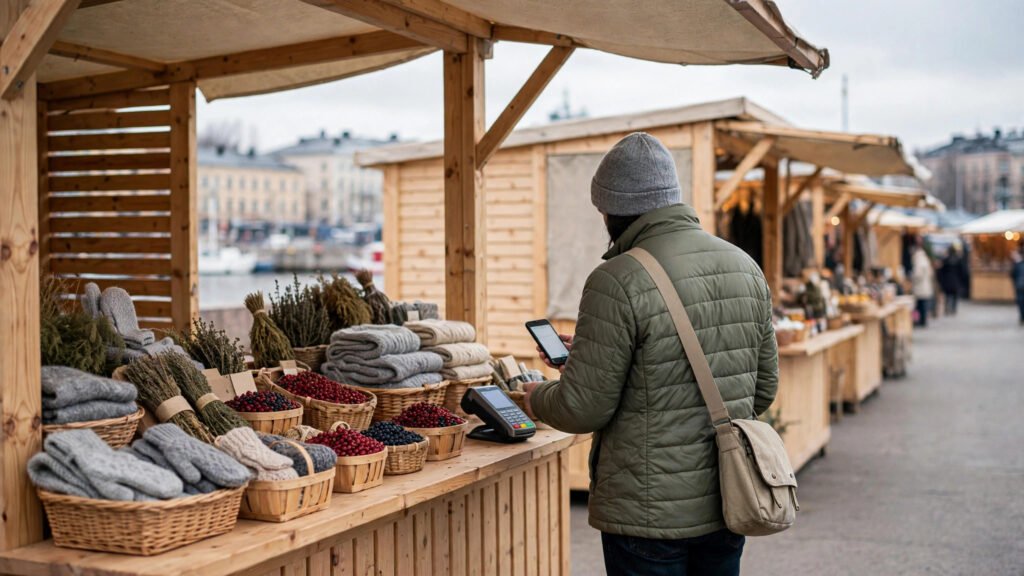
Walk through a market square in Helsinki, a café in Tampere, or a flea market in Turku, and you will notice something quickly: very few people reach for coins or notes. Instead, many Finns pick up their phone, open one app, and send money in seconds. That app is often MobilePay, and for a growing number of everyday payments it has quietly replaced cash — and sometimes even the card.
So why do Finns pay with MobilePay instead of cash and cards? The short answer is that it fits how Finland already lives: a country where banking went digital early, where trust in digital systems runs high, and where even small, informal payments — splitting a dinner bill, buying berries at a market stall, paying a neighbour for a used bike — still need a simple way to move money between people.
Key Takeaways
- MobilePay lets Finns send money phone-to-phone using only a phone number, which makes splitting bills and paying small sellers far simpler than cash.
- Finland was already moving away from cash before mobile payments arrived, so an easy phone app landed on habits that were ready for it.
- Cards are still widely used, but MobilePay wins the moments cards handle awkwardly: paying friends, market stalls, clubs, and second-hand sellers.
Finland was already leaving cash behind
To understand MobilePay in Finland, it helps to start with cash itself. Finns have used cards for everyday shopping for years, and many shops, cafés, and public services are set up for card and digital payments as the default. Carrying large amounts of cash feels unnecessary to many people, and younger Finns in particular often go days without handling a single coin.
That shift left one gap, though. Cards work well when you pay a shop, but they are awkward when you pay another person. If a friend covers lunch, or a neighbour sells you a bookshelf, there is no shop till to tap a card on. Cash used to fill that gap. MobilePay now fills it instead — and it does so without anyone needing to count change or visit a cash machine.
The result is a payment habit built around the phone people already carry. A phone number becomes the address for money, in the same way it is already the address for calls and messages.
What MobilePay actually does
MobilePay is a mobile payment app linked to a user’s bank account or card. Once it is set up, sending money is deliberately simple: pick a contact or type in a phone number, enter the amount, and confirm. The receiver gets the money in their own MobilePay account, usually within moments.
That simplicity is the whole point. There are no account numbers to copy, no paper slips to keep, and no need to meet at a bank. For the person paying, it feels closer to sending a message than making a bank transfer. For the person receiving, it feels closer to being handed cash — except the money lands straight in the account, with a record of the payment kept automatically.
A phone number becomes the address for money, in the same way it is already the address for calls and messages.
Why friends, clubs, and small sellers love it
Some of MobilePay’s most natural territory is the informal economy of everyday Finnish life: the situations where cash once ruled because nothing else was practical.
- Splitting a restaurant bill or a shared taxi ride between friends, without anyone owing anyone afterwards.
- Paying at flea markets, school fundraisers, sports clubs, and hobby groups that do not run a card terminal.
- Buying second-hand goods from a private seller, where a phone-to-phone payment is safer and simpler than carrying cash.
- Paying small businesses and market traders who want to accept digital payments without extra hardware.
For small sellers, the appeal is practical. A market trader selling berries, knitwear, or baked goods does not need to handle float, worry about counterfeit notes, or carry the day’s takings home in cash. A phone is enough. For clubs and associations, collecting membership fees or event payments becomes a matter of sharing a number rather than chasing bank transfers or envelopes of cash.
That same person-to-person convenience explains why the app spread through friend groups and families. Once one person in a group uses it, everyone else has a reason to join: otherwise they are the one person who still has to be paid back in cash.
How it compares with cards
None of this means cards have disappeared in Finland. Cards remain the standard way to pay in supermarkets, department stores, and most larger shops, and contactless card payments are fast and familiar. MobilePay’s advantage is not speed at a supermarket till — it is everything around the till.
A card payment needs a merchant, a terminal, and a purchase. A MobilePay payment needs only two people with phones. That difference matters most for small amounts between people, where setting up a card payment would be more trouble than the payment itself. It is also why MobilePay and cards now sit side by side in Finnish life rather than one fully replacing the other: cards for shops, MobilePay for people.
Finland’s experience also fits a wider pattern. In Peru, many people pay with Yape instead of cash and cards for similar everyday reasons, while in the Philippines GCash has become the everyday wallet for millions, and in Kazakhstan the Kaspi app covers shopping, banking, and payments in one place. Different countries, different apps — but the same shift from cash to the phone.
What still keeps cash and cards alive
MobilePay has not made cash extinct in Finland, and it was never designed to. Some people still prefer cash for budgeting, privacy, or simply habit, and cash remains important for anyone without a smartphone or a bank app. Cards, meanwhile, remain the simplest option for visitors, for large shops, and for anyone who does not use the app.
There are also limits to any single app. A payment app only works when both sides use it, and not every visitor or newcomer to Finland will have it installed. That is why Finnish daily life still runs on a mix: cards in shops, MobilePay between people, and cash in the corners where neither fits.
The lesson of Finland is not that one app conquered everything. It is that the payment method that wins is the one that fits the moment — and for the countless small, personal payments of Finnish life, the phone turned out to fit better than the wallet.
What to Watch Next
MobilePay’s place in Finland now depends on the same everyday habits that built it: friends splitting bills, small sellers taking phone payments, and clubs collecting fees without cash. Cards will keep their role in shops, and cash will keep its corners, but the phone-to-phone payment has earned its place as Finland’s simplest way to pay another person. The next question is not whether Finns keep paying by phone — it is how many more of life’s small payments move there next.