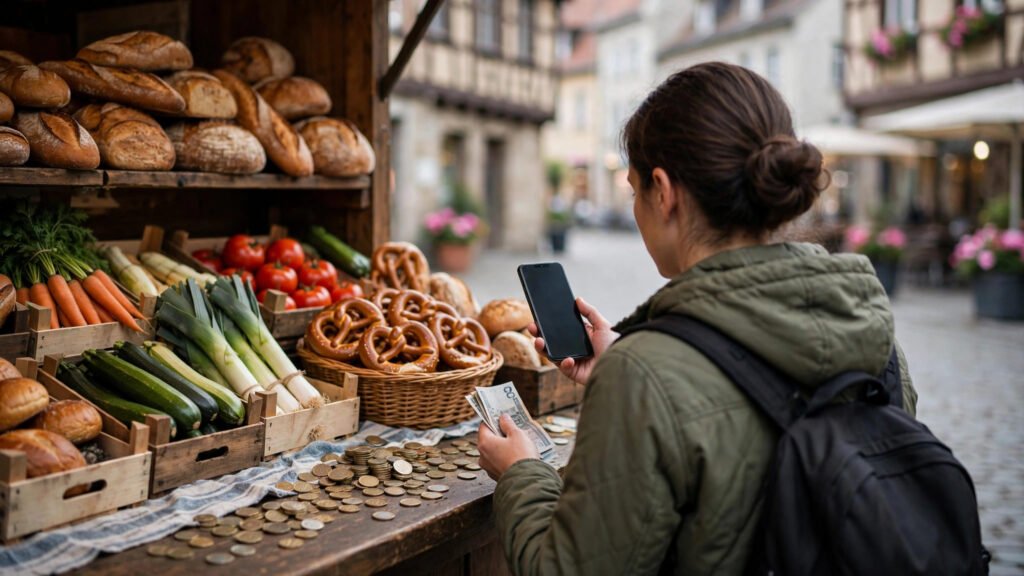
Walk into a bakery in Germany in the morning and you will see something that surprises many visitors. The card reader is there, the phone payment option is there, and still a long line of customers pays with notes and coins. In a country known for engineering and efficient systems, cash has not quietly disappeared. It is still part of everyday life, from the bread roll at breakfast to the ticket machine at the station.
So why do Germans still pay cash when cards and phones work almost everywhere? The answer is not that Germany rejected modern payments. Cards are common, phone payments are growing, and many larger shops accept them without a second thought. Cash survives because it fits how many people like to handle money: directly, privately, and without depending on a device, a signal, or a battery.
Key Takeaways
- Cash remains part of daily life in Germany even though cards and phone payments are widely available.
- Many people value cash because it is private, simple, and works without a phone, signal, or battery.
- Small shops, markets, and everyday routines keep cash practical, so it survives alongside cards rather than being replaced by them.
Cash Is Still Part of the Daily Routine
For many people in Germany, cash is simply the habit they grew up with. Weekly shopping, a coffee, a newspaper, a snack from a market stall — these are small, quick purchases, and cash makes them feel quick. There is no app to open, no screen to check, and no question about whether this particular terminal will accept this particular card.
That routine matters more than it sounds. Habits formed over decades do not change just because a new option exists. A person who has always paid the baker in cash does not need a reason to switch, especially when the old way still works perfectly well. New payment methods have to be clearly easier to win that person over, and for a small purchase, cash already feels easy.
Small businesses play a part too. A market stall, a food truck, a small café, or a family-run shop may prefer cash for practical reasons. It avoids terminal costs, it avoids waiting for a payment to clear, and it keeps the queue moving. Even where cards are accepted, cash remains a welcome option, and customers take the hint.
Privacy Is a Real Reason, Not Just a Slogan
One of the most commonly given reasons for paying cash in Germany is privacy. A cash payment leaves no digital trail. There is no record of what was bought, where, or when, sitting in an app or a bank statement. For people who care about keeping everyday spending to themselves, that matters.
This is not only about secrecy. It is about control. With cash, the buyer decides what information changes hands: the money itself, and nothing else. With a card or a phone, a payment also creates data — about the shop, the time, and the amount — and that data is stored somewhere. Many Germans are careful about personal data in general, and that careful attitude shows up at the till as well.
Cash makes spending visible in a way a tap does not: when the notes leave your hand, the purchase feels finished.
That visibility is another reason people hold on to cash. A tap can feel almost weightless, and it is easy to lose track of several small taps across a day. Cash makes spending visible in a way a tap does not: when the notes leave your hand, the purchase feels finished. For people who like to keep a close eye on a weekly budget, a wallet with a set amount in it is a simple, honest tool.
Cards and Phones Have Not Replaced Cash — They Sit Beside It
It would be wrong to picture Germany as a country that refuses cards. Debit cards linked to a bank account are a normal part of life, and contactless payment is now common in supermarkets, petrol stations, and larger shops. Phone payments are also growing, especially among younger shoppers and in cities. Visitors who pay by card in a large store will rarely have a problem.
The picture changes in smaller settings. A rural shop, a Christmas market stall, a club canteen, or a parking meter may still be cash-only or cash-first. The same cash habit in a high-tech country shows up in Japan too, where advanced technology and cash live side by side. In Germany, the mix is similar: modern payment options exist, but they have not pushed cash out of the places where cash is simplest.
There is also the question of reliability. A phone can run out of battery. A signal can drop, as anyone who has struggled with weak mobile signal in rural Germany knows. A terminal can go offline at exactly the wrong moment. Cash does not need any of that. It works in a power cut, on a train with no reception, and at a stall with no terminal at all. For many people, that independence is worth keeping in the wallet as a backup, even if they usually pay by card.
Why Small Amounts Still Favour Cash
Think about the smallest payments of the day: a single bread roll, a bottle of water, a donation box, a tip for the delivery driver. For these amounts, cash can feel more natural than getting a card out. It also avoids an awkward moment at the till, where a customer wonders whether a tiny amount is worth a card payment at all.
Tips are another quiet reason. In restaurants and cafés, a cash tip goes straight to the person who served you, without passing through a card system. Many customers prefer that directness, and many staff members appreciate it too. It is a small human exchange, and cash keeps it simple.
- Cash works without a phone, a signal, a battery, or a working terminal.
- Cash leaves no digital record of what was bought, where, or when.
- Cash makes small spending visible and easy to track by hand.
- Cash stays practical at market stalls, small cafés, and club events where card readers may be absent.
- Cards and phone payments are growing in Germany, but they sit beside cash rather than replacing it outright.
What Visitors Should Know
If you are visiting Germany, the safest approach is to carry some cash alongside your cards. Larger shops, hotels, and restaurants will usually accept cards, but smaller places may not, and a cash-only surprise is still common enough to plan for. Cash machines are easy to find in towns and cities, and having notes and coins in your pocket will save you from hunting for one at a market stall.
It also helps to watch what locals do. If the person ahead of you in the bakery pays cash, that is a useful clue. If a sign says cash only, it means exactly that. There is no embarrassment in asking before you order — shopkeepers are used to the question, and a quick check avoids a queue building up behind you while a terminal refuses your card.
The contrast with other countries is striking. In Spain, instant phone payments have become a normal way to split a bill or pay a friend, while in Switzerland, phone payment apps cover many of the same everyday moments. Germany has its own balance: cards and phones are welcome, but cash keeps its place at the table.
What to Watch Next
Cash in Germany is unlikely to vanish suddenly, but the balance is slowly shifting. Younger shoppers use phones and cards more, larger shops accept them more widely, and small businesses are gradually adding card readers. The habits described here — privacy, simplicity, and reliability — will decide how fast that shift goes, and whether cash remains a daily choice or becomes mainly a backup. For now, the wallet with notes and coins beside the card is still a very German sight, and it is not going away this year.