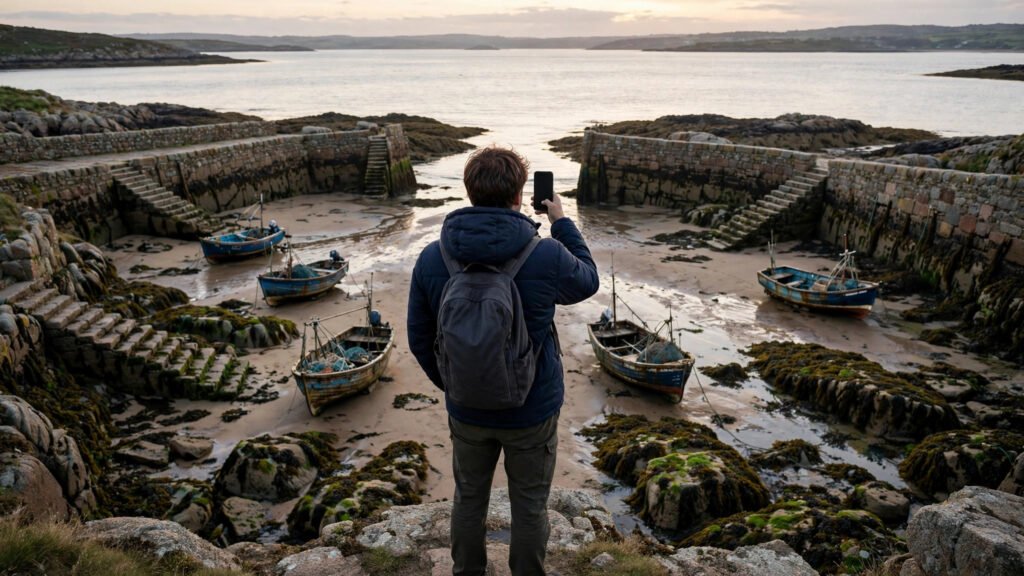
On Guernsey, a quick glance at the tide can matter more than a glance at the clock. The island sits in the English Channel, where the sea rises and falls twice a day, and that rhythm quietly shapes daily life. Boats in small harbours rest on sand when the water drops away, slipways disappear under the returning sea, and a walk that is easy at low tide can be cut off at high tide. So before setting out, many Guernsey residents check the tide times on their phones — a small habit that saves wasted trips, missed boats and awkward waits.
It is not really about the sea in the abstract. It is about timing. The tide decides when a boat can leave its mooring, when a causeway is passable, when a beach is wide and walkable, and when a harbour is busy with arrivals. Checking first turns guesswork into a plan, and on a small island where the sea is never far away, that plan matters almost every day.
Key Takeaways
- Guernsey’s tides shape boats, causeways, beaches and harbour trips, so timing a journey around the water is part of everyday planning.
- A phone check before leaving home helps residents avoid arriving when a boat cannot move, a slipway is under water or a coastal path is cut off.
- Tide times are a planning habit, not just a fishing tool, used by walkers, boat owners, families and visitors alike.
Why the Tide Matters So Much on a Small Island
Guernsey is small enough that the coast is part of ordinary life rather than a special trip. People live, work and walk close to the water, and many of the island’s harbours and bays change character completely as the tide moves. At high tide, the water comes right up to harbour walls and steps. At low tide, it pulls back to reveal sand, rock pools and stretches of seabed, leaving small boats sitting on the shore until the water returns.
That change is why timing matters. A boat that floats freely at high tide may be unable to move at low tide, and a launch that looks simple on a map may need to wait for enough water under the hull. For boat owners, the question is rarely whether to go out at all — it is when the water will allow it. A phone check gives that answer in seconds, and it can be repeated later in the day when plans change.
The same logic applies on land. Some coastal paths and bays are comfortable at low tide and narrow or impassable when the tide is in. A family heading for a beach walk, a swimmer looking for a safe entry point, or a walker planning a longer coastal route all benefit from knowing which way the water is moving. The tide does not just affect people who own boats; it affects anyone whose day touches the shore.
Boats, Harbours and the Daily Timing Puzzle
St Peter Port, the island’s main town and harbour, is the natural centre of much of this planning, but the habit reaches far beyond one harbour. Around the island, small harbours, slipways and moorings each have their own relationship with the tide. Some dry out completely at low water. Others stay usable for longer but still need care around the edges of the tide. Local knowledge helps, but a tide table on a phone gives every resident the same starting point.
For fishermen and leisure boat owners, the check often comes first thing in the morning. It shapes decisions about when to launch, when to return and how long a trip can realistically last. Leaving too late can mean a longer wait for the water to return, while leaving with the tide can make the whole outing smoother. The phone does not replace experience or seamanship, but it puts the day’s water levels in a pocket, ready to check again whenever a plan shifts.
Ferry and inter-island trips add another layer. Guernsey is connected by sea to neighbouring islands such as Herm and Sark, and to Jersey and the mainland, and those crossings are planned around harbour conditions as well as timetables. A traveller who checks the tide alongside the sailing time understands why a departure is set when it is, and why some days feel different from others. The habit, in other words, turns a timetable into something that makes sense.
The Causeway, the Beaches and Walks That Depend on Low Water
One of the clearest examples of tide-dependent life is the causeway to Lihou Island, a small island off Guernsey’s west coast that can be reached on foot only around low tide. The crossing is not available all day, and the window for walking across and back is limited by the returning water. Anyone planning that walk checks the tide first, because the whole outing depends on it. It is a simple idea — walk when the sea allows — but it only works with good timing.
Beaches follow a similar pattern. At low tide, Guernsey’s bays open up into wide stretches of sand and rock pools, popular with families, swimmers and walkers. At high tide, some of those same bays shrink to a narrow strip, or disappear under the water altogether. Checking the tide helps people pick the right beach for the right hour, rather than arriving to find the sand gone and the sea at the wall.
On Guernsey, checking the tide is not an extra step — it is the step that decides whether the rest of the plan works.
Coastal walking works the same way. A route that hugs the shore at low water may need a different path, or a different time, when the tide is high. Walkers who check first can choose a route that stays enjoyable for its full length, instead of turning back halfway. The phone, in this sense, is less a gadget than a timetable for the natural world — a way to fit human plans around a sea that keeps its own hours.
How a Phone Check Fits Into an Ordinary Day
Part of the reason the habit is so widespread is how easy it has become. Tide times are available through tide apps, harbour pages and weather services, and a resident can check them while making breakfast, before loading the car, or while waiting for a sailing. The check takes moments, and it often happens alongside other small planning steps: checking the weather, confirming a ferry time, or deciding what to wear for a coastal walk.
That ease matters because tide times shift every day. The highs and lows do not fall at the same hour each morning, so yesterday’s timing is not today’s. A routine that worked on one day can fail on the next if it is not rechecked. The phone solves that problem by always showing the current day’s pattern, and by making it easy to look ahead to the weekend or to a planned boat trip later in the week.
Visitors notice the habit quickly, too. A guest who asks why a boat trip leaves at a particular hour, or why a beach walk is planned for the afternoon rather than the morning, usually gets the same answer: the tide. It is one of those local customs that looks small from the outside and turns out to be practical at its core. Learning to check the tide is, for many visitors, one of the fastest ways to start thinking like an islander.
- Small harbours and slipways change with the tide, so boat trips are planned around high and low water.
- The causeway to Lihou Island is only walkable around low tide, making a tide check essential for that outing.
- Beaches and coastal walks are widest and easiest at low tide, and some routes are cut off when the tide returns.
- Tide times shift every day, so a fresh phone check beats relying on yesterday’s timing.
- Ferry and inter-island crossings are easier to understand once harbour conditions and tide times are taken into account.
Why Islanders in Other Places Do the Same
Guernsey is not alone in this. Other small islands face the same daily puzzle, and their residents have built similar phone habits around it. People in Jersey run much of island life through their phones, balancing ferries, harbours and coastal routines in the same Channel Island waters. On the Isle of Man, Manx residents run island life through their phones too, fitting daily plans around sea crossings and island distances. Further north, Faroe Islanders rely on their phones across scattered North Atlantic islands, where weather, ferries and tunnels shape the day in a similar way.
What links these places is not the technology itself but the geography. When the sea sets the timetable, a phone becomes the easiest way to read it. Guernsey’s version of that habit simply has a very visible focus: the tide, rising and falling twice a day, deciding what is possible and when.
What to Watch Next
For anyone visiting Guernsey, or thinking about island life there, the habit to copy is a simple one: check the tide before leaving home, and check it again if plans change. Boat trips, causeway walks, beach outings and coastal routes all run more smoothly when they are timed around the water. The sea will keep its own hours either way — but a quick phone check means the day can be planned around them, rather than interrupted by them.