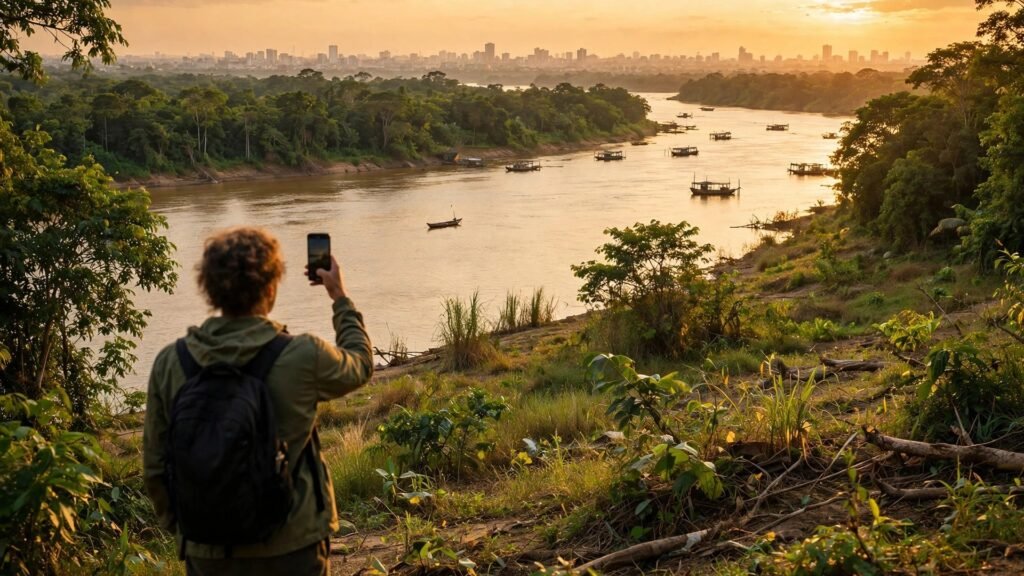
In the Republic of Congo, distance shapes daily life. The capital, Brazzaville, sits on the Congo River, with Kinshasa, the capital of the neighbouring Democratic Republic of Congo, just across the water. Beyond the cities lie long river routes, forest roads and towns where the nearest bank branch or government office can be a difficult journey away. That geography is one reason phones have become so central: a small device can carry money, news and work across distances that are hard to travel every day.
For many Congolese, the phone is not an extra device — it is the wallet, the post office and the family meeting place in one. A message can confirm that money has arrived. A call can check that a relative is safe. A photo can show goods before a buyer travels to see them. None of this replaces roads, boats or in-person care, but it reduces the number of trips a family must make, and it keeps plans moving when travel is slow or uncertain.
The shift is also practical because phones fit into routines people already have. Markets, river ports, schools, clinics and places of worship are places where people meet and exchange news. A phone extends those meetings: a trader can check a price before leaving home, a parent can hear from a child studying in another town, and a family can coordinate a visit without relying on a single fixed meeting time.
Key Takeaways
- Phones help Congolese families send money, share news and coordinate travel across rivers, forests and long distances.
- Mobile money wallets reduce the need for a long trip to a bank branch for everyday payments and family support.
- Calls, messages and photos keep relatives, traders and workers connected when travel is slow or uncertain.
Why the Phone Comes First
The first reason is simple: the phone is already in the pocket. Banking, by contrast, often requires a journey, a queue and opening hours that do not match a working day. When a payment can be sent from a phone, the sender does not need to close a stall, leave a field or miss a boat to make it. The receiver does not need to travel to collect it either, provided there is a nearby agent or a way to use the balance locally.
That convenience matters most for small, frequent amounts. Family support is rarely one large transfer. It is often a series of smaller helps: money for food, for school costs, for transport, for medicine or for a phone top-up. A phone wallet suits that rhythm because it can move a small amount quickly, and the family can confirm it in the same conversation. In neighbouring Gabon, a similar pattern appears, where phones help people working far from home stay in touch with family over long distances.
Phones also help with timing. River travel, road conditions and weather can change a plan at short notice. A quick message can warn that a boat is delayed, that a road is difficult, or that a meeting has moved. Without that message, a person might travel for hours only to find the other party absent. With it, the trip can be rescheduled before it starts, saving time, money and effort.
For many Congolese, the phone is not an extra device — it is the wallet, the post office and the family meeting place in one.
Money Without a Bank Branch
Mobile money in Congo works through wallets linked to a phone number. A user can load value, send it to another phone, pay a merchant or withdraw cash through an agent, depending on the service and the place. Agents are often found in markets and busy streets, which makes the system feel closer to daily life than a formal branch in a distant town.
Trust in this system is built in small steps. A first transfer is usually small and sent to someone the sender knows well. When it arrives and is confirmed, confidence grows. Over time, the same wallet may be used for regular family support, for paying a supplier, or for receiving payment for goods. The phone keeps a record of the transaction, which helps both sides remember what was sent and when.
There are limits to keep in mind. A wallet is only useful where agents, network coverage and electricity for charging are available. A lost phone, a forgotten code or a drained battery can interrupt access until the problem is fixed. That is why many people keep more than one way of paying, and why cash still matters in places where agents are few or networks are weak. The phone has not replaced every other method; it has added a faster option alongside them.
- Small, frequent family transfers suit phone wallets better than occasional large bank visits.
- Agents in markets and busy streets bring money services closer to everyday life.
- Transaction records on the phone help families and traders keep track of what was sent.
- Cash still matters where agents are few, coverage is weak or charging is difficult.
Family News Across Distance
Family contact is the other half of the story. Many Congolese families live across more than one place: some members in Brazzaville, others in Pointe-Noire, in river towns, in forest communities or abroad. A phone call or voice message can cross those distances in seconds, even when a visit would take days. Birthdays, illness, school results and everyday news travel through the same device that carries money.
Voice messages are especially useful where writing is slow or where a person prefers to speak. A short recording can carry tone and reassurance that a text message cannot. Photos add another layer: a picture of a new baby, a harvest, a house repair or a market stall can be shared instantly, making distant relatives feel present in daily life. Group chats help extended families coordinate, from planning a visit to organising help after an illness.
This kind of contact also supports work. A fisherman can tell a buyer what catch is available. A farmer can ask about prices before travelling to market. A driver can confirm a pickup. A teacher or health worker can share information with colleagues in another town. In each case, the phone does not create the work, but it makes coordination possible across a country where travel alone would be too slow.
Work on the River and in the Forest
Rivers are highways in much of Congo, and forests provide livelihoods that are spread across wide areas. Both settings reward good information. Knowing when a boat leaves, whether a buyer is ready, or whether a road is passable can decide whether a day is productive or wasted. Phones help workers share that information early, rather than discovering a problem after a long journey.
Island and coastal life shows the same logic in a different setting. In São Tomé and Príncipe, phones help people working in cocoa and fishing stay connected with family and buyers across island distances. In Congo, the distances are shaped by rivers and forests rather than sea, but the need is similar: timely news, a confirmed payment and a way to reach family without travelling first.
Small traders feel this most directly. A trader who can confirm an order by phone avoids carrying goods to a market where no buyer is waiting. A buyer who can pay by phone avoids carrying large amounts of cash on a long trip. A family that can receive money by phone can buy what it needs locally, rather than waiting for a relative to arrive in person. Each step is small, but together they change how far a household can reach in a day.
What to Watch Next
The phone will keep mattering in Congo for the same reasons it matters now: distance, rivers and forests make travel costly, while families, traders and workers still need to send money, share news and coordinate plans. The most useful changes will be the practical ones — wider coverage, more agents in smaller towns, easier charging and simpler ways to recover access after a lost phone.
For families, the habit is already clear. The phone is checked first for money and news, before a trip is made. For traders, the same habit saves wasted journeys. And for relatives separated by rivers and long roads, the phone remains the closest thing to being in the same room. As in Guinea-Bissau, where phones link farm trade, cash and family news, the value in Congo is not the device alone — it is the connection it keeps alive between people who cannot always be in the same place.