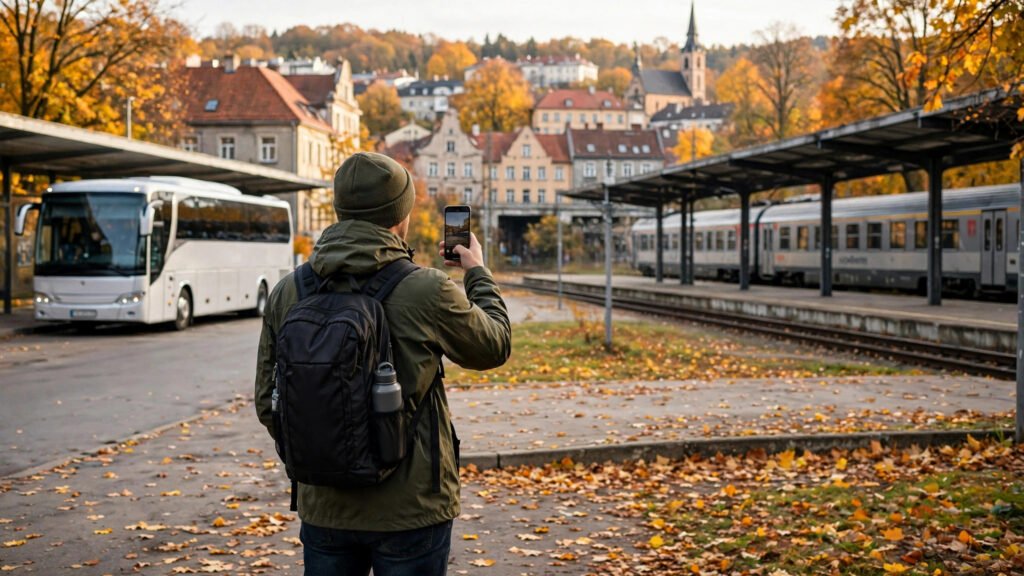
In Lithuania, a journey often starts before anyone leaves the house. A traveller opens a phone, checks the next bus or train, looks at the connection, and only then decides when to walk out of the door. It is a small habit, but it shapes how people move between cities, towns, and villages across the country.
The reason is simple. Lithuania is a country of short city trips and longer intercity journeys, and the two do not always run on the same rhythm. A city bus may come often, while the bus to a smaller town may come only a few times a day. A train may be the faster choice on one route and the slower choice on another. Checking the phone first turns that uncertainty into a plan.
Key Takeaways
- Lithuanians check bus and train times on their phones because intercity services can be infrequent, so missing one departure can mean a long wait.
- The phone check helps travellers compare buses and trains, spot connections, and adjust the plan before leaving home.
- Weekend timetables, seasonal changes, and delays make a live check more useful than a printed timetable alone.
Why the Phone Check Comes First
For many Lithuanians, the phone is the timetable. Printed timetables at stops are useful, but they cannot show a delay, a cancelled service, or a changed platform. A phone can. That difference matters most when a journey has more than one leg, because one late arrival can break the whole chain.
The habit also saves time in a very ordinary way. Nobody wants to stand at a stop in rain, snow, or summer heat for a bus that left ten minutes ago. A quick check answers the only question that really matters at that moment: should I leave now, or do I still have time?
In Lithuania, the phone check is not about impatience — it is about making a journey with more than one leg actually work.
In Lithuania, the phone check is not about impatience — it is about making a journey with more than one leg actually work.
Buses Cover the Gaps Trains Do Not
Buses do a large share of the work in Lithuanian travel. They reach towns and villages that have no railway station, and they link smaller places to larger cities such as Vilnius, Kaunas, and Klaipėda. For a traveller in a small town, the bus is often the only public option, which makes its timetable worth checking carefully.
That is also why the habit looks familiar in other countries. Elsewhere, travellers follow the same logic when checking phones before taking buses in busy cities, where routes, traffic, and timing decide whether a trip runs smoothly. In Lithuania, the pressure is different — it is less about traffic and more about frequency. When the next bus is far away, the phone check protects the traveller from a wasted trip to the stop.
Buses also change with the seasons and the day of the week. School holidays, weekends, and public holidays can all change which services run. A traveller who checks on the day of travel is far less likely to be caught out by a timetable that looked right last week.
Trains, Connections, and the Long Wait
Trains offer a different kind of journey in Lithuania: a smoother ride between major cities, with space to work, read, or rest. But trains also bring their own planning problem. If a traveller needs a bus after the train, or a train after a bus, the connection becomes the most important part of the trip.
This is where the phone earns its place. A traveller can check the train time, then check the onward bus time, and see whether the two fit together. If they do not, the traveller can leave earlier, choose a different route, or wait for a better combination — all before leaving home.
The same thinking applies to train journeys across language regions in Switzerland, where travellers also plan around connections and changing services. The countries are different, but the question is the same: will the next leg still be there when I arrive?
City Travel Is Different From Intercity Travel
Inside Vilnius or Kaunas, the phone check is often about the next few minutes. A traveller wants to know which bus is coming, whether it is delayed, and whether walking to a different stop would be faster. The stakes are low, because another bus will usually come soon.
Between cities, the stakes rise. A missed connection can mean hours of waiting, a changed plan, or a night spent somewhere unexpected. That is why intercity travellers tend to check more than once: once while planning, once before leaving, and sometimes once more on the way, in case something has changed.
Families feel this most. A parent travelling with children, luggage, or an elderly relative cannot afford to guess. The phone check turns a journey into something that can be explained in advance: we leave at this time, we change here, we arrive around then.
Weekends, Seasons, and Timetable Changes
Lithuanian timetables are not fixed in stone. Services can run differently on weekdays and weekends, and summer and winter schedules can differ too. A route that works on a Tuesday may not work on a Sunday, and a traveller who assumes otherwise can end up stranded.
Weather adds another reason to check. Snow, ice, and storms can slow road travel and affect departure times, especially on rural roads. A live check does not remove the weather, but it does give the traveller a chance to leave earlier or choose another option.
Long-distance travellers in other countries face a similar mix of systems. In Austria, for example, travellers rely on nationwide trains and buses that also need a phone check to line up well. The lesson travels: wherever buses and trains must work together, the phone becomes part of the ticket, even when it is not the ticket itself.
What to Check Before You Leave
A good phone check answers more than just the departure time. It answers the whole journey, step by step, so there are no surprises at the station or the stop.
- The exact departure time and place, including which stop or platform to use.
- Whether the service is running today, and whether it is delayed or changed.
- How the connection works, and how much time there is between each leg.
- Whether a weekend, holiday, or seasonal timetable applies to the journey.
- What the backup plan is if the first bus or train is missed.
None of this needs special skill. It needs a few minutes and a habit: check early, check again before leaving, and keep the phone handy during the journey in case a connection changes.
Why This Habit Is Likely to Stay
The phone check is unlikely to fade, because it solves a problem that timetables alone cannot solve. Timetables describe the plan. Phones describe what is actually happening. As long as buses and trains run on different networks, with different frequencies and different operators, travellers will want one place where the whole journey comes together.
For Lithuania, that habit also fits the geography. The country is compact enough that many journeys are possible in a day, but spread out enough that a missed service still hurts. The phone sits exactly in that gap: it turns a day trip from a gamble into a plan.
Over time, the habit may become even more routine. Younger travellers already treat the phone check as the first step of any trip, not an extra step. Older travellers, once they try it, often keep it for the same reason: it removes the worst part of public travel, which is waiting without knowing.
What to Watch Next
What to watch next is whether bus and train information keeps getting easier to check in one place, whether weekend and seasonal timetables become clearer for intercity travellers, and whether the phone check remains the simple habit that turns a multi-leg Lithuanian journey into a plan rather than a gamble. The habit itself is already settled: check the phone, check the connection, and only then leave.