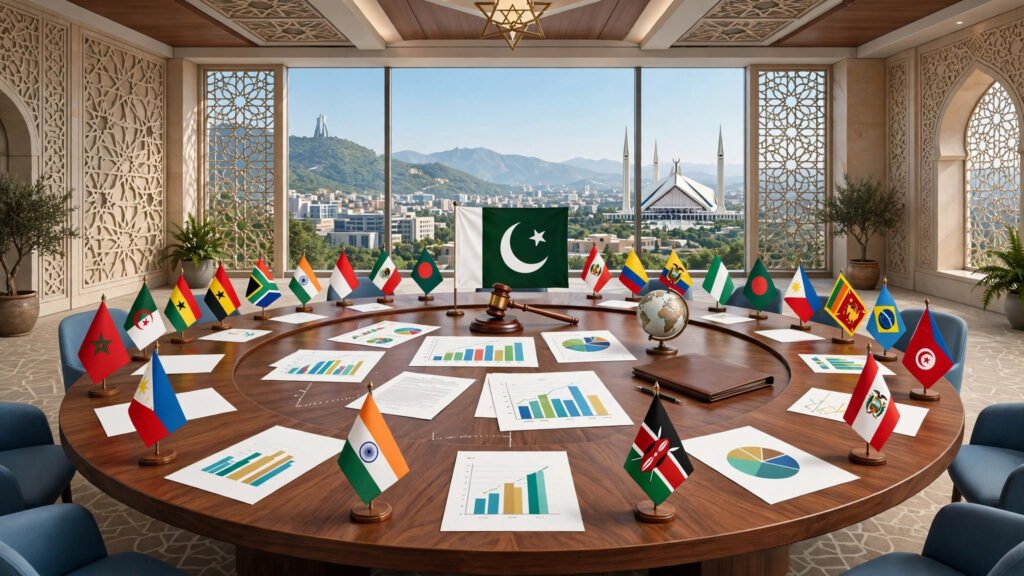
Pakistan on Sunday, November 1, 2026, assumed the chairmanship of the Intergovernmental Group of Twenty-Four, known as the G-24, a coalition of developing economies that coordinates common positions on international monetary and development finance issues. The handover places Pakistan at the centre of a bloc that speaks for countries across Africa, Asia, Latin America and the Caribbean in discussions with the International Monetary Fund and the World Bank.
Pakistan succeeds Nigeria as chair of the group. Finance Minister Muhammad Aurangzeb will lead the chairmanship, and Pakistan’s finance ministry said the country would approach the role through consultation, consensus and collective advocacy. Prime Minister Shehbaz Sharif welcomed the appointment, describing it as an important diplomatic milestone that recognises Pakistan’s role in global economic affairs.
Key Takeaways
- Pakistan assumed the G-24 chairmanship on November 1, 2026, succeeding Nigeria as chair.
- Finance Minister Muhammad Aurangzeb set out three priorities: development-led growth, stronger representation for developing economies, and reform of the international financial architecture.
- The chairmanship is an agenda-setting and convening role at the IMF and World Bank, not a decision over any single country’s loan programme.
What the Chairmanship Means
The G-24 was established in 1971 by the Group of 77 and formally constituted in 1972. It is not an organ of the IMF or the World Bank, but it works closely with both institutions, preparing common positions ahead of their ministerial meetings. Its members reach decisions by consensus, and the chair country’s minister helps set the agenda and represent the group in those discussions.
That distinction matters. The chairmanship does not give Pakistan control over IMF or World Bank lending, and Pakistan’s announcement did not include a new financing package, a debt agreement, or changes to the rules of either institution. What it does give Pakistan is a platform: a year in which it can put the concerns of developing economies higher on the agenda, frame the questions that ministers debate, and push for reforms that smaller and poorer countries have long sought.
Pakistan’s finance ministry said the country would work with member countries across Africa, Asia, Latin America and the Caribbean, as well as with the IMF, the World Bank and other international partners. The ministry also acknowledged Nigeria’s leadership as outgoing chair and said Pakistan would build on the group’s progress.
The Three Priorities
Aurangzeb outlined three strategic priorities for Pakistan’s term. The first is placing development at the centre of global economic policymaking, so that growth, jobs and investment in developing countries are treated as central goals rather than afterthoughts. The second is stronger and more representative participation for developing economies in multilateral institutions, so that countries affected by decisions have a fairer say in making them. The third is reform of the international financial architecture itself, the set of rules and institutions that govern lending, debt and development finance.
In practical terms, Pakistan’s agenda also covers development financing, fairer multilateral institutions, sustainable debt solutions and climate resilience. The finance ministry’s statement pointed to climate shocks, development financing gaps and global economic fragmentation as pressures that developing countries are facing at the same time, and called for renewed international cooperation and stronger multilateral institutions to address them.
- Development-led growth: putting jobs, investment and development at the heart of global economic policy.
- Stronger representation: a fairer voice for developing economies inside multilateral institutions.
- Financial reform: a more responsive and development-oriented international financial architecture.
- Climate and debt: support for countries facing climate shocks and unsustainable debt burdens.
- Consensus first: the chair works through consultation with members across Africa, Asia, Latin America and the Caribbean.
Why the G-24 Matters Now
Developing economies are navigating several pressures at once. Borrowing costs, commodity swings and climate-related damage can each strain a national budget, and the rules that govern emergency lending and debt relief shape how quickly a country can recover. A fairer financial system is not an abstract goal for developing economies; it shapes how much borrowing costs, how quickly help arrives after a shock, and how much room a country has to invest in its own future.
A fairer financial system is not an abstract goal for developing economies; it shapes how much borrowing costs, how quickly help arrives after a shock, and how much room a country has to invest in its own future.
That context is visible in recent reporting on the wider region. Pakistan and China have opened a green trade channel at the Sost-Khunjerab border to fast-track farm trade, a reminder that trade and finance are linked for developing economies. The World Bank has reported large falls in extreme poverty in India over twelve years, while also warning in a separate report that commodity prices could jump sharply in 2026. Together, those stories show why developing countries want a stronger collective voice: progress is real, but it remains exposed to prices, shocks and rules set elsewhere.
Pakistan’s own position adds another layer. As chair, it will be judged, in Aurangzeb’s own framing, by the impact the group’s work has on developing economies, not by the ceremony of the handover. The G-24 publishes communiques after its ministerial meetings, and those documents, rather than the opening statement, will show how far the three priorities travel in practice.
What to Watch Next
Watch for the G-24’s next ministerial meeting and its communique, which will show whether Pakistan’s three priorities — development-led growth, stronger representation and financial reform — are reflected in the group’s common position. Watch also for how Pakistan works with the IMF and the World Bank during its term, and for any concrete proposals on development financing, debt and climate resilience that emerge from that process. The chairmanship runs for about a year, until the next annual ministerial meeting, so the test of this handover will be measured over the months ahead, not in a single day.