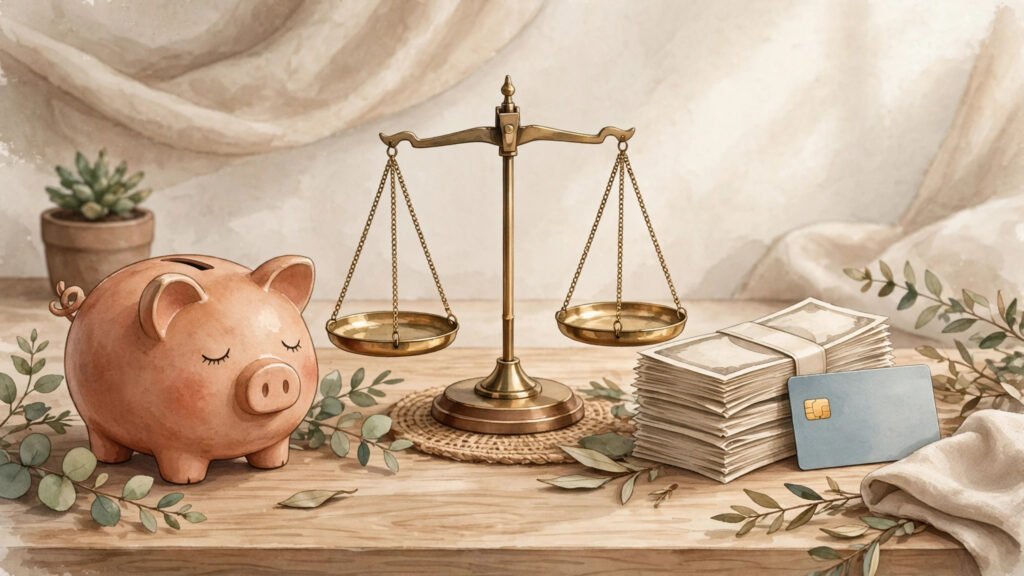
When money is tight, one question comes up again and again: should you save or pay off debt first? Both goals matter, and both feel urgent. Savings give you a cushion for surprises, while paying off debt frees up money you currently send to lenders each month. The honest answer is that there is no single right order for everyone. The best choice depends on the kind of debt you carry, how stable your income is, and how much breathing room you already have. This guide walks through that decision in plain steps, so you can choose a plan you can actually keep.
Key Takeaways
- A small starter cushion can come first, so one surprise does not force you back into new debt.
- High-cost debt usually deserves the larger share of your spare money, once that cushion exists.
- A split plan — part to savings, part to debt — often works better than an all-or-nothing plan.
Start by getting a clear picture of where you stand. List each debt with its balance and its monthly payment, and note which ones feel most stressful to carry. Then look at your savings: do you have anything set aside at all, or would a single unexpected bill leave you with no option but to borrow again? That picture, not a rule from someone else, is the starting point for your decision.
How to Decide: Save or Pay Off Debt First
The simplest way to decide is to work in order. First, make sure you are meeting the minimum payment on every debt, so nothing falls behind. Second, build a small starter cushion — an amount that covers a minor surprise, such as a repair or a bill that arrives earlier than expected. Third, put the larger share of any spare money toward the debt that costs you the most to carry, while still adding a little to savings. This order protects you from new borrowing while still making real progress on debt.
A split plan — part to savings, part to debt — often works better than an all-or-nothing plan.
Why does the starter cushion come before aggressive debt payoff? Because without any savings, every surprise becomes new debt. You pay off one balance, then a broken appliance or a car repair puts you straight back where you started. A small cushion breaks that cycle. It does not need to be large to be useful; it just needs to be there, separate from your everyday spending money, so you reach for it before you reach for a card.
When Paying Off Debt Should Come First
Once you have that starter cushion, debt usually takes priority, especially debt that carries a high cost over time. Every month a balance stays unpaid, part of your payment goes toward the cost of borrowing rather than reducing what you owe. Clearing such a balance frees up that monthly payment for the future, which is money you can then redirect into savings. If you are carrying a balance that grows month after month despite regular payments, that is a strong sign to focus on it first. A practical way to work through it is to follow a low-income debt plan step by step, starting with the balance that costs the most, as explained in how to pay off debt on a low income.
It also helps to think about momentum. Some people prefer to clear the smallest balance first, because finishing one debt completely feels like real progress and keeps motivation high. Others prefer to clear the most expensive debt first, because it saves the most over time. Either approach works if you stick with it. The method that keeps you going is the one worth choosing, because a plan you abandon helps no one.
When Saving Should Come First
There are times when saving deserves the larger share. If you have no savings at all, or if your income changes from month to month, a cushion matters even more. Irregular income means some months bring less money in, and savings smooth out those gaps so bills still get paid. In that case, building a modest emergency fund before attacking debt aggressively can be the calmer, safer choice. You can read more about that first step in how to build an emergency fund on a small income.
Saving first also makes sense when a known cost is coming soon — a bill you can already see on the horizon, a deposit, or a seasonal expense. Setting money aside for that cost now means you will not need to borrow for it later. The point is not to save instead of paying debt forever; it is to avoid creating new debt while you work on the old debt.
- Pay every minimum payment first, so no debt falls behind.
- Build a small starter cushion before aggressive debt payoff.
- Then split spare money: the larger share to costly debt, a smaller share to savings.
- Review the split each month as balances and income change.
A Simple Split Plan You Can Keep
For many households, a split plan is the most realistic option. Suppose you have a small amount left after essentials and minimum payments. You could send most of it to your most expensive debt and a smaller part to savings. You are still reducing debt every month, and your cushion is still growing, even slowly. Over time, as a debt is cleared, you can redirect its old monthly payment into savings, so the habit keeps building without needing extra income.
Choosing the right place for that savings cushion matters too. Keeping it separate from everyday spending money makes it less likely to be spent by accident, and comparing accounts on access and terms helps you pick one that fits how quickly you may need the money, as covered in how to choose a savings account. A simple, separate account you can reach when you truly need it is usually enough; the habit of adding to it regularly matters more than finding a perfect account.
Finally, review your plan once a month. Income changes, balances fall, and a plan that was right three months ago may need adjusting. If a debt is cleared, celebrate the progress, then move its payment to the next debt or into savings. If an unexpected cost eats into your cushion, rebuild it before returning to aggressive payoff. Small, steady adjustments keep the plan honest and keep you moving forward, rather than letting one bad month undo months of good work.
What to Watch Next
The decision to save or pay off debt first is not a one-time choice. Start with minimum payments, build a small cushion, then split spare money between costly debt and savings, and review the split each month. Keep the method you can stick with, protect yourself from new borrowing, and let each cleared balance strengthen your savings habit from there.