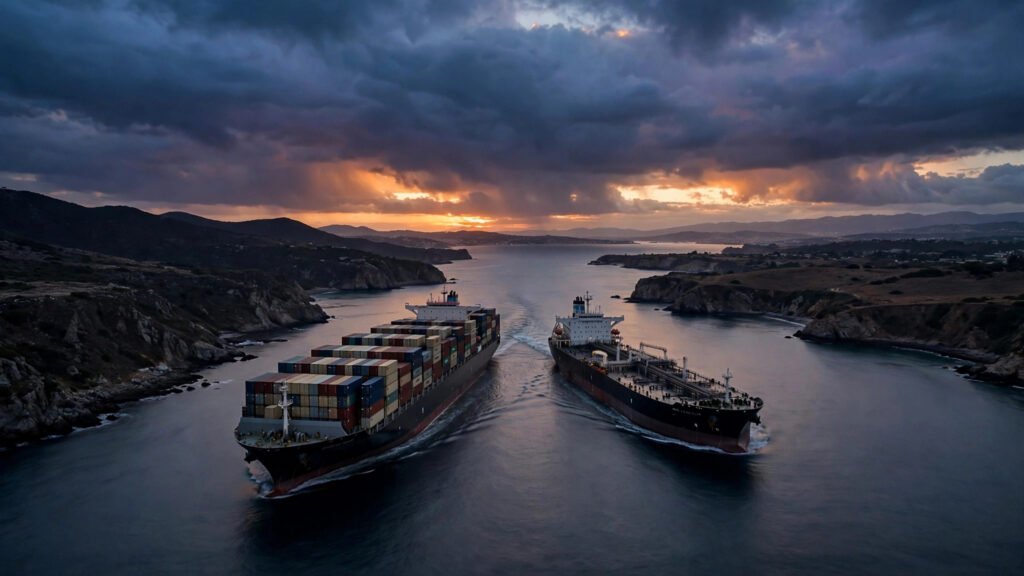
Saudi Arabia has called for a collective international response to threats against shipping through the world’s most sensitive waterways, warning that no single country can secure the straits on its own. The appeal came on Sunday, November 1, 2026, from Vice Admiral Fahd al-Ghufaili, the kingdom’s Deputy Chief of the General Staff, speaking at the 22nd IISS Manama Dialogue security forum in Bahrain.
Al-Ghufaili said threats to maritime routes now affect the interests of countries worldwide and have become an international challenge. Protecting international straits, he argued, is a shared global responsibility, and the waterways that carry the world’s trade and energy must not be turned into instruments of pressure.
Key Takeaways
- Saudi Deputy Chief of General Staff Fahd al-Ghufaili told the Manama Dialogue that protecting maritime straits is a shared global responsibility, not the job of one country.
- He warned that international straits must not remain tools of political or military pressure, saying force cannot be a substitute for law.
- The appeal comes as shipping through the Strait of Hormuz and Bab al-Mandeb faces mounting threats linked to the US-Iran conflict.
The message from Manama
Speaking at the Manama Dialogue, al-Ghufaili put the case for cooperation in plain terms. “Maritime security is not the responsibility of a single country, and force cannot be a substitute for law,” he said. “International straits must not remain tools of political and military pressure.”
Maritime security is not the responsibility of a single country, and force cannot be a substitute for law.
He added that the threats facing maritime corridors touch countries far beyond the region, because the same narrow passages carry energy, goods and food to markets around the world. The answer, in his framing, is not a single navy or a single state acting alone, but an effective collective response grounded in international law.
Why the straits matter
The warning lands at a moment when the two waterways at the centre of the debate, the Strait of Hormuz and Bab al-Mandeb, are under sustained strain. The Strait of Hormuz, which normally carries a fifth of global oil supplies, has become a focal point of the US-Iran conflict, with ships regularly coming under Iranian fire, according to Arab News. Bab al-Mandeb, at the southern end of the Red Sea, is the other choke point through which much of the trade between Europe and Asia must pass.
The disruption is already visible in energy markets. Oil prices surged to near six-month highs in late October after Houthi attacks on Saudi Arabia stoked fears of further supply disruption, and shipping through the region has faced repeated attacks on commercial vessels. An LNG carrier was also struck in the Gulf in recent days, as covered in our report on the attack on the Al Mayeda, underlining how quickly a single incident at sea can ripple through energy markets.
For Saudi Arabia, the stakes are direct. The kingdom is the world’s largest crude exporter, and its ports, terminals and shipping lanes sit at the heart of the threatened routes. But al-Ghufaili’s argument was deliberately wider than one country’s interests: when a strait is threatened, he said, every country that relies on trade and supplies through it is affected.
A region-wide approach, built on prevention
Beyond the call for collective action, al-Ghufaili sketched what that cooperation should look like in practice. Security at sea, he said, depends on transparency, clear rules, de-escalation mechanisms and the ability to communicate in times of crisis. He urged a shift toward a region-wide concept based on prevention, early detection, and the exchange of information and intelligence, so that threats are dealt with before they become crises.
Straits and maritime corridors, he said, should not be arenas for competition or conflict. They serve everyone, because all countries rely on them for trade and supplies, and they should be spaces for collaboration and coordination. The seas, in his words, are bridges for development and prosperity, not places for confrontation, and international law is the only reference for settling differences.
- Maritime security is a shared international responsibility, not the job of a single country.
- International straits must not be used as tools of political or military pressure.
- The Strait of Hormuz normally carries a fifth of global oil supplies.
- Al-Ghufaili urged prevention, early detection and intelligence sharing before threats become crises.
- Saudi diplomats raised maritime threats at the G20 foreign ministers’ meeting in Atlanta.
Diplomacy around the dialogue
The maritime message was echoed by other Saudi officials across the weekend. Speaking at a session on Saturday at the Manama Dialogue, Saudi Vice Foreign Minister Waleed Elkhereiji stressed the need to contain crises and strengthen security and stability amid widening regional conflicts, mounting humanitarian suffering and growing repercussions for maritime security, energy supplies and the global economy.
On Saturday, Saudi Foreign Minister Prince Faisal bin Farhan also held talks with his counterparts from Germany, Japan, France and Brazil on the sidelines of the G20 Foreign Ministers’ Meeting in Atlanta, to discuss threats to maritime navigation in the Strait of Hormuz and Bab al-Mandeb and their potential impact on energy security, global trade and supply chains. The ministers stressed the need for stronger international cooperation to protect maritime routes and ensure the uninterrupted flow of global commerce.
The diplomatic activity comes alongside continuing efforts to keep the wider conflict from escalating. Iranian negotiators met Qatari mediators in Doha on Saturday, and reports have said a US delegation may join direct talks with Iran there. Our coverage of the Iran talks in Doha follows that track. At the same time, Iran’s Supreme Leader Mojtaba Khamenei has ordered the armed forces to meet any threat with an immediate and unrestricted response if US attacks resume, a reminder that the diplomatic track and the military risk are running in parallel.
What to Watch Next
What to watch next is whether the call for collective action turns into concrete coordination, whether shipping through Hormuz and Bab al-Mandeb stabilises or faces further attacks, and whether the Doha diplomatic track produces any easing of the tensions that have made the waterways so dangerous. The Manama Dialogue message was that the sea lanes belong to no single country and must not become weapons of pressure; the test in the coming days is whether the countries that depend on them act together to keep them open.