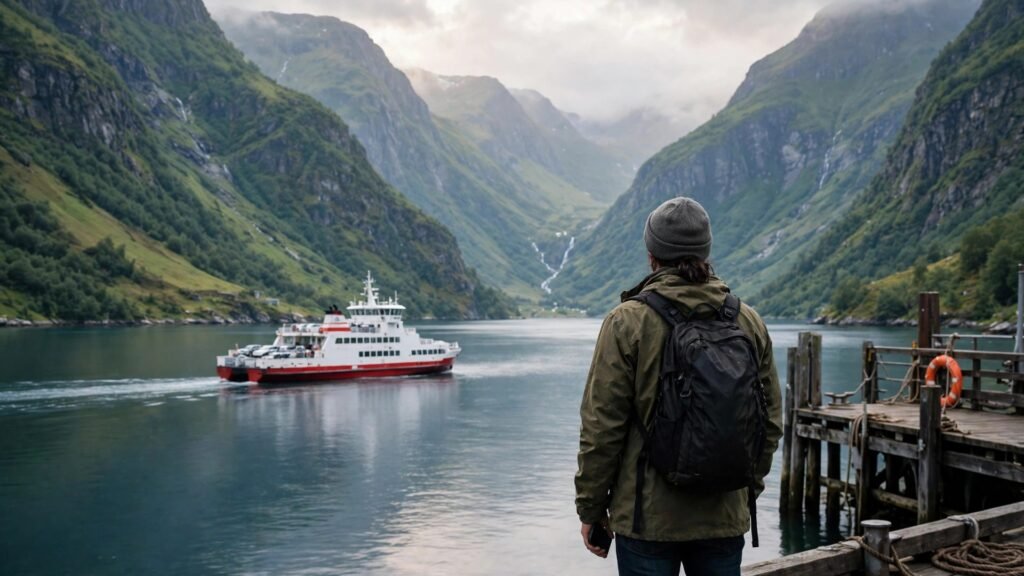
Norway is a country shaped by water. Long fjords cut deep into the coastline, islands sit off the shore, and in many places the road simply stops at the water’s edge. For people who live in these places, and for visitors travelling through them, the ferry is not a sightseeing extra. It is part of the journey itself, and that is why so many Norwegians check their phones for ferry times before they leave home.
The habit looks small: a quick glance at a timetable, a check for a delay, a look at the next departure. But behind that glance is a very practical question. If you miss a ferry in Norway, you may not just wait a few minutes. On some routes the next sailing can be much later, and the alternative route by road can be long, winding, and slow. Checking first saves a wasted trip to the quay and a long wait in a car.
Key Takeaways
- Norway’s fjords and islands make ferries a normal part of everyday road journeys, not just a tourist activity.
- A missed sailing can mean a long wait or a much longer drive, so checking times before leaving is a practical habit.
- Weather, season, and vehicle space can all change a sailing, which is why a live check beats a printed timetable.
A coastline built around ferries
Norway’s coastline is long and deeply indented. Fjords reach far inland, and communities grew up along the water long before modern roads existed. Even today, building a road around every fjord or a bridge to every island is not always practical. In those places, a ferry fills the gap, carrying cars, passengers, and sometimes freight across the water as part of the ordinary road network.
That changes how people think about travel. A journey that looks short on a map may include a ferry crossing in the middle of it. Drivers plan their departure around the sailing, not just around the distance. A family heading to a cabin, a worker commuting to a nearby town, or a visitor exploring the coast all face the same basic step: find out when the ferry leaves, and be there in time.
Island life makes the point even clearer. For people living on an island, the ferry can be the link to shops, schools, health services, and work on the mainland. It is a daily service, used in all kinds of weather and at all times of year. Checking the timetable is therefore less like checking a holiday excursion and more like checking a bus or train time before a normal day out.
Why a phone check comes first
Printed timetables still exist, but they cannot show what is happening right now. A sailing can be delayed by weather, a vessel can be replaced, or a timetable can change with the season. Summer and winter schedules are often different, because demand changes and daylight and weather conditions change too. A phone gives travellers the current picture rather than the picture from when a timetable was printed.
Vehicle space is another reason to check early. Many Norwegian ferries carry cars, and on busy routes or at popular times, the sailing a driver wants may already be full. Knowing that before setting off lets a traveller choose an earlier or later sailing, or adjust the rest of the day, instead of arriving at the quay and finding there is no room. For foot passengers the pressure is usually lower, but the timing still matters, because the next sailing may not fit with a connecting bus or train.
Weather adds a further layer. Strong wind, rough seas, fog, or ice can disrupt sailings, especially in winter and in exposed coastal areas. A traveller who checks before leaving can decide whether to wait, take another route, or postpone the trip. Someone who simply drives to the quay may arrive to find a cancelled sailing and no easy alternative. In a country where distances are long and the weather can change quickly, that early warning is valuable.
If you miss a ferry in Norway, you may not just wait a few minutes.
Planning the whole journey, not just the crossing
Ferry times also shape everything around the crossing. A driver may need to allow time to reach the quay, join a queue, and board in an orderly way. After landing, there may be a bus to catch, a road that continues on the other side, or a meeting to reach. When the ferry is the middle link in a longer chain, one missed sailing can push the whole day later.
This is why travellers often check more than once. A first check at home sets the plan. A second check on the road confirms that nothing has changed. If a delay appears, there may still be time to adjust, for example by taking a different road, waiting for a later sailing, or letting someone at the destination know about the delay. The phone makes that kind of flexible planning possible in a way a fixed timetable cannot.
Visitors face the same logic, often with less local knowledge. A tourist driving a coastal route may not realise that a stretch of road includes a ferry until the road ends at the water. Checking ferry times in advance turns a surprise into a planned stop. It also helps visitors understand that some routes are seasonal, that some sailings run less often on weekends or holidays, and that arriving early is usually wise on popular crossings.
- Ferries link islands and fjord communities to the mainland road network.
- Seasonal timetables mean summer and winter sailings can differ.
- Weather can delay or cancel a sailing, so a live check matters.
- Car space on busy routes can fill up, making an early check worthwhile.
- A missed ferry can affect buses, trains, and plans on the other side.
The same habit in other island and coastal places
Norway is far from the only place where this habit makes sense. In Greece, travellers have grown used to ferry booking on a phone rather than turning up at the port and hoping for the best. In the Seychelles, people check inter-island ferry times before travelling between islands, because a missed boat can reshape the whole day. And in Saint Lucia, travellers check ferry times before leaving an island for the same practical reason: the boat is the bridge.
What these places share is geography. Where water separates communities, timetables become part of daily planning. The phone simply puts that timetable, and any changes to it, in a pocket. It does not remove the need to travel carefully or to arrive in good time, but it removes much of the guesswork.
What a good check looks like
A useful ferry check answers a few simple questions. When is the next sailing, and is it running on time? Is there space for a car, if one is being taken? Has the timetable changed for the season or the day of the week? And is there a later sailing that still works if the first one is missed? Travellers who can answer those questions before leaving are far less likely to be caught out.
It also helps to think about the return journey. A day trip that depends on a ferry in both directions needs two checks, not one. The last sailing of the day deserves special attention, because missing it can mean an unplanned overnight stay or a very long alternative route. In winter, when daylight is short and weather is less predictable, that last-sailing check matters even more.
None of this makes ferry travel complicated. It makes it calmer. The crossing itself is often the most relaxing part of the journey, with time to look at the fjord, rest from driving, and arrive refreshed on the other side. The phone check beforehand is what protects that calm, by making sure the traveller is on the right boat at the right time.
What to Watch Next
Norway’s ferry habit is a reminder that technology is most useful when it fits the landscape. Phones did not create the need to check ferry times; fjords, islands, and long coastal distances created it. Phones simply made the check faster, more current, and easier to repeat on the road. As timetables keep changing with seasons and weather, the habit of checking before leaving is likely to stay, because the geography behind it is not changing. For anyone planning a coastal or island journey in Norway, the simplest advice remains the same: check the ferry first, then travel.