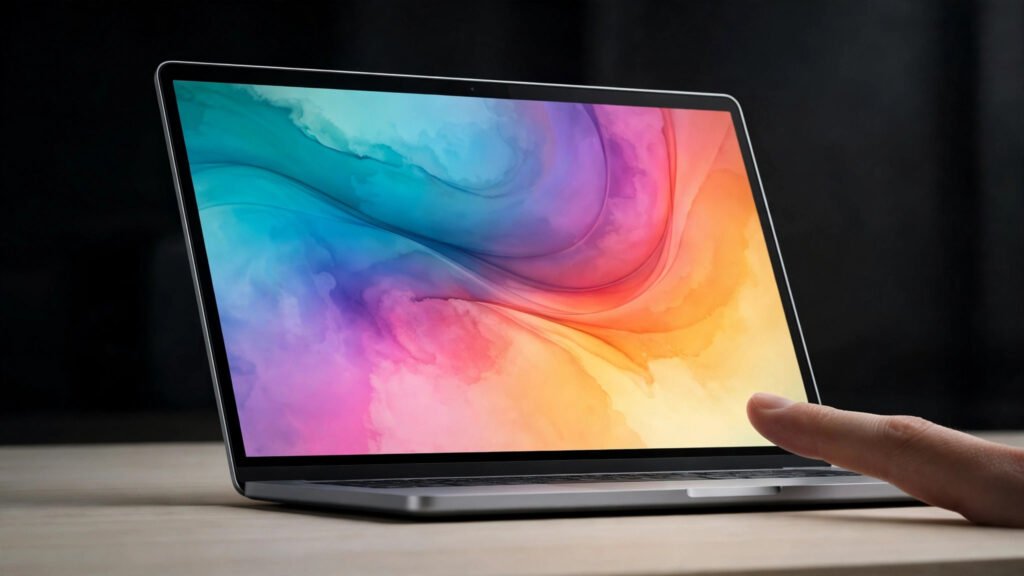
Apple has unveiled its first touchscreen MacBook Pro, ending years of resistance to touch on the Mac and marking one of the biggest design shifts in the laptop line in a decade. The new models, announced on October 28, come in 14-inch and 16-inch sizes, run on Apple’s M5 Pro or M5 Max chips, and are due to reach customers on November 6.
For a company that long argued that laptops were best controlled with a keyboard and trackpad, the move is a clear change of direction. Apple is now betting that direct touch can sit alongside the keyboard and trackpad, rather than replacing them, and that creative professionals will use it to scrub through video, edit images and work with apps in a more hands-on way.
Key Takeaways
- Apple has launched its first touchscreen MacBook Pro, in 14-inch and 16-inch sizes, powered by the M5 Pro or M5 Max chips.
- Prices start at $2,899 for the 14-inch model and $3,399 for the 16-inch model, while a fully loaded 16-inch configuration reaches $14,549.
- The new PROLED XDR display is Apple’s first OLED screen in a MacBook Pro, with a Dynamic Island cutout replacing the notch.
What Apple announced
The headline change is touch itself. Announcing the device in Los Angeles, chief executive John Ternus said, for the very first time, Apple was bringing touch to the Mac. Demonstrations showed users swiping and pinching directly on the screen to move through video timelines, adjust images and interact with creative apps, while macOS and the traditional keyboard and trackpad remain fully in place.
That combination matters because it separates the new machine from both tablets and older MacBooks. It is still a full desktop computer, running macOS, but the screen itself is now an input surface as well. Apple has also redesigned the hinge so the display stays stable when it is touched, an engineering detail that matters in practice: a wobbling screen would make touch frustrating rather than useful.
The launch follows Apple’s recent standard M6 MacBook Pro, which starts at $1,999. The touchscreen models sit well above that machine in price, positioning touch as a premium option for professionals rather than a feature for every buyer.
The display and touch design
Apple is calling the new panel a PROLED XDR display, its first OLED screen in a MacBook Pro. The company promises greater brightness, higher contrast and wider viewing angles than the screens it replaces, with 2,000 nits of peak brightness for both HDR and SDR content and a 10,000,000:1 contrast ratio.
Apple is betting that direct touch can sit alongside the keyboard and trackpad, rather than replacing them.
The notch found on recent MacBooks is gone, replaced by a Dynamic Island-style cutout similar to the one on recent iPhones. The machines are also thinner and lighter than their predecessors, according to Apple, with the 14-inch model weighing 3.0 pounds and the 16-inch model weighing 4.0 pounds.
- 14-inch model starts at $2,899; 16-inch model starts at $3,399.
- M5 Pro or M5 Max chips, up to 128GB of unified memory and up to 16TB of storage.
- PROLED XDR display: tandem OLED, 2,000 nits peak brightness, 10,000,000:1 contrast ratio.
- Dynamic Island cutout replaces the notch; new hinge stabilises the screen for touch.
- Three Thunderbolt 5 ports, HDMI, SDXC card slot, MagSafe and a headphone jack.
- Six-speaker array, 12MP Center Stage camera, Wi-Fi 7 and Bluetooth 6.
For video editors, designers and 3D artists, the display and direct controls could make a real difference to daily work. For everyone else, the question is simpler: whether touch alone justifies paying a large premium over a conventional MacBook Pro or a cheaper touchscreen Windows laptop, where touch has been standard for years.
The price shock: why a top model hits $14,549
The starting prices already place the touchscreen MacBook Pro firmly in premium territory, but the configurator is where the numbers become striking. A fully loaded 14-inch model prices out at $14,249, and the fully loaded 16-inch model reaches $14,549, both with Apple’s top-tier M5 Max chip, featuring an 18-core CPU and a 40-core GPU.
Several upgrades drive that total higher. Moving to a 4TB SSD adds $1,000, upgrading to 8TB adds $3,000, and the new 16TB option adds $7,000. Adding 128GB of memory costs a further $2,000, while nano-texture glass adds $150. By comparison, the previous 16-inch MacBook Pro topped out at $10,149, so the new flagship ceiling is $4,400 higher.
Part of that pressure comes from memory costs. The ongoing memory shortage, driven in part by artificial intelligence’s appetite for hardware, is pushing component prices up across the industry, a trend also visible in record results for memory makers and in record profits reported by SK Hynix. Apple is not alone in passing those costs on, but its top configuration makes the effect unusually visible.
In India, the 14-inch touchscreen model starts at Rs 3,49,900 and the 16-inch model at Rs 4,09,900, according to local pricing reports, with education pricing lower. Those figures underline the same point: this is a machine aimed at buyers who need its performance and display, not at casual users looking for a first laptop.
Why Apple changed its mind
Apple’s shift is notable because it reverses a long-held position. Former chief executive Steve Jobs famously described touchscreen laptops as ergonomically problematic, and Apple spent years arguing that Macs were optimised for indirect input through a keyboard and trackpad. Its one earlier experiment with touch on a MacBook, the Touch Bar strip above the keyboard, was eventually abandoned.
Windows rivals from HP, Lenovo and ASUS, along with Samsung’s Galaxy Book series, have offered touchscreens for years, so Apple is arriving late to a familiar feature. Its argument now is that the combination is different: touch paired with in-house silicon, a high-end OLED display and the full desktop operating system, rather than touch on a compromised machine.
Whether that argument persuades buyers will depend on how well touch works in real creative apps, not just in demonstrations. If developers build genuinely useful touch interactions into video, photo and design software, the screen could become a second way of working. If touch remains a novelty used mainly for scrolling, many buyers may decide the standard MacBook Pro offers better value.
What to Watch Next
Watch how the touchscreen MacBook Pro is received when it reaches customers on November 6, and whether creative apps make touch a genuinely useful part of the workflow or leave it as a premium extra. Watch too whether the high top-end price, driven by memory and storage upgrades, puts buyers off or simply reflects a market willing to pay for maximum performance. The answer will show whether touch becomes a standard part of future MacBooks or remains a feature reserved for the most expensive models.