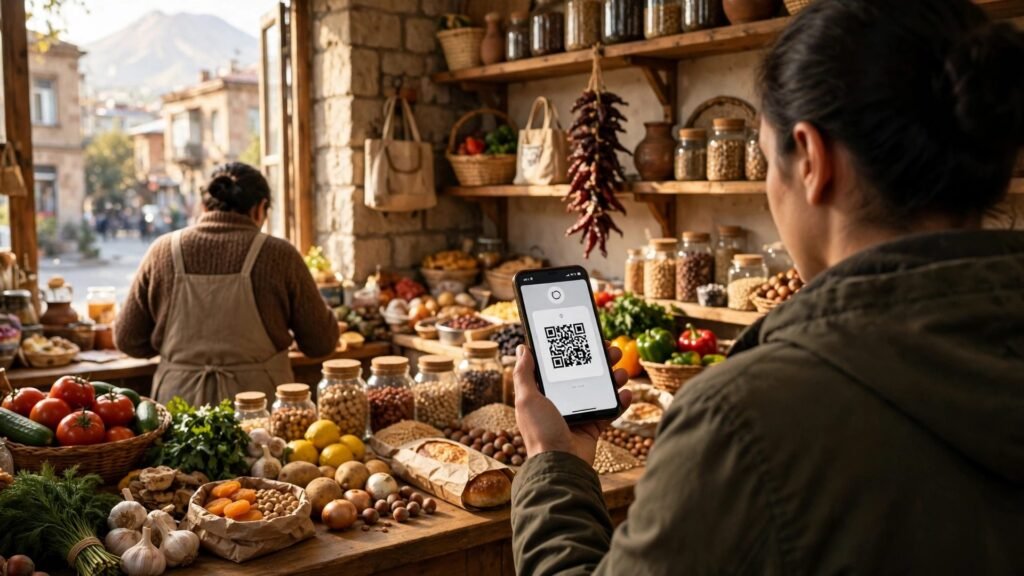
In Armenia, paying with a phone has become an ordinary part of daily life. For many people in Yerevan and beyond, the wallet app Idram is the first thing they open when they need to pay a bill, send money to family, or settle up at a shop. Cash and bank cards have not disappeared, but for a growing number of everyday payments, the phone comes out first.
Idram is an Armenian electronic wallet. It lets users keep money in an app, pay by scanning a QR code, transfer money to other users, and pay for services such as utilities, mobile top-ups, transport and online shopping. That combination is the key to its popularity: instead of carrying cash for one thing and a card for another, many Armenians handle a whole range of small, routine payments from a single app.
Key Takeaways
- Idram brings bills, transfers, QR payments and online shopping together in one Armenian wallet app.
- QR codes make it practical for small shops and market stalls that may not want a card terminal.
- Cash and cards still have a place, but the phone is winning the small, everyday payment.
One App for Everyday Payments
The strongest reason people stick with a wallet is convenience, and Idram is built around the payments people make most often. Utility bills, phone credit, internet and everyday shopping can all be handled without visiting a payment terminal or a bank branch. For busy households, that saves trips and queues, and it keeps payment records in one place on the phone.
Transfers between people matter just as much. Splitting a meal, sending money to a relative, or paying a neighbour for a small service is easier when both sides already use the same wallet. Once a circle of friends and family is on Idram, using it becomes the default, because nobody has to ask how the other person wants to be paid.
Why QR Codes Changed Small Shops
QR codes are a big part of the story. A shop only needs to display a printed code for a customer to pay, which is far simpler and cheaper than installing and maintaining a card terminal. That makes phone payments practical for small cafés, bakeries, market stalls and neighbourhood shops, not just large supermarkets.
For customers, the process is quick: open the app, scan the code, confirm the amount, and the payment is done. There is no need to count out notes and coins, wait for change, or worry about whether the shop accepts a particular card. As with Cambodia’s single QR code system, one simple scanning habit can spread quickly once shops and customers both trust it.
Once a circle of friends and family is on Idram, using it becomes the default, because nobody has to ask how the other person wants to be paid.
Built for Armenia, Not Imported
Another reason Idram fits so well is that it was made for Armenian users and Armenian services. Its bill-payment options, local merchants and language support reflect how people in Armenia actually pay, rather than asking them to adapt to a system designed for another country. Local wallets often win for exactly this reason: they solve local problems first.
The same pattern shows up across the region. In Kazakhstan, the Kaspi app has become an everyday super-app by bundling shopping, banking and payments, while in Uzbekistan Click and Payme have made phone payments the everyday default. In each case, the winning app is the one that covers the most daily needs in one place.
Cash and Cards Are Not Gone
None of this means cash has vanished from Armenia. Cash is still useful in rural areas, at some markets, and for people who prefer it or do not use smartphones for payments. Cards remain common too, especially for larger purchases and in bigger stores. What has changed is the balance: for small, frequent payments, the phone wallet is often the fastest and simplest choice.
Trust also plays a role. People adopt a wallet gradually, often starting with a single bill payment or a transfer from a friend, and only later using it at shops. Each successful payment builds confidence, and confidence is what turns an app from a novelty into a habit.
- One app covers bills, transfers, QR payments and online shopping.
- QR codes let even small shops accept phone payments without a card terminal.
- Local design, local merchants and local language make the wallet feel made for Armenia.
- Cash and cards still matter, especially outside cities and for larger purchases.
What to Watch Next
Idram’s future in Armenia will depend on the same things that made it popular: covering more everyday payments, staying simple to use, and keeping the trust of shops and customers. If more small businesses display QR codes and more services accept wallet payments, the phone will keep gaining ground on cash for daily spending. Cash and cards will remain part of the picture, but the everyday payment in Armenia increasingly starts with a phone in hand.