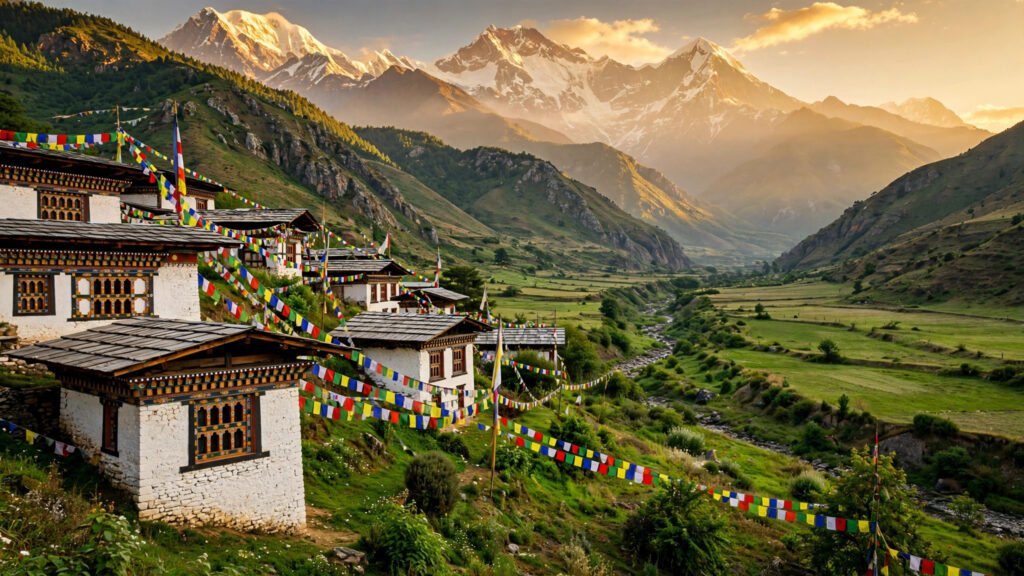
For most of the twentieth century, Bhutan watched the world change from a distance. While television became an everyday object in homes across Asia, Europe and the Americas, Bhutanese households had no television service of their own. Then, in 1999, television and the internet arrived in Bhutan in the same year, decades after they had become ordinary elsewhere.
That late arrival was not an accident, and it was not because Bhutanese people were uninterested in new technology. It was the result of a deliberate choice: to open up slowly, on Bhutan’s own terms, and to think carefully about what outside influences would mean for a small Himalayan kingdom with a strong culture of its own.
Key Takeaways
- Bhutan introduced television and the internet in 1999, much later than most other countries.
- The delay reflected a cautious approach to outside influence, not a lack of interest in technology.
- Once the door opened, mobile phones and the internet spread quickly, especially among younger Bhutanese.
Why television arrived so late
Bhutan is a landlocked country in the eastern Himalayas, between India and China. Its mountains, narrow valleys and scattered settlements have always made travel and communication difficult, and for much of its history the country chose to limit contact with the outside world. That isolation helped protect Bhutan’s language, religion, customs and way of life, but it also meant that new inventions reached Bhutan later than they reached its neighbours.
Television was part of that story. Bhutan’s leaders worried that foreign programmes, beamed in without any local control, could overwhelm local culture, especially for children. In a country where community life, Buddhism and traditional arts matter deeply, that was not a small concern. The question was never simply whether television worked. It was what television would bring with it, and whether Bhutan was ready for it.
A cautious approach, not a rejection of technology
It is easy to misunderstand Bhutan’s late start as a dislike of modern life. The reality is more interesting. Bhutan has long measured progress in its own way, giving weight to wellbeing, community, culture and the environment alongside economic growth. New technology was judged by that broader standard, not just by whether it was new or popular elsewhere.
It was the result of a deliberate choice: to open up slowly, on Bhutan’s own terms, and to think carefully about what outside influences would mean for a small Himalayan kingdom with a strong culture of its own.
That caution also applied to other changes. Bhutan opened itself to tourism in a controlled way, limiting visitor numbers and shaping how visitors experience the country. The same instinct shaped its approach to television: move carefully, keep control, and make sure the change serves Bhutanese life rather than replacing it.
What changed in 1999
In 1999, Bhutan launched its own television service and introduced the internet. The two arrivals together marked a turning point. For the first time, Bhutanese viewers could watch programmes made for Bhutan, in their own context, alongside programmes from abroad. The internet, meanwhile, gave Bhutanese people a direct way to communicate, learn and share information with the rest of the world.
The change was felt quickly in daily life. Families who had never had a television at home suddenly had one. Young people in towns could follow news, sport and entertainment from far beyond the Himalayas. Schools, offices and government services began to see what connected computers could do. The country that had waited longest had, in a single year, stepped into two new eras at once.
- Television and the internet both arrived in Bhutan in 1999.
- Local Bhutanese programming gave viewers content rooted in their own culture.
- Mobile phones later made the internet personal, portable and part of everyday life.
- Geography still matters: mountain valleys make mobile coverage a practical challenge.
The internet arrived in the same moment
Because television and the internet arrived together, Bhutan skipped some of the steps other countries went through. Many Bhutanese people’s first experience of the wider digital world came not through a desktop computer in a living room, but through a shared connection, a school computer or, later, a mobile phone. That pattern is familiar in other mountain and rural societies, where phones become a lifeline across long distances and difficult terrain.
Mobile phones changed the story again. A phone fits in a pocket, needs no fixed line, and can reach places where laying cables through mountains is slow and expensive. For farmers checking prices, students studying far from home, and families keeping in touch across valleys, the phone became the most practical way to be online. In that sense, Bhutan’s late start did not leave it behind forever. It meant that when connection finally came, it came in the most flexible form available.
What Bhutan looks like online today
Today, Bhutanese life online looks familiar in many ways: social media, messaging apps, video, news and online shopping all play a part in daily life, especially in towns and among younger people. At the same time, Bhutan still tries to hold on to the balance that shaped its late start. Traditional dress, festivals, architecture and community customs remain visible parts of everyday life, even as screens become more common.
Other small and remote societies have faced the same balancing act. Estonia built much of daily life around phones and digital services, while Finland made generous mobile data a normal part of everyday life. Bhutan’s path is different from both, but the underlying question is the same: how does a society take the benefits of connection without losing what makes it itself?
What to Watch Next
Bhutan’s story is a reminder that a late start is not the same as a missed start. The country waited, weighed the costs, and then embraced television, the internet and mobile phones on terms it could shape. The challenge ahead is the same one Bhutan faced in 1999: keeping that balance as connection becomes deeper, faster and harder to switch off, while protecting the culture, community and mountain way of life that made Bhutan want to wait in the first place.