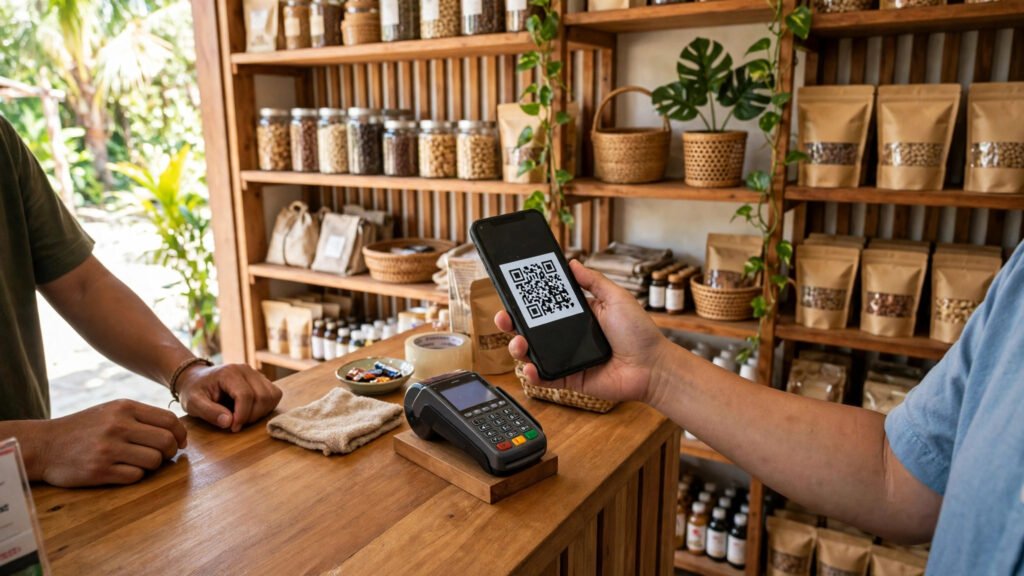
Walk into a cafe or a small shop in Bandar Seri Begawan today and you may notice something different at the counter. Instead of reaching for notes and coins, many customers simply open their bank app, point their phone at a printed QR code, and walk out with their purchase paid for. It is quick, it is quiet, and it is becoming an everyday sight across Brunei.
So why have QR codes caught on so fast in a country where cash has always worked perfectly well? The answer is a mix of practical convenience, strong banking apps, and a small, well-connected population where new payment habits can spread quickly from one shop to the next.
Key Takeaways
- QR payments let Bruneians pay straight from a bank app by scanning a code, with no cash and no card terminal needed.
- A shared national QR standard means one shop code can work with different banks’ apps, which makes the system simple for small businesses.
- Cash is still accepted in Brunei, but QR codes win on speed, hygiene, and keeping a clear record of every payment.
How a QR Payment Actually Works
The process is deliberately simple. A shop prints a QR code and places it at the counter, or shows it on a small stand. The customer opens their bank’s mobile app, chooses the scan or pay option, and points the camera at the code. The shop’s details appear on screen, the customer types in the amount, confirms, and both sides see the payment go through within seconds.
For the shopkeeper, there is no card machine to rent, maintain, or wait for. A printed code costs almost nothing, and the payment lands directly in the business account. For the customer, there is no need to carry exact change, count notes, or hand a card to a stranger. The phone they already carry everywhere becomes the wallet.
This simplicity matters most for small businesses. A food stall, a neighbourhood grocery, or a market vendor can start accepting digital payments with little more than a printed code and a bank account. That low barrier is one of the main reasons QR payments have spread beyond big shopping malls into everyday neighbourhood trade.
One Code That Works Across Banks
QR payments only work well when customers do not have to worry about which bank the shop uses. In Brunei, a shared national QR standard means a single code displayed by a merchant can be scanned by customers of different participating banks and payment providers. A shop does not need a separate code for every bank, and a customer does not need a separate app for every shop.
This kind of shared standard is a quiet but important piece of the puzzle. In countries where every bank runs its own closed system, shoppers face a wall of different codes at the counter and quickly give up. A common standard removes that friction, and friction is exactly what kills new payment habits.
Local banks have supported the shift by building QR scanning into the mobile banking apps their customers already use. People do not need to download a new wallet or learn a new system. The payment option sits inside a familiar app, next to transfers and balance checks they already trust.
Why Brunei Was Ready for QR
Brunei is a small country with a compact population, high smartphone use, and a banking system that most adults already use. Those conditions make it easier for a new payment method to reach a tipping point. When friends, family, and favourite shops all use the same method, trying it once is enough to make it a habit.
Daily life helps too. Much of Brunei’s shopping happens in small, local transactions: a coffee, a meal at a food court, groceries, fuel, or a small purchase from a neighbourhood store. These are exactly the payments where counting out cash feels slowest and where a quick phone scan feels easiest.
There is also a practical side for record-keeping. A QR payment leaves a clear entry in the bank app, showing where the money went and when. For people budgeting a household, and for small business owners tracking daily sales, that automatic record is genuinely useful. Cash, by contrast, leaves no trace unless someone writes it down.
A printed code costs almost nothing, and the payment lands directly in the business account.
What About Cash and Cards?
QR codes have not replaced cash in Brunei, and they were never meant to overnight. Cash is still accepted almost everywhere, and cards remain common in larger stores, hotels, and restaurants. Many Bruneians simply use all three, choosing whichever fits the moment.
Cash still wins in some situations. Older shoppers may prefer it, some rural stalls may not display a code, and a phone with a dead battery cannot scan anything. Cards still make sense for larger purchases where people want the protection and record-keeping a card provides. QR payments have found their sweet spot in the middle: fast, small, everyday spending.
This mix is normal. Payment habits rarely change in one jump. They change stall by stall and shop by shop, as more merchants display codes and more customers try scanning them. In Brunei, that gradual shift is already visible in how ordinary a phone payment now looks at an ordinary counter.
- QR codes turn an ordinary phone into a payment tool, with no card terminal needed at the counter.
- A shared national standard lets one merchant code work with different banks’ apps.
- Small shops benefit most, because a printed code costs far less than card machine hardware.
- Cash and cards still have their place, especially for larger purchases and older shoppers.
The Same Pattern Across the Region
Brunei is part of a wider Southeast Asian move toward scan-to-pay. Neighbours have built their own national QR systems, and the idea is the same everywhere: make paying as simple as pointing a phone. In Cambodia, shoppers scan a single KHQR code that works across banks, while in Sri Lanka, customers scan LankaQR codes at shops and stalls. Malaysia’s shoppers, meanwhile, pay with DuitNow QR in much the same way.
Each country arrived at QR payments for its own reasons, but the shared lesson is that a common code, built into apps people already trust, spreads faster than any single company’s closed wallet. Brunei’s experience fits that pattern closely.
What to Watch Next
QR payments in Brunei are already part of everyday shopping, but the story is not finished. More small merchants are likely to display codes as customers keep asking for them, and more everyday spending is likely to move from cash to phone scans. Cash will remain an option, and cards will keep their place for larger purchases, but the quick scan at the counter is becoming the default for small daily payments. For shoppers, the habit is simple: open the bank app, scan, confirm, and go. For shops, the lesson is equally simple: one printed code can now serve customers from different banks, and that simplicity is exactly why QR payments have caught on across Brunei.