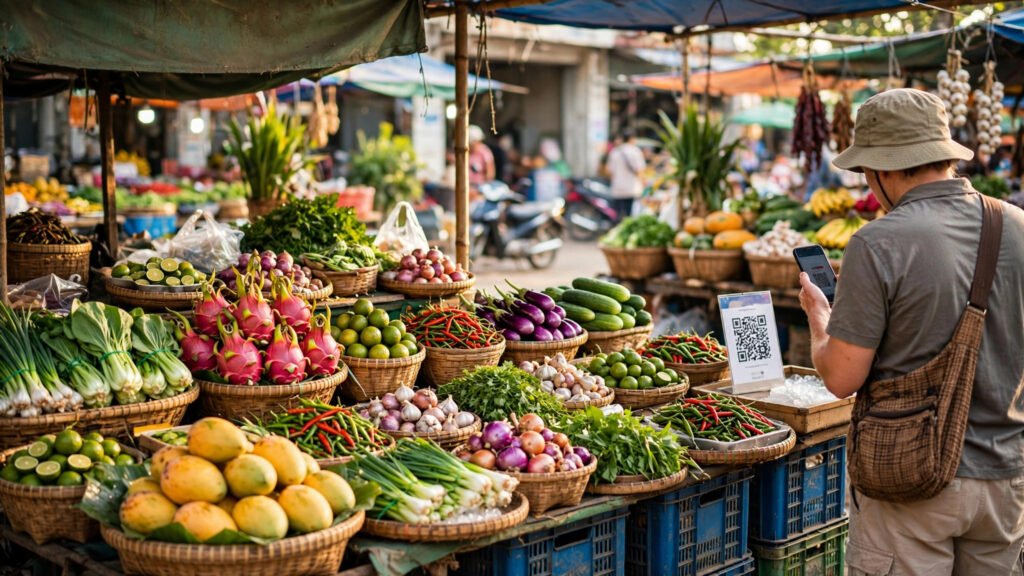
Walk through a market in Phnom Penh or Siem Reap and you will notice something that surprises many first-time visitors: a small printed QR code standing next to the vegetables, the coffee, or the phone accessories. The customer points a phone at it, taps once, and walks away. No notes change hands, no card machine beeps, and no one asks for change.
So why do Cambodians pay with QR codes instead of cash or cards? The short answer is that QR payments fit how Cambodia actually lives, shops, and banks. They are cheap to accept, easy to use on an ordinary smartphone, and they work in places where card terminals never arrived.
Key Takeaways
- QR codes let even tiny stalls accept digital payments without buying a card machine.
- A shared QR standard means one code can work with many different banking and wallet apps.
- Cash is still used in Cambodia, but QR has become the everyday default for countless small purchases.
Cash Was King, But Change Was a Hassle
Cambodia has long been a cash-heavy, dual-currency economy, with the riel used alongside the US dollar in daily life. That system works, but it has friction. Small sellers need change in two currencies, notes wear out, and carrying large amounts of cash is a risk for both buyers and sellers.
QR payments remove much of that friction. The buyer scans, confirms the amount, and the money moves from one account to another. There is nothing to count, nothing to make change for, and the seller gets a record of the sale on their phone straight away.
One Code, Many Apps
The real breakthrough was standardisation. Cambodia’s KHQR system gives merchants a single standard QR code that customers can scan with different participating banking apps and wallets, rather than needing a separate code for every provider. For a market seller, that matters enormously: one printed code on the counter covers customers whatever app they happen to use.
Big banks and popular wallets, including names most Cambodians know such as ABA and Wing, sit inside this same everyday payment world. A customer does not need to ask which app the seller accepts. They scan the same kind of code they have scanned a hundred times before.
Why Cards Never Took Over First
In many countries, cards arrived before phones and became the default. In Cambodia, the order was different. Smartphones spread widely while card terminals stayed rare outside malls, hotels, and larger shops. A card machine costs money, needs a connection, and needs a business bank setup that a street vendor may not have.
A QR code, by contrast, costs almost nothing to print. A seller needs a bank or wallet account and a phone to receive payment notifications. That low barrier is why QR codes reached the smallest stalls first, while cards remained something you mostly saw in bigger, formal businesses.
A QR code costs almost nothing to print, and that low barrier is why it reached the smallest stalls first.
Everyday Life Runs on the Phone
For many Cambodians, the phone is already the bank branch, the shop, and the wallet in one device. People top up phones, send money to family in another province, pay bills, and order food from the same handset. Paying a market seller by QR is simply one more step in a routine that already lives on the phone.
That matters for family support too. Someone working in the city can send money home quickly, and the recipient can then spend it by scanning a code at a local shop. The whole chain stays digital, without a trip to a bank or an agent.
- QR codes work for tiny amounts, so they suit market shopping and street food.
- Sellers get instant confirmation on their phone, with no counting or change.
- One standard code works across many banking apps and wallets.
- Cash still has a role, especially in rural areas and for people without smartphones.
What About Cash and Cards Now?
QR has not killed cash. Notes are still common, especially in rural areas, for older shoppers, and for people who do not use a smartphone or a bank account. And cards still have their place in hotels, larger stores, and for international visitors. The shift is better described as a new default for everyday spending, not a total replacement.
This pattern is not unique to Cambodia. In Finland, daily life is organised around mobile ID for banking, healthcare, and government services, while in North Macedonia many people still reach for cash even as phone payments grow. Panama shows yet another path, where people pay with Yappy instead of bank cards. Each country finds its own shortcut, and Cambodia’s shortcut is the QR code.
What Could Slow It Down?
QR payments still depend on a charged phone, mobile signal, and a bank or wallet account. In areas with weak connectivity, or for people without a smartphone, cash remains the reliable fallback. Trust matters too: first-time users want to be sure the money went to the right seller, which is why the instant confirmation message on the seller’s phone is so important.
Fraud is another risk with any payment method, and QR codes are no exception. Users need to check the seller’s name and amount before confirming, and sellers need to check that the payment actually arrived rather than trusting a screenshot. Those habits, learned over time, are part of what makes the system work.
What to Watch Next
QR payments in Cambodia are likely to keep spreading into more corners of everyday life, from rural markets to school fees and small business suppliers, as more sellers print a code and more customers get used to scanning one. Cash will not disappear overnight, and cards will keep their place in larger stores, but the QR code has already changed what paying looks like for millions of ordinary purchases. The next test is whether the same simple system can reach the people and places it has not reached yet, without leaving cash users behind.