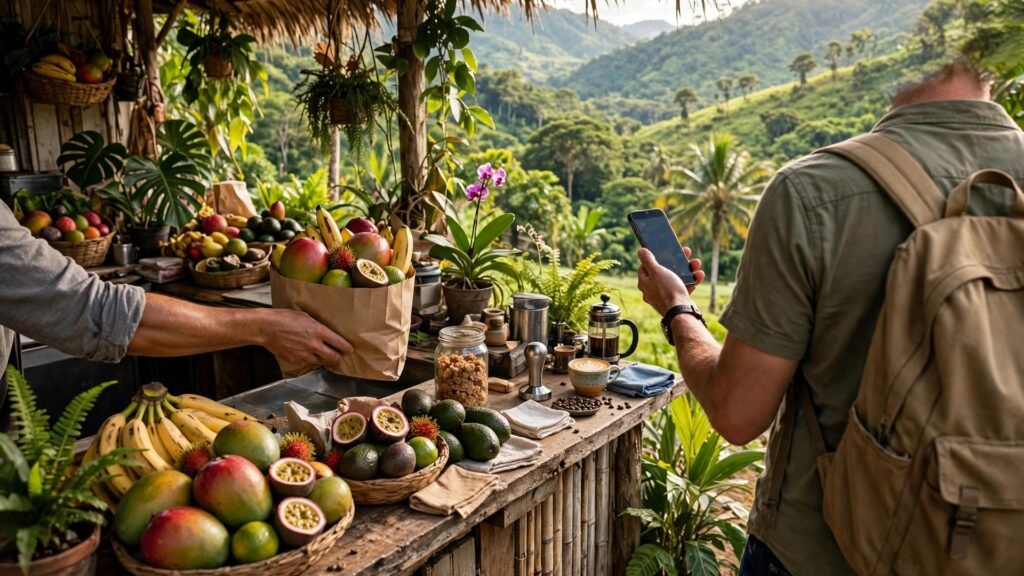
Walk through a farmers market in San José on a Saturday morning, or stop at a small soda for lunch on the road to the coast, and you will see a familiar scene: a customer holds up a phone, types a number, and the payment is done. No wallet opened, no card tapped, no change counted. In Costa Rica, that moment is very often SINPE Móvil, the phone-based transfer system that has quietly become part of everyday life.
SINPE Móvil is not a separate bank and it is not a card. It is a service offered through banks in Costa Rica that lets people send and receive money using a mobile phone number instead of a long account number. If both people have it set up, the sender enters the receiver’s phone number and the amount, confirms, and the money moves from one bank account to another. For the person paying, the phone number is the address. That simplicity is the whole idea.
Key Takeaways
- SINPE Móvil lets Costa Ricans send money using just a phone number, instead of a long bank account number.
- It works across different banks, so it fits small shops, markets, friends and family alike.
- For many everyday payments, it is simpler than carrying cash or waiting on a card machine.
Why a phone number beats an account number
Most people know their friends’ phone numbers by heart, or have them saved in their contacts. Almost nobody knows a friend’s bank account number. SINPE Móvil builds on that everyday habit. To pay someone, you do not need to ask for banking details, copy a long string of digits, or worry about typing one digit wrong. The phone number you already use to call or message that person is enough.
That matters most for the payments people make again and again. Splitting a restaurant bill, sending money to a family member, paying a neighbour who helped with a repair, or settling up with a colleague after a shared taxi ride — all of these are small, social payments. They happen between people who already know each other, and a phone-number payment matches how those exchanges already work.
It also helps in the other direction. A small seller at a market stall, a street vendor, or a person offering a service from home does not need to set up card equipment or handle a separate payment device. If they have a bank account linked to their phone number, they can receive payments on the phone they already carry. The barrier to accepting a digital payment becomes very low.
One system across different banks
Another reason SINPE Móvil caught on is that it is not locked to a single bank. Costa Ricans bank with different institutions, and a payment system that only worked inside one bank would be of limited use. SINPE Móvil was designed as a shared system, so a customer of one bank can send money to a customer of another bank using the same phone-number method.
That shared reach changes the question a buyer asks. Instead of wondering whether a seller uses the same bank or the same app, the buyer can simply ask whether they accept SINPE Móvil. In many everyday settings, the answer is yes, and the payment takes only a few taps. The system fits the way people already move between banks, jobs and towns, without forcing everyone onto one brand.
The phone number you already use to call or message that person is enough.
Why it fits small, everyday payments
Cash still has a place in Costa Rica, and cards are widely used too. SINPE Móvil did not replace either overnight. What it did was fill the gap between them, especially for smaller amounts and informal payments where cash used to be the only easy option and cards were awkward.
- Small shops and market stalls can accept a payment without card equipment.
- Friends and family can split bills and send support without meeting in person.
- A phone number is easier to share and remember than a bank account number.
- Payments work across banks, so buyers and sellers are not locked to one institution.
Consider a market stall. A card payment needs a terminal, a connection, and a wait while the machine processes. A cash payment needs the right notes and coins, and change. A SINPE Móvil payment needs only the seller’s phone number and a phone signal. For a seller handling fresh produce, coffee or crafts, that speed and simplicity is a real advantage, and for a buyer carrying a phone anyway, it is one less thing to think about.
The same logic applies to services. A tutor, a gardener, a driver, or a person selling homemade food can be paid the same way, without either side needing to visit a bank branch or an ATM. In a country where many people work independently or run small businesses, that flexibility matters.
Cash and cards still have their place
None of this means cash has disappeared from Costa Rica, or that cards are no longer used. Larger purchases, formal shopping, and places with card terminals still see plenty of card use, and some people still prefer cash for privacy, habit, or budgeting. SINPE Móvil is best understood as an addition to those options, not a replacement for all of them.
Its strength is in the everyday middle ground: payments that are too informal for a card machine but too frequent to keep settling in cash. When a payment is between people rather than between a customer and a large store, a phone-number transfer often feels like the natural choice. That is why it shows up at markets, in neighbourhood shops, and among friends, even while cards remain common in supermarkets and larger stores.
There are limits, too. Like any phone-based system, it depends on having a charged phone, a connection, and a bank account linked to the service. People without those things still rely on cash, and that is a reminder that no single payment method fits everyone. The appeal of SINPE Móvil is not that it works for every person in every situation, but that it works well for a very common kind of payment.
A habit built on trust and convenience
Payment habits change slowly, because money involves trust. People stick with what feels safe and familiar. SINPE Móvil grew because it borrowed something people already trusted — their bank account — and paired it with something they already used every day — their phone number. There was no new currency to learn, no separate balance to top up, and no new card to carry.
Over time, that familiarity builds its own momentum. Once friends, family and favourite sellers all accept the same method, using it becomes the default. A new seller joins because buyers ask for it, and buyers keep using it because sellers accept it. The system becomes useful precisely because so many people already use it, and that network effect is hard for any single bank’s app to match on its own.
For visitors, the lesson is simple: if a Costa Rican seller or friend suggests paying by SINPE Móvil, they are pointing to the country’s shared shortcut for person-to-person payments. It is the local answer to a universal question — how do you pay someone quickly, without cash and without a card machine — and in Costa Rica, the answer increasingly starts with a phone number.
What to Watch Next
The story of SINPE Móvil is, at its core, a story about simplicity winning over complexity. A phone number proved easier than an account number, a shared system proved more useful than a single-bank app, and a method that fits small sellers proved more practical than one built only for large stores. Cash and cards still have their place, but for everyday payments between people, the phone has become the wallet. What to watch next is whether that habit keeps spreading to more kinds of payments, and whether the same phone-number simplicity shapes how Costa Ricans pay in the years ahead. Related systems show the same pattern elsewhere: Chileans paying with CuentaRUT and Mach, Paraguayans paying with Tigo Money, and Peruvians paying with Yape all point to phones becoming the everyday way to pay across the region.