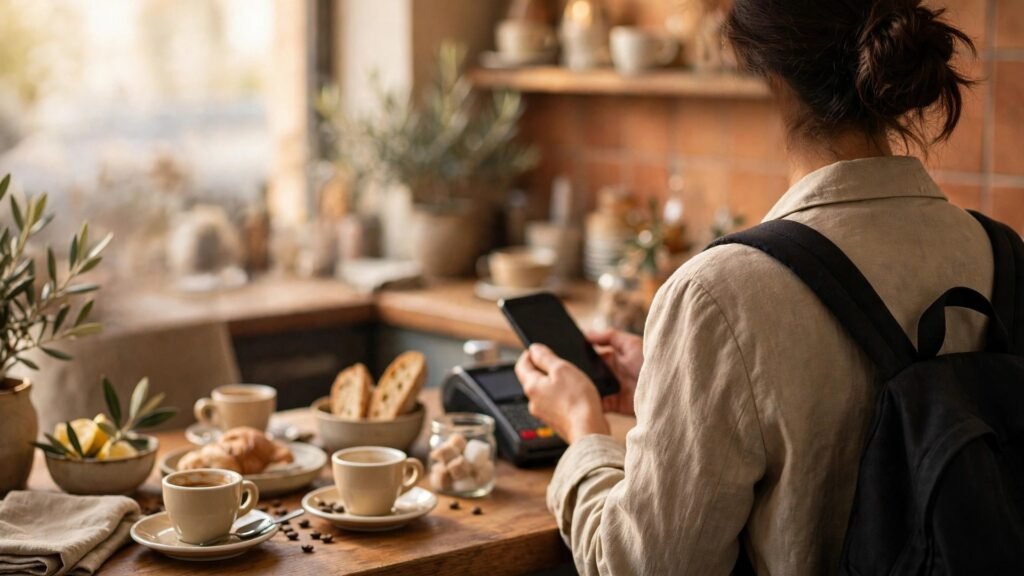
In Italy, cash has long been king. From the morning espresso at the bar to the weekly market shop, paying with notes and coins felt normal, even expected. Yet in recent years, a growing number of Italians have started reaching for their phones instead — and for many of them, the app they open is Satispay. So why do Italians pay with Satispay instead of cash or cards, and what makes it different from the payment methods that came before it?
Key Takeaways
- Satispay lets Italians pay with a phone number instead of a card, using money linked to a bank account.
- It fits Italy’s small-shop culture, where cafés, markets and independent stores want simple, low-friction payments.
- Its appeal is convenience and everyday habits — splitting bills, paying friends and shopping — rather than replacing cash overnight.
What Is Satispay, and How Does It Work?
Satispay is an Italian mobile payment app that works without a physical card. Once someone sets it up, they link it to their bank account and can send or receive money using just a phone number. In a shop, payment usually happens by scanning a QR code or confirming the amount in the app, rather than tapping a card or handing over cash.
That simplicity matters. There is no card to carry, no PIN pad to fumble with, and no need to check whether you have the right change. For the person paying, the steps feel closer to sending a message than to completing a bank transaction. For the shopkeeper, the sale is recorded in the app, which can be easier than managing a cash drawer at the end of a long day.
Satispay also works between friends and family. Splitting a restaurant bill, sending money for a shared gift, or paying someone back for a train ticket can all be done from the same app people already use in stores. That combination — shops and person-to-person payments in one place — is a big part of why it caught on.
Why Cash Was So Hard to Replace in Italy
To understand Satispay’s rise, it helps to understand Italy’s relationship with cash. Small businesses are everywhere in Italy: family-run cafés, bakeries, greengrocers, hairdressers and market stalls. For generations, cash was fast, familiar and free of extra steps, especially for small amounts like a coffee.
Cards, by contrast, did not always feel like an obvious upgrade. Some small merchants were slow to adopt card terminals, and some customers simply preferred the control of paying in cash. Any new payment method therefore had to be genuinely easier than cash, not just newer. It had to work in the places Italians actually shop, for the small, everyday amounts they actually spend.
That is the gap a phone-based system could fill. Most Italians already carry a smartphone everywhere, so paying with the phone removed a step instead of adding one. And because Satispay was built in Italy, for Italian shops and Italian banking habits, it could speak directly to that local reality.
For the person paying, the steps feel closer to sending a message than to completing a bank transaction.
What Makes Satispay Different From a Card?
The most obvious difference is that Satispay does not rely on a card network in the usual way. Payments are tied to a phone number and a linked bank account, so the phone itself becomes the payment tool. That can feel more personal and more direct than handing over a card, especially among friends.
Another difference is how it fits daily routines. Italians use Satispay for more than checkout. Paying a friend back, contributing to a group gift, or settling up after a shared meal are all part of the same habit. Once an app becomes the default way to move small amounts of money between people, using it in shops feels like a natural next step rather than a new skill to learn.
There is also a practical point for small merchants. Shops that already deal in small transactions want a payment option that does not slow down the queue at the counter. A quick scan and confirmation keeps the line moving at a busy bar in the morning rush, which matters as much as any technology behind the scenes.
- Pay in shops by scanning a code or confirming in the app — no card needed.
- Send money to friends using just their phone number.
- Split bills and shared costs from the same app.
- Works for small everyday amounts, from coffee to market shopping.
Why Italians Still Keep Cash and Cards Too
Satispay’s growth does not mean cash has disappeared in Italy, and it does not mean cards are gone either. Many Italians still carry cash for markets, tips or small purchases, and cards remain common for larger spending, travel and online shopping. Payment habits rarely switch all at once; they layer on top of each other.
What has changed is the default for certain moments. When friends split a bill, when a regular pays at a neighbourhood café, or when a small shop wants a quick, simple checkout, the phone is increasingly the first choice. Satispay won those moments by being easy, local and social — three qualities that matter a great deal in Italian daily life.
That also explains why similar apps have taken off in neighbouring countries. People everywhere like paying friends by phone number, and small merchants everywhere like a checkout that does not slow them down. In Spain, Bizum fills a similar role, while Portugal’s MB WAY and Sweden’s Swish show how the same idea adapts to different banking systems and habits.
What to Watch Next
Satispay’s story in Italy is really a story about habits changing slowly, one coffee and one shared bill at a time. It did not replace cash overnight, and it did not need to. It became useful in the small, repeated moments of everyday life — paying friends, shopping locally, and keeping the morning queue moving — and that usefulness is what keeps Italians opening the app. The question now is not whether phone payments will keep growing in Italy, but which everyday moments they will take over next.