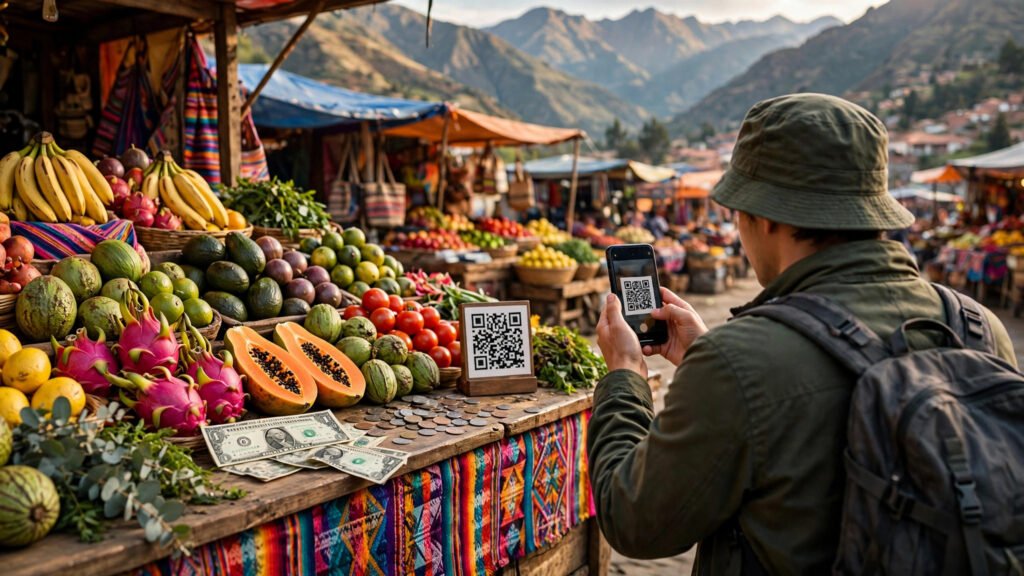
Walk through a market in Quito or Guayaquil, and you will see two kinds of payment sitting side by side. On one counter there is a pile of dollar bills and coins, counted out by hand. On the next, a small printed QR code stands beside the fruit, and a customer points a phone at it, taps once, and walks away with the shopping done. That second scene is where Deuna comes in, and it explains a quiet change in how many Ecuadorians pay.
Deuna is a payment app from Banco Guayaquil, one of Ecuador’s large banks, and it is built around a simple idea: paying should not require a card machine, a wallet full of notes, or a trip to a bank branch. A seller shows a QR code, a buyer scans it, and the money moves from one account to another through the phone. For small businesses, street vendors, and neighbourhood shops, that matters, because a printed code costs far less trouble than renting and maintaining a card terminal.
Key Takeaways
- Deuna lets Ecuadorians pay by scanning a QR code with a phone, instead of handling cash or using a card machine.
- Cash still matters in Ecuador, but QR payments suit small shops, markets, and everyday purchases where card terminals are uncommon.
- The appeal is practical: no change to count, a record of the payment on the phone, and no need to carry large amounts of cash.
Why cash is still hard to beat in Ecuador
Ecuador uses the US dollar, and cash has long been the default for everyday life. Market stalls, buses, corner shops, and family-run restaurants have traditionally run on notes and coins, and many customers are simply used to paying that way. Cash works without a signal, without a battery, and without any account at all, which is a real advantage in places where connectivity is patchy or where a seller has never had a card machine.
But cash also has frictions that people feel every day. Change runs out, notes get worn, and carrying larger amounts of money feels unsafe. For a seller, counting takings at the end of the day takes time, and for a buyer, a purchase can stall over a missing coin. None of this makes cash unusable, but it leaves room for something simpler, and that is the gap a phone payment fills.
How paying with Deuna actually works
The everyday Deuna payment is deliberately unglamorous. The seller generates a QR code for the amount, or displays a fixed code at the counter. The buyer opens the app, scans the code, checks the amount and the recipient, and confirms. The payment is recorded in the app, so both sides have a trace of what was paid, without a paper receipt that can be lost.
That record is part of the appeal. A customer can look back and see where money went during the week, and a small business owner can see the day’s sales without counting a drawer. The phone itself becomes the receipt book, the wallet, and the till, all in one device that most people already carry. For many Ecuadorians, the phone has quietly become the wallet they actually carry everywhere.
For many Ecuadorians, the phone has quietly become the wallet they actually carry everywhere.
Why small sellers like QR codes
For a large supermarket, a card terminal is routine. For a market stall or a small café, it is another device, another cost, and another thing that can break. A QR code avoids most of that. It can be printed, placed on a counter, and used all day, and it does not need the seller to handle a customer’s card at all.
This is a pattern seen across the region and beyond. In Bolivia, shoppers have taken to QR payments for similar reasons, as explained in our look at why Bolivians pay with QR codes instead of cash. The technology differs from country to country, but the seller’s logic is the same: the simplest payment method that works at the counter tends to win.
- A printed QR code replaces the need for a card terminal at small counters
- Buyers pay by scanning with a phone, with no change to count and no notes to carry
- Both sides keep a digital record of the payment inside the app
- Cash stays in use alongside QR payments, especially where connectivity is weak
What about cards?
Cards are common in Ecuador’s larger stores, hotels, and restaurants, and they are not disappearing. But card acceptance is uneven. A shop that takes cards in a shopping mall may be the exception rather than the rule in a neighbourhood market, and some customers prefer not to hand over a card for a small purchase. QR payments sit in the middle: they are digital like a card payment, but they work at the kind of counter where a card machine never made sense.
There is also a trust question. Some people are wary of sharing card details, while a QR payment feels more contained: the buyer scans, confirms an amount they can see, and the transaction is done. That sense of control matters, especially for people trying a digital payment method for the first time.
The wider shift behind Deuna
Ecuador’s story fits a much larger change in how the world pays. In Kenya, paying by phone became an everyday habit long before it spread elsewhere, as described in our explanation of why so many Kenyans pay with phones. In Jamaica, the central bank went further and created its own digital currency, covered in our post on why Jamaica created the JAM-DEX digital dollar. Ecuador has not taken either of those exact paths, but the direction is familiar: the phone is becoming the place where money lives.
None of this means cash will vanish from Ecuador soon. Dollar notes are woven into daily life, and many transactions will stay in cash for years. What Deuna shows is that cash no longer has to be the only option at the counter. Where a seller can offer a QR code and a buyer can scan it, the payment becomes quicker, cleaner, and easier to track, and that is enough reason for many people to switch for everyday purchases.
What to Watch Next
What to watch next is whether QR codes spread further beyond markets and small shops into the places where cash still dominates, whether more sellers display a code as a matter of routine, and whether customers who try phone payments for small purchases start using them for larger ones too. The other question is how cash, cards, and QR payments settle into their own roles, rather than one replacing the others outright. Until those answers arrive, the picture is a practical one: in Ecuador, the phone is quietly joining the dollar at the counter, one scan at a time.