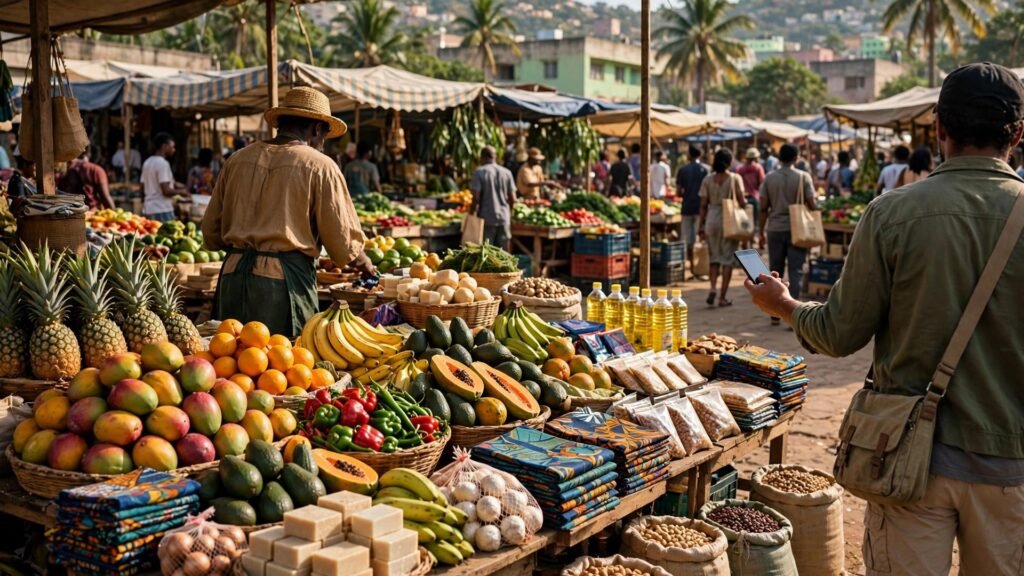
In Gabon, paying with a phone has become an everyday habit for many people. Instead of carrying cash everywhere or relying only on a bank card, a growing number of Gabonese use mobile money services such as Airtel Money and Moov Money to send money, pay for goods, and settle small bills. The change did not happen overnight, but it fits the way daily life already works: the phone is always close, and the payment follows the person rather than the other way round.
For someone visiting Gabon for the first time, the pattern can look surprising. A market trader, a taxi driver, or a small shopkeeper may prefer a phone transfer over notes and coins. The reason is rarely about technology for its own sake. It is about convenience, safety, and reach — three things that matter in Libreville just as much as they do in smaller towns and villages across the country.
Key Takeaways
- Mobile money lets Gabonese pay and send money from a phone, without needing cash or a bank card at the counter.
- Airtel Money and Moov Money are widely recognised names, so both sides of a payment usually already know how the system works.
- The habit is strongest for everyday amounts, where speed and simplicity matter more than a formal banking process.
The payment follows the person rather than the other way round.
What Airtel Money and Moov Money Actually Do
At their simplest, Airtel Money and Moov Money are wallets that live on a phone. Money held in the wallet can be sent to another person, used to pay a merchant, or used for services linked to the provider. The other person does not need to be in the same place, and the transfer does not depend on a bank branch being open.
That simplicity is the point. A payment that once needed a trip, a queue, or exact change can now be completed in a few steps on a handset. For people who send money to family members in another town, the difference is practical rather than abstract: the money can move the same day, without either side travelling to meet.
The two services are linked to two of the country’s mobile networks, which means many phone users already have a natural route into one of them. When friends, family, and regular traders all use the same kind of wallet, paying by phone becomes the default, not the exception. A similar pattern can be seen elsewhere in the region, where mobile wallets have become a normal way to pay for everyday goods.
Why Cash Loses Out for Everyday Payments
Cash still has a role in Gabon, and nobody should pretend otherwise. But cash has drawbacks that phone payments avoid. Notes can be lost or damaged, change can be hard to find for larger amounts, and carrying a large sum can feel unsafe. A phone wallet removes the need to count out notes at a busy stall or to worry about having the right denominations.
There is also the question of record-keeping. A phone payment leaves a trace on the handset, so both the payer and the receiver can check what was sent and when. For a small business, that trace helps keep track of sales without a separate notebook. For a household, it helps to see where money has gone during the week.
Speed matters too. At a market stall or a roadside shop, a phone transfer is usually quicker than a cash transaction that needs change, and quicker than a card payment where a terminal may not be available. When a queue is forming behind you, that speed is not a luxury — it is the reason the next customer stays patient.
- Phone payments avoid the search for exact change at busy stalls and shops.
- Both sides get a record of the payment on their handsets.
- Transfers can reach family in another town without either side travelling.
- Small traders can accept payments without buying card-terminal equipment.
Why Bank Cards Have Not Taken the Same Role
Bank cards are useful, but they depend on more pieces falling into place: a bank account, a card, a terminal, and a reliable connection at the point of sale. In many everyday settings in Gabon, one or more of those pieces may be missing. A market stall may have no terminal at all, and a rural shop may not have the setup to take cards even if customers carry them.
Mobile money lowers that barrier. The phone itself is the terminal, and the network is the infrastructure. A trader does not need extra equipment beyond the phone already in a pocket. A customer does not need to carry a separate card. That is why the wallet has spread further, faster, into the places where daily trade actually happens.
The same logic explains why phone-based payments have grown in other countries where card terminals are not everywhere. In Egypt, for example, phone wallets and instant transfers have become a popular alternative to cash, even though cards exist there too. The deciding factor is rarely which system is newer — it is which system works in the shop in front of you.
How Mobile Money Fits Gabon’s Geography
Gabon is a country of dense forest, scattered towns, and long distances between settlements. That geography shapes how people pay. Travelling to a bank branch can take time and planning, especially outside the main cities. A phone wallet, by contrast, travels with its owner wherever there is a mobile signal.
This matters most for family support. Many households have members living and working in different parts of the country, and money often needs to move between them. A phone transfer lets that happen without a journey, and without asking a traveller to carry cash on someone else’s behalf. The result is a quieter, safer way to look after relatives at a distance.
Phones also bridge the gap between places in other island and coastal settings, where people rely on phones to stay connected across separated communities. The principle is the same: when distance is the problem, the phone is the bridge.
What Still Needs Care
None of this means mobile money is without risks, and a careful user treats it like any other way of holding money. A phone that is lost or stolen needs to be secured quickly, and the codes that protect a wallet should never be shared with strangers, however convincing the request sounds. Scams that try to trick people into sending money or revealing a code are a known problem wherever phone payments are common.
It is also worth remembering that a wallet is only as useful as the network and the balance behind it. If a phone runs out of charge, or if the signal is weak, a payment may have to wait. Keeping a small amount of cash for those moments is still sensible, and many people in Gabon do exactly that — using the wallet for most payments, but not pretending it covers every situation.
Fees and limits are another practical point. Different transactions can carry different charges, and wallets may have limits on how much can be sent or held. Checking those details inside the app before a large transfer avoids an unpleasant surprise at the counter.
What to Watch Next
The story of mobile money in Gabon is still being written by its users, one payment at a time. The wallet has already proved itself for everyday amounts, for family transfers, and for traders without card terminals. What comes next will depend on how far the habit spreads into new kinds of payments, and on whether the services keep working smoothly in the places where they are needed most.
For now, the pattern is clear: the phone has become the wallet for many Gabonese, not because cash disappeared, but because the phone payment is simpler, quicker, and easier to keep track of. And as long as that stays true at the market stall, the taxi rank, and the family home, Airtel Money and Moov Money are likely to remain the first choice for everyday payments in Gabon.