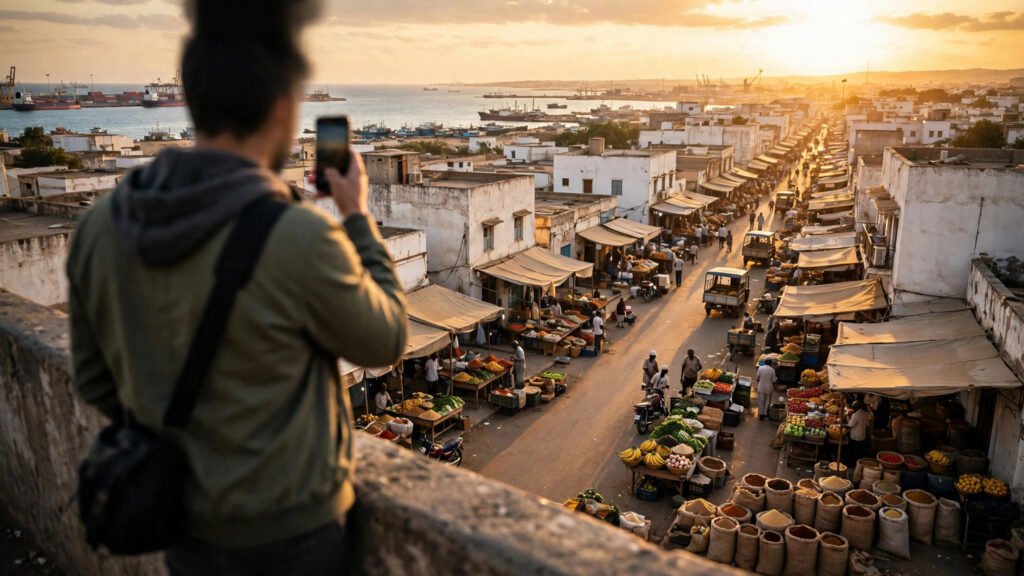
Djibouti sits at one of the busiest crossroads of the internet. Submarine cables carrying data between Europe, Asia and Africa pass through its waters, and its port city is a hub for shipping, logistics and military bases from several countries. Yet for many ordinary people living in Djibouti, getting online on a mobile phone can feel surprisingly expensive. Data bundles run out fast, video calls stutter, and households think twice before streaming a film or letting children watch videos for school.
So why is mobile internet in Djibouti so expensive, when the country is literally wired into the world’s busiest data routes? The answer is not one single reason. It is a mix of a small market, a long history of one dominant telecom operator, the cost of building networks in a hot and dry climate, and the way wholesale cable capacity does — or does not — reach ordinary phone users.
Key Takeaways
- Djibouti is a major submarine-cable crossroads, but that global capacity does not automatically mean cheap mobile data for local users.
- A small population and one dominant operator have long limited competition, which tends to keep prices high.
- People adapt with Wi-Fi, shared connections, careful data habits and offline alternatives — and change, if it comes, will likely be gradual.
A Cable Hub With a Small Local Market
To understand the puzzle, it helps to separate two different things: the cables that pass through Djibouti, and the mobile network that serves people inside Djibouti. The cables are a bit like a motorway running past a small town. The motorway may carry enormous traffic, but the town still needs its own local roads, junctions and service stations before residents can use it — and building those costs money.
Djibouti is a small country by population, with most people living in and around Djibouti City. A mobile operator therefore has fewer customers over which to spread the fixed costs of towers, backhaul links, licences, staff and maintenance. In a much larger market, the same tower can serve many more paying users, which can push the cost per user down. In a small market, that maths is harder, and prices tend to reflect it.
The climate adds another layer. Djibouti is hot for much of the year, and equipment needs power and cooling to keep running. Fuel, electricity and maintenance in remote areas all add to the cost of keeping a network alive, and those costs eventually show up in what users pay.
One Dominant Operator for a Long Time
For most of its modern telecom history, Djibouti’s market has been dominated by a single state-owned operator, Djibouti Telecom. Competition is one of the strongest forces that pushes prices down in other countries: when two or three operators fight for customers, they tend to offer bigger bundles, cheaper plans and better coverage. Where one operator serves almost everyone, there is less pressure to cut prices or to rush out new offers.
That does not mean nothing has changed. Mobile coverage in Djibouti City is now a normal part of daily life, and mobile money and messaging apps are widely used. But the structure of the market still shapes the price of data. Without strong rivals, an operator has less reason to sacrifice revenue for market share, and users have fewer alternatives to switch to when they feel a bundle is poor value.
The cables are a bit like a motorway running past a small town: the town still needs its own local roads before residents can use it.
Wholesale Capacity Is Not Retail Data
Another common misunderstanding is to assume that because many submarine cables land in Djibouti, local data should be almost free. Wholesale capacity — the huge pipes between continents — is sold in bulk to operators, governments and large companies. Turning that capacity into a mobile data bundle for one person involves many more steps: landing stations, national fibre, city networks, mobile towers, radio spectrum, billing systems and customer support.
Each step has a cost, and each step needs investment before it earns anything back. An operator that pays for international capacity still has to pay to carry that data across the country and out to a phone in a neighbourhood in Djibouti City, or to a smaller town further inland. That last stretch, often called the last mile, is usually the most expensive part of the whole chain to build and maintain.
What Expensive Data Means in Daily Life
When data costs a lot relative to income, people change how they use their phones. This pattern is familiar across the region. In neighbouring Ethiopia, for example, phone-based payments grew because they reached people through their phones, even where other services were limited. In Djibouti, the adaptation looks different but the logic is similar: people make the most of what they have.
- Wi-Fi first: many people wait until they are home, at work or at a café with Wi-Fi before downloading large files or updating apps.
- Short and light: voice notes, compressed photos and text messages are often preferred over long video calls.
- Shared access: one connection, one hotspot or one family phone can serve several people.
- Careful bundles: users learn which bundle size fits their week, and top up in small amounts rather than buying more than they need.
For students, this matters a great deal. A lesson video that buffers for minutes, or a bundle that runs out before homework is finished, is not just an annoyance — it can decide whether a child keeps up with class. For small traders, port workers and delivery riders, a slow or costly connection can mean missed orders and lost income. For families spread between Djibouti and relatives abroad, it can mean shorter calls home.
Why the Neighbourhood Comparison Is Misleading
People in Djibouti often compare their prices with friends or relatives in other countries and wonder why the gap is so wide. The comparison is understandable, but it can mislead, because each country starts from a different place. Some countries have several competing operators, larger populations, cheaper electricity or older networks that have already paid for themselves. Others, like Eritrea next door, face their own limits: mobile internet in Eritrea remains limited for different reasons, even though the two countries share a region.
In Somalia, meanwhile, phone payments filled the gap left by scarce banks and card machines, showing how a phone can become essential even where formal infrastructure is thin. Djibouti’s story is its own version of the same theme: the phone matters enormously, which is exactly why the price of data feels so heavy.
Could Prices Fall?
There is no single switch that would make Djiboutian mobile data cheap overnight, and anyone promising that should be treated with caution. Prices usually fall gradually, when several things move together: more competition, more investment in fibre and towers, cheaper wholesale capacity actually reaching the retail market, and a growing number of users sharing the fixed costs.
New entrants, if they arrive and stay, could change the competitive picture. So could investment that brings fibre closer to homes and businesses, reducing reliance on expensive mobile links for heavy use. But both take time, licences, capital and trust — and in a small market, a new operator must be confident it can win enough customers to survive. Until then, the most realistic expectation is slow improvement rather than a sudden price collapse.
For users, the practical advice stays the same: compare bundles before renewing, use Wi-Fi for large downloads, keep apps updated on Wi-Fi rather than mobile data, and check which apps are quietly using data in the background. None of that fixes the underlying market structure, but it does stretch a bundle further — and in a country where every megabyte counts, that stretching matters.
What to Watch Next
Djibouti will remain a cable crossroads, and its port and logistics role will keep growing. The question to watch is whether that global connectivity translates, over time, into cheaper and faster mobile data for ordinary Djiboutians. The signs to look for are more competition, more fibre reaching neighbourhoods, and bundles that give users more data for the same money. Until those signs appear together, Djiboutians will keep doing what they already do best: making a small bundle go a long way.