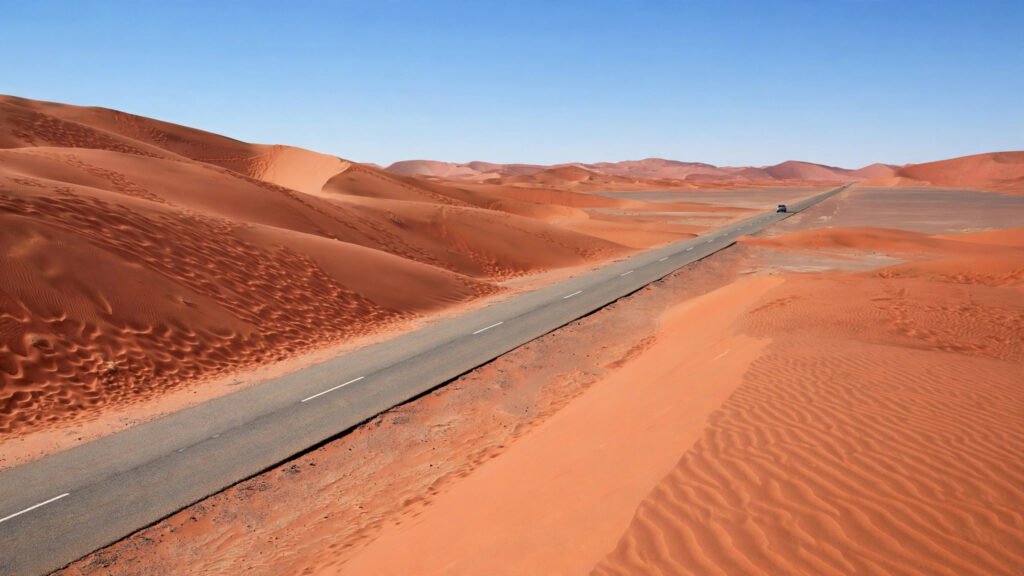
Drive far enough out of a Namibian town and something familiar happens. The music stops streaming, messages stop sending, and the signal bars on your phone quietly fall away, one by one. It can feel sudden, but it is rarely a fault with your phone. On Namibia’s long desert roads, losing signal is usually the normal result of distance, landscape and the way mobile networks are built.
Namibia is a country of wide open spaces. Towns can sit a long drive apart, and the road between them can run through desert, gravel plains and dry riverbeds with very little in between. A mobile network follows people, and where there are few people, there are fewer towers. That simple fact explains most of the dead zones drivers meet on a desert journey.
Key Takeaways
- Namibia’s towns are far apart, so mobile towers are spaced widely along desert roads.
- Dunes, hills and heat can weaken a signal that is already travelling a long way.
- When the signal fades, a phone works harder to find a tower, which can drain its battery faster.
Distance Is the Biggest Reason
A mobile phone does not connect to the internet directly. It talks to the nearest tower, and that tower connects onward to the wider network. Every tower covers only a limited area around it. On a long desert road, the nearest tower can simply be too far away for a steady connection. The phone may catch a faint signal for a while, then lose it again as the road bends away or dips behind a rise.
This is not unique to Namibia. Drivers in other thinly populated places face the same problem, which is why phones lose signal in rural Australia and why travellers report weak mobile signal in rural Germany too. The cause is the same in each case: long gaps between towers, and a landscape that does not help the signal travel.
On a long desert road, the nearest tower can simply be too far away for a steady connection.
Desert Land Shapes the Signal
Desert country is not flat and empty in the way it looks from a car window. Tall dunes, rocky ridges and dry valleys all sit between a phone and the nearest tower. A radio signal travels best in a clear line, and every hill or dune in the way can block or weaken it. A driver can therefore have signal on one stretch of road and none on the next, even without travelling very far.
Heat and dry air also play a part, though they are not the main cause. The bigger problem is that the signal must cross open ground with nothing to carry it onward. In a town, towers are close together and buildings, while they can block signals, sit inside a dense network. On a desert road, there is no second tower nearby to take over when the first one fades.
Why Towers Cannot Cover Every Kilometre
Building a tower in the desert is not just a matter of putting up a mast. Each site needs power, access for maintenance and a link back to the rest of the network. On a road used by relatively few people, covering every kilometre would mean building many expensive sites for very few users at a time. Networks therefore tend to cover towns, main routes and busy corridors first, and leave the quiet stretches between them with thinner coverage.
That trade-off is easy to see from the road. Signal is usually strongest near towns, fuel stops and junctions, where a tower has a reason to be. Between those points, coverage can thin out, break up and return again. It is a pattern shaped by where people live and travel, not by a single gap in one company’s network.
What Your Phone Does When the Signal Fades
When the signal weakens, a phone does not simply give up. It keeps searching for a tower, and it may switch between towers, or between different types of connection, as it tries to hold on. That searching is one reason a phone can feel warm and lose battery faster on a long drive through a dead zone. A weak connection can also make apps behave strangely: a message may sit unsent, a map may load slowly, or a page may fail altogether, much like slow mobile internet at peak hours in Egypt frustrates users for a different reason.
Turning the phone off and on again sometimes helps, because the phone then makes a fresh search for the strongest available tower. But no setting can create a tower where none is in range. If the nearest tower is beyond reach, the honest answer is to wait for the next covered stretch, rather than keep retrying a connection that is not there.
How to Prepare Before a Long Desert Drive
A little preparation makes a dead zone far less stressful, especially on a route where the next town is a long way off. The aim is not to stay connected the whole way, but to make sure a gap in coverage does not leave a driver without maps, information or a way to ask for help later.
- Download offline maps for the whole route before leaving town, so navigation keeps working without signal.
- Save accommodation details, fuel stops and emergency numbers on the phone itself, not only in an online account.
- Charge the phone fully and carry a car charger, because searching for signal drains the battery faster.
- Tell someone the planned route and expected arrival time before setting off into a remote stretch.
- Download music, podcasts and any reading material in advance, instead of relying on streaming on the road.
It also helps to fill up with fuel and water while still in town. A dead zone is much easier to handle when the car, the driver and the phone are all prepared for a long quiet stretch, and when nobody is depending on a live connection to find the next stop.
What to Watch Next
The pattern on Namibia’s desert roads is unlikely to change overnight, because it comes from distance and landscape rather than a single fault. What matters next is the same set of facts this article has described: how widely towers are spaced along main routes, how the desert land shapes the signal between them, and how well travellers prepare before they leave town. A driver who understands those three things will not be surprised when the bars disappear — and will already have the maps, charge and plans needed to keep going until the signal returns.