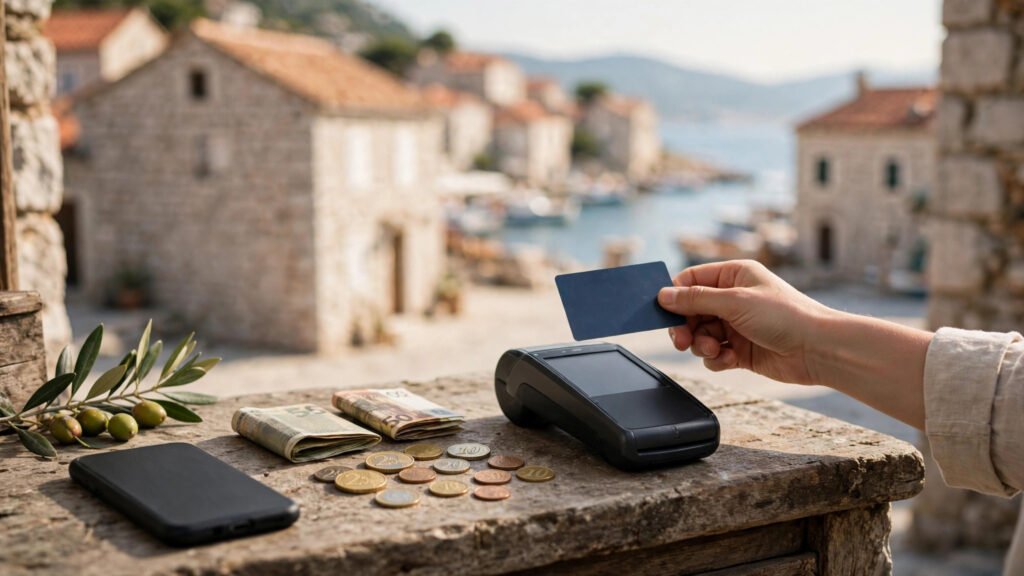
Walk through a market in Podgorica, a café on the Budva coast, or a small shop in a mountain town, and you will notice something about how Montenegro pays. Cards are accepted in many places, phones can pay in others, and yet cash still changes hands all day long. For a visitor, that mix can be confusing. For people who live here, it usually feels practical rather than old-fashioned.
So why do Montenegrins still carry cash even as card and phone payments spread? The short answer is that Montenegro sits between two payment worlds. It uses the euro, its larger towns and tourist areas are well set up for cards, and its smaller shops, markets and rural communities still run largely on notes and coins. Cash is not a refusal of modern payment. It is a habit shaped by shop size, season, place and trust.
Key Takeaways
- Montenegro uses the euro, so cash feels familiar to locals and to many European visitors alike.
- Cards and phone payments are common in cities and tourist areas, while cash still dominates small shops, markets and rural areas.
- Carrying both cash and a card is the practical answer, because acceptance can change from one shop to the next.
The euro makes cash easy to keep using
Montenegro uses the euro as its everyday currency, even though it is not a member of the eurozone. That matters for daily life. People are paid, shop and save in euros, and prices are shown in euros, so cash never feels like a second currency that needs converting in your head. A banknote handed over at a bakery or a market stall is simple, immediate and understood by everyone in the queue.
Cash also travels well across generations. Older shoppers may prefer notes and coins because that is how they have always budgeted, while younger shoppers may tap a card for the same purchase. In one family, both habits can live side by side without any argument about which one is correct. The euro simply makes the cash habit easy to keep.
Where cards work well — and where they do not
In Podgorica, the coastal resorts and larger supermarkets, card payment is a normal part of the day. Hotels, restaurants aimed at visitors, petrol stations and bigger stores usually accept cards, and contactless payment is familiar to many shoppers. A phone with a stored card can work in the same places, which is why visitors often assume Montenegro has gone fully cashless.
Step into a smaller setting and the picture changes. A family-run kiosk, a green market stall, a rural café or a taxi in a quiet town may prefer cash or may not take cards at all. That is not always a technology problem. Small businesses weigh the cost and paperwork of card terminals, and in a seasonal economy a machine that sits unused for months may not feel worth it. For a market trader selling a handful of items at a time, cash is faster and simpler.
This is a pattern seen across the region. In neighbouring countries, too, daily shopping still leans heavily on cash in smaller places, even where phone and card options are growing. Readers curious about that wider Balkan picture can compare it with why Bosnians still pay cash for everyday purchases and why North Macedonians still reach for cash as phone payments grow.
Tourism keeps cash in circulation
Tourism is another reason cash stays visible. Montenegro’s coast fills up in summer, and visitors arrive with different cards, different phone wallets and different expectations. Some travellers prefer to pay cash for small things like coffee, bus fares, beach snacks and market goods, because it avoids questions about whether a foreign card will work or what fee might appear later.
Local businesses adapt to that. A café that takes cards for a sit-down meal may still expect cash at a takeaway window. A boat operator or a guide may ask for cash because the job happens far from a terminal. Tips, too, are often given in cash, which keeps notes circulating even among people who pay the main bill by card.
Cash is not a refusal of modern payment. It is a habit shaped by shop size, season, place and trust.
Trust, budgeting and control
There is also a quieter reason people hold on to cash: control. When money is physical, spending is visible. A wallet with a set amount for the week makes it easy to see what is left, and there is no statement to check later. For households watching every euro, that visibility matters.
Cash also works when systems do not. A power cut, a weak mobile signal in the mountains, or a terminal that refuses a card can turn a simple purchase into a problem. Cash has no battery, no signal and no software update. That reliability is reassuring in a country where a mountain road and a coastal promenade can feel like two different worlds.
None of this means Montenegrins reject digital payment. Phone and card use is spreading, especially among younger shoppers and in urban areas, and many people now switch between methods without thinking about it. The same shopper may tap a card at a supermarket, pay cash at a market stall, and send money to family through a bank app later in the day. The choice depends on the moment, not on loyalty to one method.
- Euro cash is familiar, simple and accepted almost everywhere, from city bakeries to mountain cafés.
- Cards and phones work best in cities, hotels and larger stores, and less reliably in small and rural businesses.
- Tourism, tipping and seasonal trade keep notes and coins moving through the summer.
- Cash gives shoppers a visible, reliable way to budget and to pay when terminals or signals fail.
What visitors should actually do
For a visitor, the practical lesson is simple: carry both. Bring euro cash for markets, small cafés, taxis and rural stops, and keep a card for hotels, larger restaurants and supermarkets. Ask before ordering if a small place takes cards, and keep small notes and coins handy, because change for a large note can be hard to find at a tiny stall.
It also helps to check with your own bank before travelling, since card acceptance and any charges depend on your card and your bank, not on Montenegro alone. And if a shop prefers cash, that is usually a business choice rather than a problem — the same choice that keeps many small Montenegrin businesses running in the first place. In Poland, by contrast, a home-grown phone system changed the habit altogether, as explained in why Poles pay with BLIK instead of bank cards.
What to Watch Next
Montenegro’s payment mix is likely to keep shifting rather than flip all at once. Card and phone payments should keep spreading in cities and tourist areas, while cash should remain the everyday choice in small shops, markets and rural communities for some time. The euro keeps cash simple, tourism keeps it circulating, and the gap between a large supermarket and a small stall keeps both methods alive. For now, the wallet that works best in Montenegro is the one that holds both — a card for the city, and cash for everywhere else.