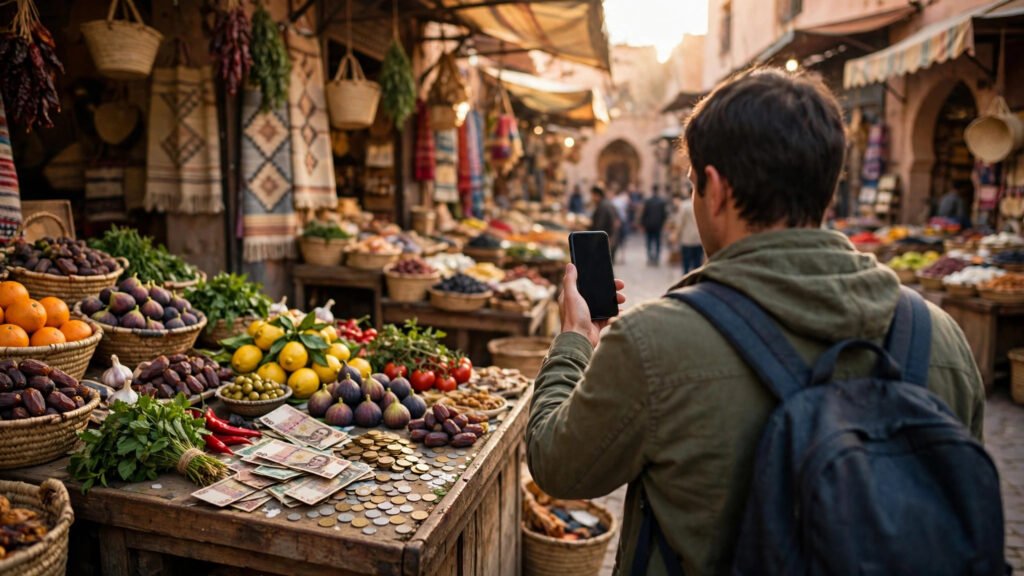
Walk through a Moroccan souk, a neighbourhood bakery or a weekly market, and one thing becomes clear very quickly: cash is still king for a huge share of everyday spending. Notes change hands for bread, vegetables, taxi rides and small repairs, often without a second thought. At the same time, mobile wallets are quietly growing — on phones in cities, for bills, for transfers between family members, and for some shop payments. So why has cash held on so firmly in Morocco, even as the phone in almost every pocket could, in theory, replace it?
The short answer is that payment habits are not only about technology. They are about trust, daily routine, the size of a purchase, and whether the person on the other side of the counter can and wants to accept a digital payment. Cash fits the way much of Moroccan daily life already works. Mobile wallets fit a growing part of it too. The two are living side by side, and that overlap explains the picture better than a simple story of old versus new.
Key Takeaways
- Cash suits small, everyday purchases in markets and small shops, where speed and simplicity matter most.
- Mobile wallets are growing mainly for bills, transfers and city shopping, where digital payment is easy to accept.
- The shift is gradual because habits, trust and trader acceptance change one shop and one customer at a time.
Why Cash Still Feels Easiest
For a small purchase, cash is hard to beat. There is no app to open, no signal to wait for, and no question about whether the payment went through. The buyer hands over notes or coins, the seller gives change, and the deal is done. In a busy souk, where a trader may serve many customers in quick succession, that simplicity matters. Haggling is also part of the culture in many markets, and a cash offer in hand can feel more concrete than a number on a screen.
Cash works everywhere, without conditions, and that reliability is a real advantage for traders who move between markets. It does not depend on battery life, mobile signal or a wallet balance. For traders who work outdoors, move between markets, or sell from small stalls, that reliability is a real advantage. A customer does not need an account, a card or a particular app — only the money itself. That universality is one of the strongest reasons cash has stayed so central to daily trade.
Trust plays a role as well. With cash, both sides can see the payment happen. There is no receipt to check later, no pending status and no worry about a failed transfer. For people who are cautious about digital systems, or who have had a confusing experience with an app, that visible exchange feels safer. Familiarity is powerful: many Moroccans have paid cash all their lives, and there is no pressing reason in a small daily purchase to change a method that already works.
What Mobile Wallets Offer
Mobile wallets, offered by banks and telecom operators, bring a different set of advantages. They let people pay bills, top up phone credit, send money to family in another city, and sometimes pay in larger shops and supermarkets without carrying large amounts of cash. For people who already bank by phone, a wallet can fold several small tasks into one place.
The appeal is strongest where digital acceptance already exists. In bigger stores, chain outlets and online shopping, card and wallet payments are normal, and customers expect them. Among younger, city-based users, paying by phone can feel natural, especially for services and subscriptions that are already digital. A wallet also leaves a record, which helps people track what they spent — something cash, once spent, does not do on its own.
Elsewhere in the region, the same pattern shows up in different forms: mobile money in Senegal grew around everyday transfers, Ghana’s mobile money spread through small traders and phone-based payments, and Cambodia’s single QR code made one scan work across many providers. Morocco’s story is similar in shape but different in pace, because cash still covers so much small-scale trade.
Cash works everywhere, without conditions, and that reliability is a real advantage for traders who move between markets.
Why the Change Is Gradual
A payment system only works when both sides use it. A customer with a wallet still needs a trader who accepts it, and a trader who accepts it still needs enough customers using it to make the effort worthwhile. That two-sided problem is why change tends to be slow. One shop may start accepting wallet payments, while the stall next door stays cash-only, and customers simply adapt to each shop as they go.
Cost and habit also slow things down. Small traders work on thin margins and quick turnover, so anything that adds a step, a fee or a delay needs a clear benefit before it is adopted. Customers, meanwhile, weigh convenience against familiarity. A wallet is convenient for a bill or a transfer, but for a loaf of bread or a bunch of mint, cash is already convenient enough. Until wallet payment becomes just as effortless at the smallest stalls, many people will keep both options and reach for cash first.
None of this means wallets are failing. It means they are filling the gaps where they clearly help — bills, transfers, online orders and larger shops — while cash keeps the ground it already holds in markets and small daily trade. Over time, as more traders accept digital payments and more customers grow comfortable with them, the balance may shift. But shifts like this usually happen shop by shop and habit by habit, not all at once.
- Cash wins on speed and simplicity for small, face-to-face purchases.
- Wallets win on record-keeping, transfers and bill payments.
- Trader acceptance is the key: a wallet only helps where it is accepted.
- Trust and familiarity keep cash strong, especially in markets and souks.
- Morocco’s future is likely a mix of both, not a sudden switch.
What to Watch Next
Watch the smallest traders. If wallet and QR payments become as quick and reliable as cash at market stalls and neighbourhood shops, everyday use will grow naturally. If they stay limited to bigger stores and bill payments, cash will keep its place in daily trade. Either way, the real story is not a battle between cash and phones — it is how Moroccans keep choosing the method that fits each purchase, one shop at a time.