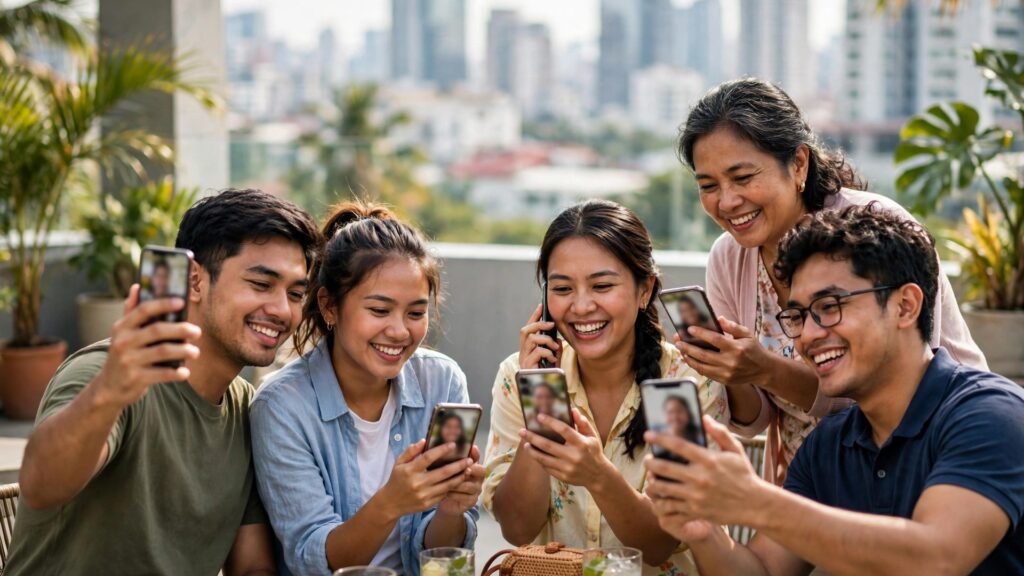
Ask anyone who has spent time in the Philippines and one thing quickly stands out: the phone is rarely far from hand, and social media is rarely far from the conversation. Friends share news in group chats, families hold video calls across oceans, and small sellers run entire shops from a single social page. It raises a natural question: why is the Philippines one of the world’s most social-media-active countries?
The answer is not a single app or a single trend. It is a mix of a young population, a mobile-first internet, affordable prepaid access, and a culture that places family and community at the centre of daily life. Together, these forces turned social media from a pastime into a practical tool for staying connected, earning a living, and taking part in public life.
Key Takeaways
- The Philippines went mobile-first: for many people, the smartphone is the main — and often only — way online.
- Prepaid data promos and affordable phones made daily social media use possible on tight budgets.
- A large overseas diaspora keeps families close through chats, video calls, and social feeds.
A Young, Mobile-First Population
The Philippines has a young population, and young people tend to adopt new platforms first. For many Filipinos, the first experience of the internet did not come through a desktop computer in a home office. It came through a phone — often a shared family phone at first, then a personal one bought on instalments or as a budget model.
That mobile-first path matters. When the phone is the internet, social media becomes the front door to everything else: news, entertainment, school groups, church communities, and neighbourhood updates all flow through the same few apps. Like in other countries where messaging apps have become everyday infrastructure, the app that everyone already uses becomes the place where life happens.
Prepaid Data Made Daily Use Affordable
Cost shaped the habit. Many Filipinos use prepaid mobile plans rather than long monthly contracts, and telecom promos have long bundled social apps with data packages. That meant a small top-up could keep someone connected to friends and family all day, even on a tight budget.
Affordable smartphones helped too. As budget phones improved, more people could watch videos, join live streams, and post photos without needing an expensive device. The pattern is familiar across Southeast Asia, where affordable phones opened the door to daily mobile life for millions of first-time users.
When the phone is the internet, social media becomes the front door to everything else.
Staying Close Across Great Distances
Few forces explain Filipino social media use better than distance. Millions of Filipinos work overseas, and many more have moved from provinces to cities for study or work. Social media fills the gap that distance creates: a parent working abroad can watch a child’s school performance on video, siblings can share a meal over a video call, and extended families can celebrate birthdays together in a group chat.
In a culture where family ties run deep and gatherings matter, these tools are not a replacement for closeness — they are how closeness is maintained when people cannot be in the same room. Birthdays, graduations, and even everyday jokes travel through feeds and chats, keeping far-flung families part of one conversation.
Social Media as Marketplace and Town Square
Social media in the Philippines is also a place of business. Small sellers advertise clothes, food, and home goods through social pages and live selling sessions, answering customers in comments and messages instead of running a separate website. For a home-based seller, a social page can be a shopfront, a customer-service desk, and an advertising channel all at once.
It is also a town square. Local news, community announcements, and public debate spread quickly through shares and group posts, sometimes faster than through traditional channels. That speed has a downside — rumours can travel just as fast as real news — but it also means ordinary people can raise issues, organise help after storms, and share verified information from local authorities within minutes.
- Mobile-first access: the smartphone is the main gateway to the internet for many Filipinos.
- Prepaid promos and budget phones made daily social use affordable.
- Overseas workers and city migrants use social apps to stay close to family.
- Small sellers run shops, live sales, and customer service through social pages.
- Community news and disaster updates spread fast through shares and groups.
Why the Habit Sticks
Habits stick when they solve real problems, and in the Philippines social media solves several at once: it keeps families together, it helps people earn, and it gives communities a shared space. Once friends, family, customers, and classmates are all in the same apps, leaving them would mean losing touch with daily life itself — much like the way one dominant app can become the default for almost everything in another connected country.
That does not mean the trend has no costs. Heavy social use raises familiar questions about screen time, attention, and the spread of misinformation — questions Filipino families, schools, and regulators wrestle with like everyone else. But understanding the habit starts with understanding what it is for: connection, livelihood, and community in a country where those three things have always mattered most.
What to Watch Next
Watch how short video, live selling, and creator-led shops keep growing on Filipino feeds, and how telecom promos and cheaper data shape who can join in. The deeper story to follow is the same one this article describes: a mobile-first, family-centred country using social media not just to pass time, but to stay close, earn a living, and take part in community life.