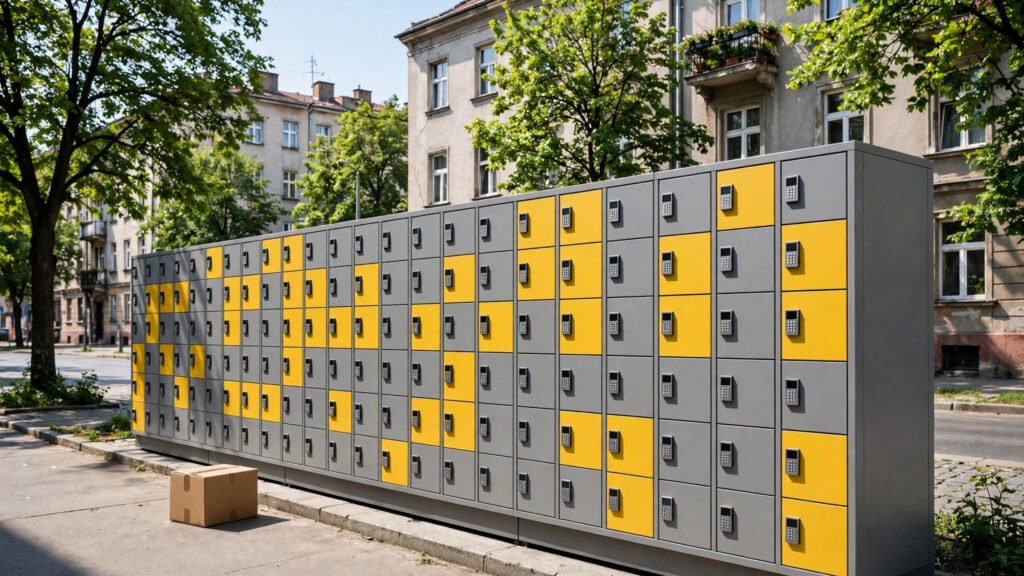
In Poland, the answer to “where is my parcel?” is often not “at my door” but “at the locker on the corner.” Parcel lockers have become a normal part of daily life in Polish cities and towns, used for clothes, books, electronics, household goods and much more. For many shoppers, choosing a locker at checkout is now the default, not the backup plan.
The idea is simple. Instead of a courier bringing a parcel to a home address at a time the recipient may not be there, the parcel waits in a secure locker until the recipient is ready. That small change in who controls the timing explains most of the appeal.
Key Takeaways
- Parcel lockers let shoppers collect parcels on their own schedule instead of waiting at home for a courier.
- Lockers fit busy routines, shared flats and workdays away from home, because the parcel waits until it is collected.
- The same locker network also makes returns easier, since a return parcel can be dropped off without booking a courier visit.
How a Locker Pickup Works
When ordering online, the shopper chooses locker delivery and picks a locker location, often one near home, work or a regular route. After the parcel arrives at that locker, the shopper receives a notification, usually through a delivery app or a message, with a code or a way to open the locker.
At the locker, the shopper enters the code or uses the app, the correct door opens, and the parcel is taken out. The whole visit can take less than a minute. There is no need to sign for the parcel in person, no need to answer the door, and no need to rearrange the day around a delivery window.
Lockers also come in different sizes, so a small book and a larger household item can both be stored. If a parcel is too large for a locker, home delivery or another collection point is usually offered instead, which is why lockers work best as one option among several, rather than the only option.
Why Waiting at Home Lost Its Appeal
Home delivery works well when someone is at home. It works badly when everyone in the household is at work, at school or out running errands. A missed courier visit can mean a second attempt, a trip to a depot, or a parcel left with a neighbour, all of which cost time and patience.
A locker removes that uncertainty. The parcel is not travelling around the city in a van while the recipient is out. It is sitting in one place, ready whenever the recipient passes by. That matters in a country where online shopping is frequent and where many people would rather collect a parcel on the way home than stay in for it.
There is also a privacy and convenience angle. Not everyone wants a courier to know their home address details or to ring the doorbell during a work call, a child’s nap or a quiet evening. A locker keeps the handover neutral and quick.
Why Lockers Fit Polish Daily Life
Poland’s locker habit grew alongside online shopping itself. As more people started ordering online, the pressure on home delivery grew too, and lockers offered a way to handle many parcels without sending a courier to every single door. Over time, lockers appeared near housing estates, supermarkets, stations and workplaces, so collecting a parcel could be folded into a trip that was happening anyway.
That placement is part of the habit. A locker on the walk home from the bus stop, next to a grocery shop or outside an apartment block does not feel like an extra errand. It feels like a stop that takes a moment. In winter, when daylight is short and evenings are cold, a quick outdoor pickup on the way home can still feel easier than waiting in for an unknown delivery time.
The app-based side of the habit matters as well. Shoppers can track a parcel, see when it has arrived, and open a locker from a phone, which fits a wider shift toward doing everyday tasks on a mobile. In neighbouring countries, similar everyday habits have grown around phones too, from Czech shoppers tapping cards for almost everything to Slovaks paying bills by scanning a QR code. In Poland, the locker is the physical version of that same idea: a small, app-connected step that removes a queue, a wait or a form.
The parcel is not travelling around the city in a van while the recipient is out. It is sitting in one place, ready whenever the recipient passes by.
What About Returns and Missed Pickups?
Lockers are not only for receiving parcels. Many shoppers also use them to send parcels back. A return label is prepared online, the parcel is placed in a locker, and the courier collects it from there. That avoids booking a home collection and avoids another wait at the door.
There is, of course, a deadline. A parcel left in a locker cannot stay there forever, because the locker space is needed for other parcels. Shoppers who do not collect in time usually have the parcel moved on, and they may need to arrange another delivery or collection. The habit therefore rewards people who pass a locker regularly and who check their delivery notifications.
For people who live far from any locker, or who order very large items, home delivery still makes more sense. Lockers have not replaced home delivery in Poland. They have simply given shoppers a choice, and for a large number of everyday orders, that choice is the locker.
- Choose a locker near home, work or a regular route when ordering online.
- Wait for the arrival notification and code before going to the locker.
- Collect promptly, because locker space is shared and parcels cannot wait indefinitely.
- Use the same locker network for returns where the shop offers that option.
- Pick home delivery instead for very large items or addresses far from any locker.
What to Watch Next
The locker habit in Poland shows no sign of fading, because it solves a simple problem: people want their parcels on their own schedule. As online shopping continues, the question for shoppers will stay the same, which collection point is closest to a route they already take, and whether the parcel fits a locker at all.
For anyone ordering in Poland, the practical lesson is equally simple. If the parcel is an everyday size and a locker sits on a regular route, locker pickup is often the fastest and least disruptive choice. If not, home delivery remains the right call. The best delivery option, in the end, is the one that fits the day, not the one that asks the day to stop for it.