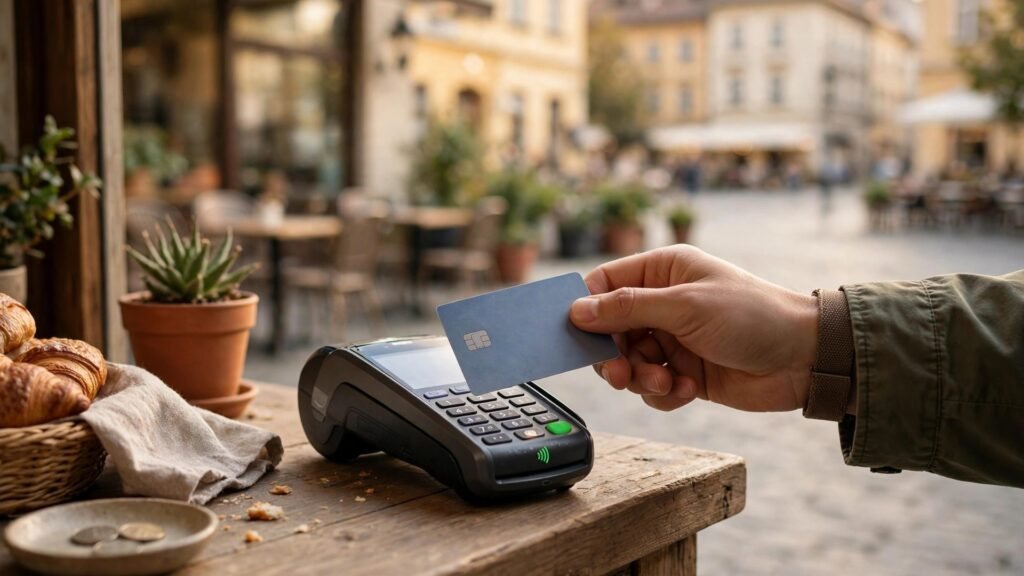
Walk into a bakery in Prague, a small shop in Brno or a pub in Olomouc, and the payment moment usually looks the same: the customer holds a card near the terminal, hears a beep, and walks away. No counting coins, no waiting for change, no signature. For many visitors, that speed is the first surprise about everyday life in the Czech Republic.
So why do Czechs tap their cards for almost everything? The short answer is habit built on convenience. Contactless payment fits the way people already live: quick purchases, busy mornings, and a long tradition of card use that grew steadily as terminals spread to smaller and smaller businesses.
Key Takeaways
- Czechs tap cards because it is fast, simple and works almost everywhere, from bakeries to public transport.
- Contactless habits grew as terminals reached small shops, cafes and market stalls, not just big supermarkets.
- Cash has not disappeared: it still matters for some small purchases, tips and places where cards are less practical.
A habit formed at the till
Contactless payment removes the slowest part of paying. There is no PIN to enter for many small purchases, no coins to count and no notes to fold back into a wallet. When a payment takes a second or two, it feels like less of an interruption, especially at a morning bakery counter or a crowded lunch spot.
That convenience matters most for the small, repeated purchases that fill an ordinary day. A coffee, a tram ticket, a loaf of bread or a newspaper are all the kind of low-value payments where fumbling for exact change feels out of proportion to the purchase itself. Tapping a card turns those moments into a single gesture.
Shopkeepers benefit too. A faster queue means more customers served in the same time, and less cash sitting in the till at the end of the day. For small businesses, that combination is a practical reason to accept cards even when the individual sale is modest.
Terminals everywhere, not just in supermarkets
A payment habit only sticks if it works wherever people actually shop. In the Czech Republic, card terminals are now a normal sight far beyond large supermarkets and chain stores. Cafes, bakeries, pharmacies, hairdressers and many market stalls accept cards, so customers do not have to guess in advance whether they need cash.
That wide coverage creates a loop. The more places accept cards, the less reason customers have to carry cash. The less cash customers carry, the more pressure there is on the next shop to accept cards as well. Over time, tapping becomes the default expectation rather than a special option.
Public transport has reinforced the same pattern. In many Czech cities, travellers can pay for a ride by tapping a card or a phone, which means the journey to work or school starts with the same gesture as buying breakfast. When one gesture covers so many parts of the day, it quickly feels natural.
When one gesture covers so many parts of the day, it quickly feels natural.
Cards, phones and watches: the same tap
For many Czechs, the card itself is only part of the story. The same contactless technology lives in phones and smartwatches, so people who leave the house without a wallet can still pay. That matters on a run, a bike ride or a quick trip to the corner shop, when carrying less is part of the point.
This is different from countries where paying by phone means opening a separate national payment app. In the Czech Republic, the tap itself is the habit, and the device behind it can be a card, a phone or a watch. The result is flexibility: people choose whichever device they already have in their hand.
Neighbouring countries show how many forms the same idea can take. In Poland, for example, many people pay through BLIK, the phone-based system that grew out of Polish banks, while in Slovenia shoppers reach for Flik, the bank-built instant payment system. The Czech version is simpler on the surface: the familiar card, tapped, again and again.
Why cash has not disappeared
Tapping for almost everything is not the same as tapping for everything. Cash still has a place in Czech life, and that is worth understanding too. Some people keep coins and notes for small tips, for farmers’ markets, or for the occasional shop or stall where a terminal is not available.
Others simply prefer cash for budgeting. When money leaves the wallet physically, spending feels more visible than a string of card beeps. That preference is personal rather than technical, and it explains why even enthusiastic card users sometimes keep a few notes at home.
The contrast with some neighbours is instructive. In Austria, for instance, cash still plays a larger everyday role in many small shops, showing that payment culture is shaped by habit and trust as much as by technology. The Czech Republic has simply moved further and faster toward the tap.
What visitors should know
- Carry a card, and a phone with card payments set up, for most everyday purchases in Czech cities.
- Keep a small amount of cash for tips, markets and rural spots where terminals may be absent.
- Expect the same tap to work for transport, food and shopping, with no special local app required.
- If a terminal asks for a PIN, it is a normal security step for larger purchases, not a problem with the card.
For visitors, the practical lesson is straightforward. A card is enough for most of a trip to the Czech Republic, but a little cash remains a sensible backup, especially outside the biggest cities. Locals make the same calculation every day, and it is why the balance between tap and cash feels settled rather than forced.
What to Watch Next
The Czech tap habit shows no sign of reversing: terminals keep reaching smaller businesses, phones and watches keep replacing wallets for quick trips, and cash keeps its smaller but lasting role for tips, markets and budgeting. The question for the years ahead is not whether Czechs will keep tapping, but how far the same gesture spreads into the last corners of everyday life where cash still lingers.