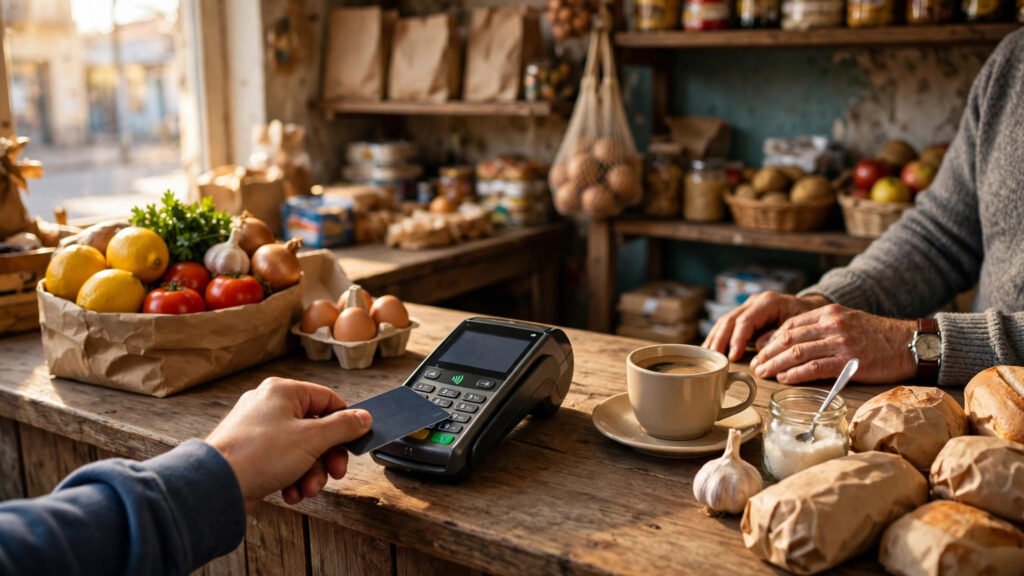
In Uruguay, paying by card can quietly cost less than paying cash. When a shopper taps a debit or credit card at the till, part of the sales tax on the purchase is cut, so the total comes down. It is not a points scheme, a bank promotion or a coupon. It is a deliberate piece of public policy, built into how everyday payments work in the country.
The idea is simple: if card payments are cheaper for the buyer, more people will use them, more payments will leave a record, and fewer transactions will happen entirely in cash. For a small country that wanted to bring more of its economy into the formal, traceable system, that small saving at the till was a practical nudge, repeated millions of times a day.
Key Takeaways
- Uruguay cuts part of the sales tax when shoppers pay by card instead of cash, so the till total is lower.
- The saving comes from the country’s financial inclusion law, which pushed wages, pensions and everyday payments into bank accounts and electronic payments.
- The habit stuck because the reward is instant and ordinary: pay by card, pay a little less, with no app or claim to file.
How the saving works at the till
Uruguay’s main sales tax is charged on most goods and services. When a customer pays electronically, a portion of that tax is not charged, so the amount on the receipt is lower than it would have been in cash. The shopper does not need to do anything special: the reduction happens as part of the payment itself, and the benefit is visible straight away rather than arriving weeks later as a refund.
Debit payments have generally attracted the larger saving, with a smaller saving on credit payments. That difference is no accident. A debit payment comes straight from money the buyer already has, while a credit payment is borrowed money that is paid back later. By rewarding debit more, the system steers people toward spending what they have, while still giving credit users a reason to leave cash behind.
Not every kind of payment qualifies, and shoppers still check the receipt when it matters. But for the ordinary weekly shop, a café bill or a pharmacy purchase, the rule is easy to remember: card in hand usually means a slightly smaller bill.
Why Uruguay built it this way
The card saving did not arrive on its own. It came with Uruguay’s financial inclusion law, passed in 2014, which changed how money moves through the whole country. Wages and pensions began to be paid into bank accounts rather than handed over in cash. Businesses were required to accept electronic payments. Workers, pensioners and small traders who had managed everything in notes and coins suddenly had a bank account, a card and a reason to use both.
For the government, the prize was a clearer view of the economy. Cash leaves no trail, which makes tax collection harder and informal work easier to hide. Electronic payments leave a record, so more of the economy is visible, tax is easier to collect fairly, and workers paid through an account build a financial history they can later use for a loan or a rental agreement.
For ordinary people, the prize was more practical. Money in an account is harder to lose or steal than cash in a pocket. A card works in a shop across town just as it works near home. And a monthly statement shows where the money went, which makes a household budget easier to keep than a pocketful of receipts.
The habit stuck because the reward is instant and ordinary: pay by card, pay a little less, with no app or claim to file.
What it changed in everyday life
The most visible change is at the counter. Card terminals that were once rare in small shops are now a normal part of the shopfront, and customers expect to be able to tap to pay even for modest purchases. Shopkeepers, who once worried about the cost of taking cards, gained customers who spend more easily when they are not limited to the cash in their pocket.
The change also reached people who had little contact with banks before. A pensioner receiving a pension into an account, or a worker paid electronically for the first time, got a card as a matter of course. Once the card was in the wallet and the saving was visible at the till, using it became a habit rather than a chore.
Cash has not disappeared, and nobody in Uruguay would claim it has. Small purchases, market stalls and tips still often involve notes and coins, just as they do in much of the world. The point of the policy was never to ban cash. It was to make the electronic option the easier, cheaper default, and then let habit do the rest.
That is also why the idea travels well as a comparison. In Argentina, shoppers turned to the Mercado Pago wallet for a different mix of reasons, while in Panama, the Yappy system grew because it let people pay from a phone number rather than a card. Uruguay’s version is quieter: no new app to learn, just a smaller number on the receipt.
What visitors should know
A visitor paying by card in Uruguay will usually benefit in the same way at the till, since the saving follows the payment method rather than the person. The practical tips are the same as anywhere: carry a card that works abroad, tell your bank you are travelling if it asks, and keep some cash for the market stall or taxi that still prefers it.
It is also worth remembering that the saving is a tax reduction, not a discount offered by the shop. If a shop’s till total looks slightly lower than the shelf prices suggested, that is the system working as designed, not a mistake to query. And where a shop does not accept cards at all, the cash price is simply the full price, with no saving to claim.
- The saving is automatic: no app, no coupon and no claim form is needed.
- Debit payments generally attract the larger saving, credit payments a smaller one.
- Cash is still accepted and still common for small purchases, so visitors should carry some.
- The policy sits inside a wider financial inclusion law that moved wages and pensions into bank accounts.
What to Watch Next
Uruguay’s card saving shows how a small, instant reward can change a national habit without banning anything or forcing anyone onto a new app. The saving at the till, the move of wages and pensions into accounts, and the spread of card terminals in small shops all point the same way: electronic payment became the easier default, and cash stayed for the occasions where it still suits people best. Other countries watching Uruguay will be asking whether their own shoppers would change habits for a smaller bill at the till, or whether, as in Hungary, where cash still rules small purchases, habit and trust keep notes and coins in the pocket whatever the incentive.