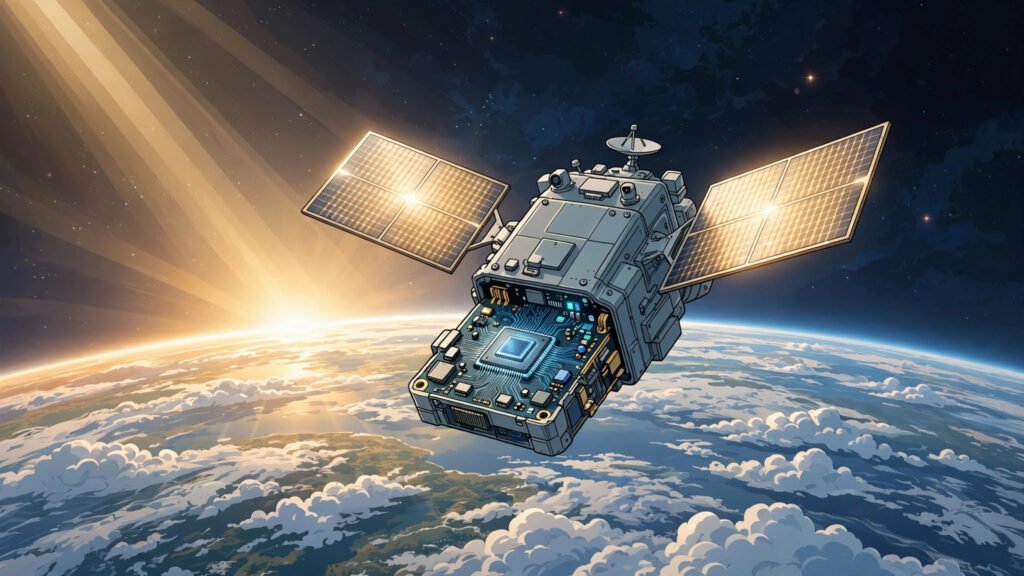
Google has run an artificial intelligence model on a satellite in orbit and received its first complete response back on Earth, marking a milestone for its Project Suncatcher initiative. The project is a long-term research effort to examine whether space could support scalable machine learning infrastructure, and this first result shows that the basic idea works end to end: a command goes up, a chip in orbit runs a prompt, and an answer comes back down.
Google chief executive Sundar Pichai announced the development in a post on X, describing it as a “hello world” milestone for Project Suncatcher. He said the team had sent a command to the satellite, booted up its Tensor Processing Unit (TPU), run a prompt and received the response back on Earth.
“After launching our prototype satellite a few weeks ago, we’ve now successfully sent a command up to orbit, booted up the TPU, ran the prompt, and received our first complete response back on earth — a haiku!” Pichai said.
Key Takeaways
- Google’s Project Suncatcher satellite has run an AI model in orbit and returned its first complete response to Earth.
- The test used the onboard Gemma 4 open model, which generated a haiku about space during a ground-station pass over Svalbard, Norway.
- The next phase will test how the TPUs perform under thermal stress and radiation, ahead of a planned two-satellite milestone in 2027.
The “Hello World” Moment in Orbit
According to a blog post by Google, the prototype satellite was launched on October 1 as part of the company’s research into whether space could support larger AI workloads. Over the following weeks, the satellite completed its initial commissioning checks, including powering up its host and TPU trays and running early machine learning tests.
During a ground-station pass, the team sent a prompt to the onboard Gemma 4 open model, asking it to generate a haiku about space. The response was received as the satellite passed over Svalbard, Norway.
The response was received as the satellite passed over Svalbard, Norway.
Google said it subsequently tested the system with space-themed limericks and prompts asking it to report the technical status of the satellite’s systems. Those follow-up tests matter because they move beyond a single poetic answer: they show the onboard system can also report on its own state, which is exactly the kind of practical check a future orbital computing system would need to do routinely.
Why Space, and Why Now?
Project Suncatcher is exploring whether satellites could eventually be linked into constellations to handle larger AI workloads. Google has said satellites in low Earth orbit could access near-constant sunlight and potentially generate up to eight times more solar power than on Earth. That energy argument is central to the project: AI computing is power-hungry, and a sunlit orbit offers a very different power picture from a data centre tied to a terrestrial grid.
The timing also fits a wider moment for AI infrastructure. AI companies are reshaping how their systems are built and governed, while AI spending remains under close market scrutiny. Against that background, a working orbital test is less about replacing data centres tomorrow and more about proving that another kind of computing location is even possible.
- Prototype satellite launched on October 1 for machine learning tests in orbit.
- Onboard TPU powered up and ran a Gemma 4 prompt, returning a haiku about space.
- Follow-up tests included limericks and system-status prompts.
- Next tests will focus on thermal stress and radiation exposure for the chips.
What Comes Next: Heat, Radiation and a Second Satellite
The next phase will involve testing how the TPUs perform under thermal stress and radiation exposure in orbit. These tests are intended to establish whether the chips can reliably run computing workloads in the space environment, where temperature swings and radiation are far harsher than inside a controlled data centre.
Google said successful testing would pave the way for its next milestone: two interconnected satellites in 2027. That step would test whether satellites can work together, not just alone — a necessary move if orbital computing is ever to scale from a single prototype to a constellation. The latest milestone follows Google’s announcement of the project, when it said the initial satellite mission would test whether its TPUs could survive and operate in space.
For now, the honest reading is narrow but real. One satellite, one prompt, one answer from orbit does not prove that space data centres are coming. It does prove the chain works: command up, model run, response down. In a field where the AI chip race dominates headlines, that working chain is the news — and it gives Google a concrete result to build its next tests around.
What to Watch Next
Watch for the results of the thermal stress and radiation tests on the TPUs, which will show whether the chips can reliably run computing workloads in orbit. Watch too for progress toward the planned two interconnected satellites in 2027, and for any further detail on whether satellites could eventually be linked into constellations to handle larger AI workloads. Until those tests land, Project Suncatcher remains a research milestone: a first complete AI response from space, and a question — how far can computing go above the clouds — that now has a real answer to start from.