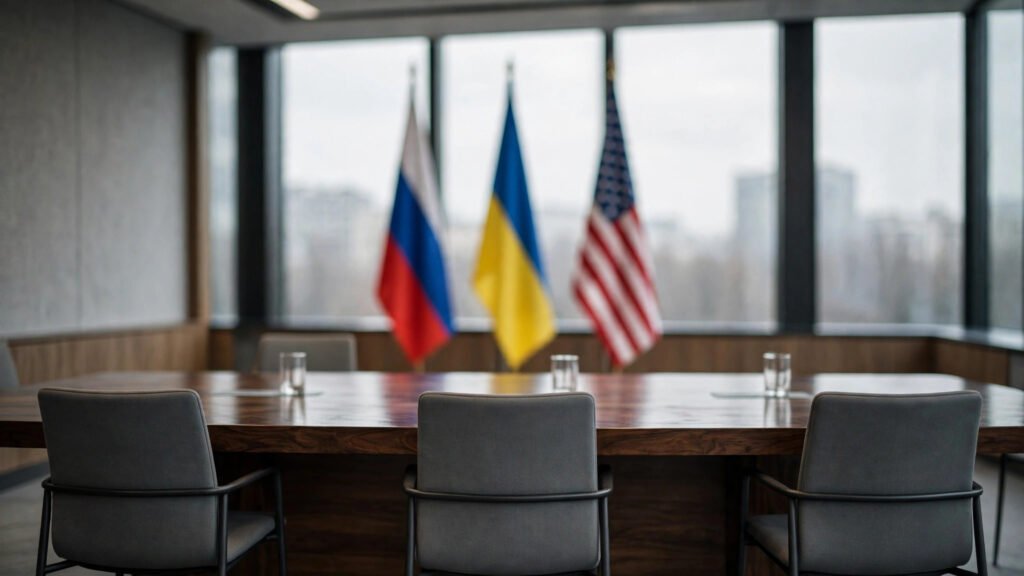
The next round of three-way talks aimed at ending the war in Ukraine may not happen as soon as hoped. Kremlin foreign policy aide Yuri Ushakov said on Wednesday that the timing depends not only on the battlefield, but also on the crisis in the Middle East — a linkage that casts doubt on plans for a meeting next month.
Ushakov, quoted by Russian news agencies, said Moscow has not yet proposed a specific date for the talks. That stands in contrast to Kyiv: Ukrainian President Volodymyr Zelensky said on Wednesday he hoped a meeting would take place in Abu Dhabi between November 6 and November 10.
The comments matter because the United States has been leading the push for a negotiated settlement to a conflict now in its fifth year, with Russia and Ukraine talking through American mediation. Any slip in the timetable would leave the diplomatic track waiting while fighting — and diplomacy elsewhere — compete for Washington’s attention.
Key Takeaways
- Moscow has proposed no date yet for the next three-way talks, while Kyiv hopes for an Abu Dhabi meeting between November 6 and 10.
- Ushakov links the timing to the Middle East crisis and the battlefield, saying the situation does not allow talks “in the near future”.
- Europe’s place at the table is still undecided, despite Britain, Germany and France saying Europe should play a role.
What Ushakov Actually Said
Asked about the timetable, Ushakov pointed to two factors at once. “It will also depend on the situation on the battlefield and the situation in general. You can see the situation now in the Middle East. It just doesn’t allow us to hold it in the near future. That’s my assumption,” he told journalists, referring to the regional fallout from the US-Israeli war on Iran.
Note the careful wording. “That’s my assumption” is an assessment, not a formal announcement that talks are off. The existing agreement, as Ushakov described it, is to resume three-sided consultations involving Russia, Ukraine and the United States. What is missing is a date.
The Middle East reference is not abstract. The war between the US, Israel and Iran that began in late February continues to dominate diplomacy, and Washington has been warning regional allies to prepare for the possibility of renewed military action — and Iranian retaliation — after the November 3 US midterm elections. At the same time, mediation efforts around that war continue: Qatar has presented a new draft peace deal aimed at ending the US-Israel war on Iran.
The Abu Dhabi Window
Zelensky’s November 6-10 window for Abu Dhabi reflects Kyiv’s urgency to keep the diplomatic track moving. For now, though, the two positions do not line up: one side hoping for early November, the other saying the moment is not near. Until Moscow names a date, the Abu Dhabi window remains a hope rather than a plan.
The gap also shows how much of the process now runs through Washington. The US has led efforts to move the talks forward, while European countries — Ukraine’s closest allies and biggest military backers — have largely been on the sidelines.
It will also depend on the situation on the battlefield and the situation in general. You can see the situation now in the Middle East.
Europe’s Seat at the Table
The leaders of Britain, Germany and France said last weekend that Europe would play a role in US-mediated talks between Russian President Vladimir Putin and Zelensky on securing a ceasefire. Ushakov’s answer was blunt: “There is absolutely no talk about this, nothing being considered,” he was quoted as saying.
That is a notable shift in tone from the weekend, when Ushakov himself said Europe should be included in discussions because its position could be crucial. The two statements are not necessarily contradictory — saying Europe’s position matters is not the same as agreeing to a seat — but they leave European capitals unsure where they stand.
For Ukraine, European backing is not a side issue. Europe’s governments are Kyiv’s closest allies and biggest military backers, and any settlement they do not support would be harder to sustain.
- No date proposed: Moscow has not named a day for the next round of three-way talks.
- Kyiv’s hope: Zelensky wants an Abu Dhabi meeting between November 6 and 10.
- Two linked crises: Ushakov ties the timetable to the battlefield and the Middle East situation.
- Europe waiting: no discussion yet of European negotiators joining the next round.
- US-led process: Washington is driving the talks, with the current agreement limited to resuming three-sided consultations.
Why the Middle East Matters to Ukraine Talks
The linkage Ushakov draws is a reminder that diplomacy does not happen in separate boxes. A crisis that threatens a wider regional war demands the same American attention, envoys and political capital that a Ukraine settlement would need — and a flare-up after the US midterms would pull that attention further away.
The war’s human and infrastructure cost continues to draw international scrutiny, including a UN inquiry into attacks on Ukraine’s energy infrastructure. A limited ceasefire around Oleshky in the Kherson region, announced by US First Lady Melania Trump, took effect on October 27 — a reminder that partial steps can move even when a full settlement cannot.
None of that settles the question Ushakov raised. It only explains why the calendar for Ukraine now depends, in Moscow’s telling, on events far from the Ukrainian front.
What to Watch Next
Whether Moscow proposes a date for the three-way talks, and whether it falls inside Zelensky’s November 6-10 Abu Dhabi window. Whether the Middle East situation eases enough, in Ushakov’s assessment, for talks to be held “in the near future”. Whether European negotiators are brought into the next round, or whether the format stays limited to Russia, Ukraine and the United States. And whether warnings of renewed action in the Middle East after the US midterms materialise, and how they affect the diplomatic calendar.