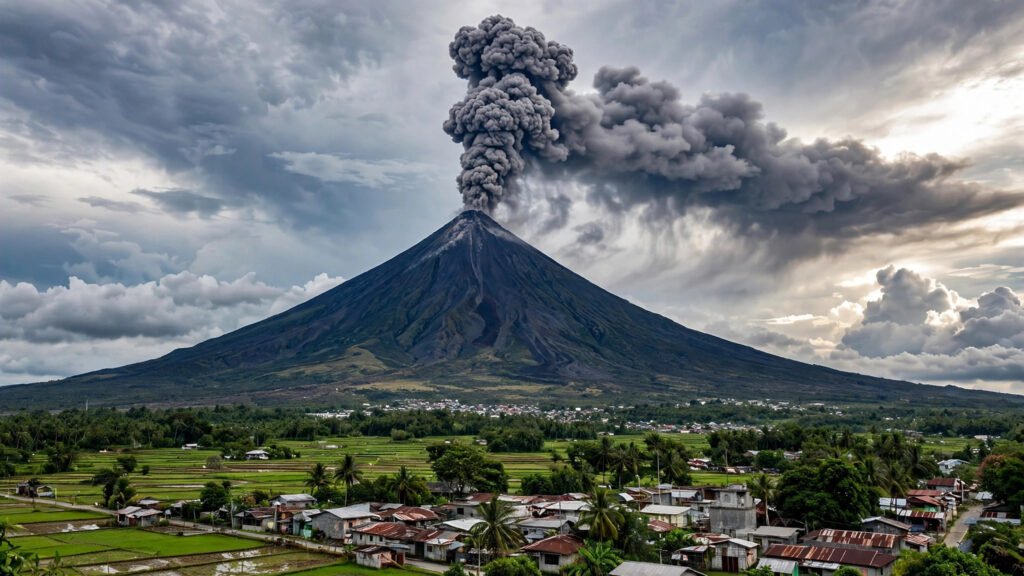
Mayon Volcano in the Philippines produced a moderately explosive eruption on Friday, October 30, sending a grey ash plume about 3,000 metres above its crater and prompting the country’s volcanology agency to raise the alert level to 3. The eruption, in Albay province, put nearby communities on watch for ashfall and for the possibility of further hazardous activity in the days and weeks ahead.
According to the Philippine Institute of Volcanology and Seismology (Phivolcs), the eruption began at 11:53 a.m. local time and lasted about six minutes, ending at 11:59 a.m. The plume drifted west-southwest, and Phivolcs said ashfall was expected in the communities of Daraga, Camalig, Guinobatan and nearby municipalities in Albay.
Key Takeaways
- Mayon Volcano erupted on October 30, sending an ash plume about 3,000 metres above its crater.
- Phivolcs raised the alert level from 2 to 3, signalling an increased tendency towards a hazardous eruption.
- Entry into the six-kilometre Permanent Danger Zone is banned, and residents are advised to wear face masks against ashfall.
What Happened on Friday Morning
Phivolcs said the eruption generated a rapidly rising, billowing ash plume that reached about 3,000 metres from the summit crater. In its eruption notification, the agency described the event as moderately explosive, and in a separate announcement it raised Mayon to Alert Level 3, up from Level 2, where it had sat since early August.
The provincial government of Albay reminded residents to wear face masks in anticipation of possible ashfall, and Albay Governor Noel Rosal suspended classes at all levels in private and public schools so students and teachers could return home while the situation developed. Phivolcs also warned aircraft not to fly close to the summit.
The eruption generated a rapidly rising, billowing ash plume that reached about 3,000 metres from the summit crater, and the alert was raised because the volcano is now in a new phase of magmatic eruption.
What Alert Level 3 Means
Alert Level 3 means there is an increased tendency towards a hazardous eruption, Phivolcs said. The volcano is in a new phase of magmatic eruption from a summit lava dome, with increased chances of lava flows and hazardous pyroclastic density currents affecting the upper to middle slopes in the immediate days to weeks.
Under Alert Level 3, entry into the six-kilometre Permanent Danger Zone is banned because of the danger from pyroclastic density currents, lava flows and rockfalls. The agency said residents should stay updated through official Phivolcs advisories and monitor news from the Department of Science and Technology’s volcanology service.
- Eruption: 11:53 a.m. to 11:59 a.m. on October 30, about six minutes
- Ash plume: about 3,000 metres above the crater, drifting west-southwest
- Alert level: raised from 2 to 3 on a five-level scale
- Danger zone: no entry within six kilometres of the summit
- Ashfall watch: Daraga, Camalig, Guinobatan and nearby Albay municipalities
A Volcano Under Close Watch
Even before Friday’s eruption, Mayon was showing signs of unrest. A Phivolcs observation summary for the 24 hours to midnight on October 30 recorded 101 volcanic earthquakes and a sulfur dioxide flux of 1,413 tonnes per day, with a plume measured at 100 metres above the crater in that earlier window. The agency noted that its written bulletin can lag the faster eruption notifications and social media announcements that residents see first.
Mayon is the Philippines’ most active volcano, with more than 50 eruptions in the last four centuries, and it is famous for its near-perfect conical shape, which also makes it a popular tourist destination. Its most destructive eruption, in February 1814, buried an entire town and killed 1,200 people, a history that helps explain why authorities act quickly when unrest rises. The Philippines sits in a seismically active region, and just this week a magnitude 5.7 earthquake struck offshore Mindanao, a reminder of the natural hazards that regularly affect the archipelago.
Friday’s eruption also comes as other natural-disaster responses are under way in the region, including evacuations along Bhutan’s Sankosh River after a glacial lake outburst. For communities living near active volcanoes, the pattern is familiar: close monitoring, clear danger zones and early warnings are what keep a dramatic eruption from becoming a deadly one, much as monitoring guides the response to earthquakes in Afghanistan’s Hindu Kush region.
What to Watch Next
What happens next depends on whether Mayon’s unrest keeps rising. Phivolcs has said that if the trend of increasing unrest continues, a hazardous eruption is possible within weeks, and that lava flows and pyroclastic density currents could affect the upper to middle slopes in the days to weeks ahead. Residents in Albay should watch for further Phivolcs advisories, possible ashfall in Daraga, Camalig and Guinobatan, and any widening of the danger zone, while schools and local authorities continue to respond to the Alert Level 3 conditions already in place.