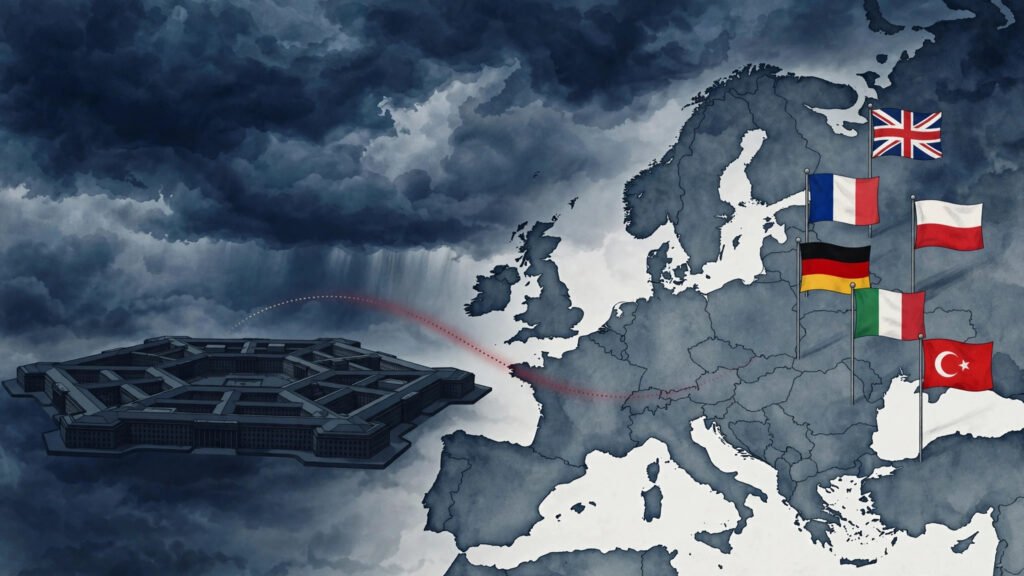
Pentagon officials have in recent weeks asked several NATO countries to tone down their rhetoric about the threat posed by Russia, arguing that some statements by European leaders and officials have undermined continental security, according to four people familiar with the matter cited by Reuters on October 30, 2026. The messages were delivered privately, in bilateral meetings, and were not presented as confrontational, the sources said.
Key Takeaways
- Pentagon officials have privately asked several NATO countries, including Lithuania, Latvia and Estonia, to tone down public rhetoric about the threat from Russia, Reuters reported on October 30, 2026.
- The requests come as the Trump administration restarts an effort to press for a negotiated end to the war in Ukraine, now well into its fifth year.
- The Pentagon declined to comment on the reported conversations, while the defence ministries of Lithuania, Latvia and Estonia and NATO also did not respond to requests for comment.
Among the nations that received messages urging them to keep public statements in check are Lithuania, Latvia and Estonia, the people said, speaking on condition of anonymity. It was not clear whether the messages were also conveyed to other European governments. The reporting does not describe a public warning or an official policy announcement, but rather a series of private conversations between allies.
What the Pentagon Reportedly Asked For
According to the reporting, the US requests focused on language that American officials considered unhelpful. Among the comments that drew US officials’ attention were suggestions by European leaders that Russia is cornered and resorting to increasingly desperate measures as its invasion of Ukraine slows to a crawl, one of the people said.
Pentagon policy chief Elbridge Colby, a key figure in an ongoing review of US troop levels in Europe, was one of the US officials delivering the message, the people said. Reuters could not determine what other officials were involved. One person familiar with the matter said Colby told a Baltic official recently that there should be no “poking” directed at the Russians, pointing to Europeans publicly suggesting that Russia was “cornered like a rat” as an example of unhelpful rhetoric.
It was not clear what specific statement Colby was referring to. However, Estonian Prime Minister Kristen Michal referred to Putin as a “rat in a corner” in late September, suggesting the Russian leader was resorting to sabotage efforts in Europe as Russia had become increasingly bogged down in Ukraine, according to the report. In a separate recent meeting, the Pentagon urged an Estonian delegation to be “measured” in its communications, according to a person briefed on the encounter, though that person did not say Pentagon officials complained about any specific statement.
The messages were delivered privately, in bilateral meetings, and were not presented as confrontational, the sources said.
Why Washington Is Making the Case Now
The US requests come as the Trump administration restarts an effort to press for a negotiated end to the full-scale war in Ukraine. According to the report, the latest push has blended incentives for Russia, including sanctions relief, with pressure on Ukraine to halt its attacks on Russian energy infrastructure. That context helps explain why Washington would want public language from allies to stay measured while diplomacy is under way.
The same administration pressure on Ukraine is visible elsewhere in recent reporting: Ukraine has paused strikes on Russian refineries amid pressure from Trump, a development that sits alongside the Pentagon’s private messaging to European capitals. The two strands point in the same direction, with Washington seeking restraint in both words and military action while it pursues a negotiated outcome.
Asked for comment, a Pentagon official said that private conversations among allies are just that, and declined to comment on the allegations. That response neither confirms nor denies the substance of the reporting, and it is consistent with how allied governments usually handle accounts of closed-door discussions.
A Debate Inside NATO About How to Talk About Russia
The US messages reflect a debate within NATO regarding how to publicly address the threat of an increasingly assertive Russia. Some Western officials have argued that emphasizing the threat posed by Moscow could play into the hands of the Kremlin, which they say seeks to sow fear and undermine support for Ukraine. Others argue European governments must be transparent to show their electorates that sacrifice and resources are needed to keep Moscow at bay, especially as Russia appears to accelerate a covert campaign of sabotage throughout the continent. Russia has denied that it is pursuing such a campaign.
One of the European officials said the Pentagon’s advice, while cordial, was baffling, given that intelligence services in the Baltic states have in recent months consistently played down the probability of Russia testing NATO’s mutual defence provisions. Other NATO intelligence services, by contrast, have publicly warned that Russia could dramatically ramp up its sabotage campaign in the near future. That gap between assessments is part of why the same set of facts can produce very different public language in different capitals.
- The messages were delivered in bilateral meetings to Lithuania, Latvia and Estonia, among others, according to the sources.
- Pentagon policy chief Elbridge Colby was one of the US officials delivering the message.
- The Pentagon declined to comment, and the three Baltic defence ministries and NATO did not respond to requests for comment.
- The reporting links the messaging to a renewed US push for a negotiated end to the war in Ukraine.
- European officials quoted in the report described the tone as cordial, not confrontational.
A Fraught Moment for European Security
The Pentagon messages to NATO officials come at a fraught time for European security. Moscow has recently intensified its campaign of deniable attacks on NATO countries, Western intelligence officials have said. On Wednesday, German prosecutors said two Belarusians were arrested for allegedly planning to set fire to a building or critical infrastructure facility in the Nuremberg area. In September, the German government blamed Russia for an attempted drone attack at Leipzig/Halle Airport, allegations Moscow has denied.
At the same time, US officials have been discussing potential business deals with Russia as part of the Trump administration’s push for peace in Ukraine. Those efforts have drawn mixed reactions from European officials, many of whom are pushing for the Kremlin’s continued economic isolation. Pentagon planners, meanwhile, are reviewing Washington’s force posture in Europe, a process that could see a sharp drawdown in America’s troop presence on the continent.
US officials have said European NATO members need to assume more responsibility for their own defence, particularly as the US focuses on threats in the Middle East, Latin America and East Asia. That broader shift is also visible in Washington’s current attention to the Middle East, where the United States has warned Gulf allies to prepare for possible action against Iran, and inside the Pentagon itself, where a top military planner linked to Iran strike planning was recently fired.
What to Watch Next
What to watch next is whether European leaders change their public language in the coming weeks, whether the Baltic governments or NATO offer any public response to the reporting, and whether the renewed US push for a negotiated end to the war in Ukraine produces visible diplomatic movement. Any change in US troop posture in Europe, any further reporting on the Pentagon’s review, and any fresh sabotage allegations will also show whether this private messaging was a one-off exchange or part of a longer shift in how Washington wants its allies to speak about Russia.