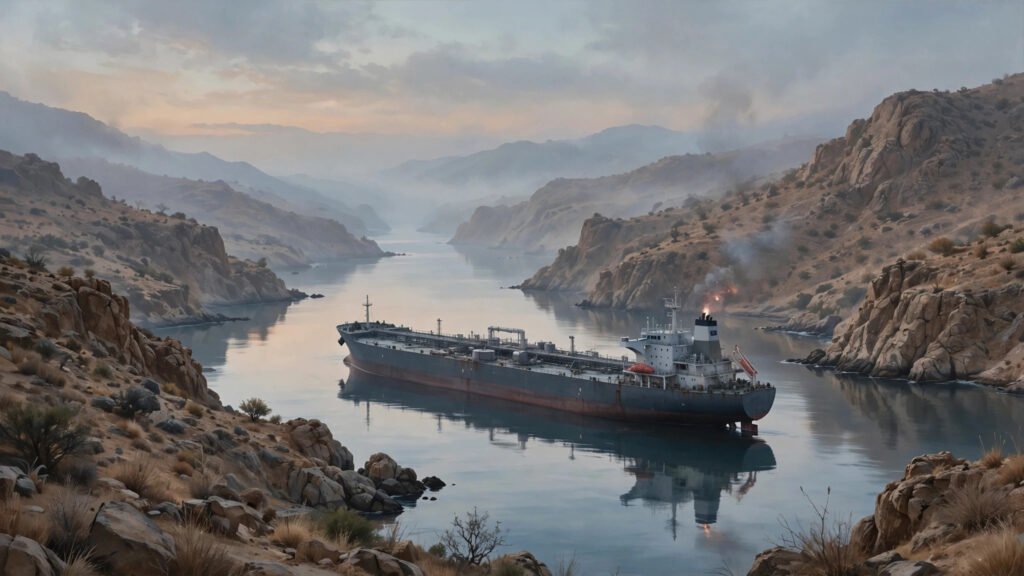
A tanker transiting the Strait of Hormuz was attacked with two explosive devices attached to its hull by a small boat, triggering a fire in the engine room and temporarily disabling the vessel, the United Kingdom Maritime Trade Operations (UKMTO) said on Friday, October 30, 2026. In an update issued on Friday, UKMTO said it had received a verified report confirming that all crew members were safe and there was no environmental impact.
The incident happened on Thursday at around 2212 UTC, approximately 25 nautical miles northeast of Khasab, Oman, while the tanker was travelling outbound through the strategic waterway. UKMTO said the fire had been extinguished and the vessel was continuing to its next port of call.
Key Takeaways
- UKMTO said a tanker in the Strait of Hormuz was attacked with two explosive devices attached to its hull by a small boat.
- The blasts caused a fire in the engine room that temporarily disabled the vessel, about 25 nautical miles northeast of Khasab, Oman.
- All crew members are safe, there was no environmental impact, the fire is extinguished, and the vessel is continuing to its next port of call.
What UKMTO Reported
UKMTO first received a report that an outbound tanker was on fire, with the cause of the incident, the status of the crew, damage assessment and environmental impact unknown at the time. Its later, verified update filled in the sequence of events. According to UKMTO, the tanker was approached on the port side by a small boat which attached two explosive devices to the hull above the waterline. The subsequent blasts caused a fire in the engine room, temporarily disabling the vessel.
The fire is now reported as extinguished and the vessel is continuing to its next port of call. That update is the most important part of the report for the crew and for shipping in the strait: an attack that disabled a tanker did not, on the verified account so far, injure its crew or spill oil into the waterway.
The fire is now reported as extinguished and the vessel is continuing to its next port of call.
What Happened Near Khasab
The location matters. Khasab sits on Oman’s Musandam Peninsula, at the southern edge of the Strait of Hormuz, the narrow passage between the Persian Gulf and the Gulf of Oman through which a large share of the world’s seaborne oil moves. An attack about 25 nautical miles northeast of Khasab therefore happened in one of the most closely watched stretches of water in global energy shipping, where any incident is read immediately for what it might mean for traffic through the strait.
UKMTO did not name the vessel, its flag, its cargo or its destination in the reports summarised on Friday, and it did not say who was behind the attack. Reporting on the incident noted that it was not immediately clear who carried it out. That gap is worth stating plainly: the verified facts so far cover what happened to the tanker, where it happened and the condition of the crew and the vessel, not responsibility for the attack.
Two Different Accounts in the Same Waterway
The UKMTO report arrived alongside a separate and different claim from Iran. Iran’s armed forces said four tankers caught fire after hitting mines while attempting to navigate the Strait of Hormuz, a day after the United States military said it had cleared key routes through the waterway. That claim has not been independently confirmed, and it describes a different mechanism, mines rather than devices attached by a small boat, from the one UKMTO described for the tanker near Khasab.
Readers should keep the two accounts apart. The UKMTO account is a maritime safety report about one outbound tanker, with a verified update on its crew and condition. The Iranian claim is a military claim about four tankers and mines, reported without independent confirmation. Treating them as the same incident, or as confirmation of each other, would go beyond what either account actually says.
The wider backdrop is a period of high tension around the strait. The United States military has denied Iran’s claim that it had captured an American drone near the Strait of Hormuz, calling the report false. US Central Command chief Adm. Brad Cooper has briefed President Donald Trump on military options for Iran, according to reports, as Washington weighs a possible resumption of major combat operations. And eleven European countries have moved to release strategic oil reserves to ease diesel supply concerns before winter, a step that underlines how quickly shipping incidents in the Gulf feed into energy worries in Europe.
- Incident time and place: Thursday, around 2212 UTC, about 25 nautical miles northeast of Khasab, Oman.
- Method reported by UKMTO: a small boat attached two explosive devices to the tanker’s hull above the waterline.
- Damage: blasts caused an engine-room fire that temporarily disabled the vessel.
- Crew and environment: all crew safe, no environmental impact reported.
- Current status: fire extinguished, vessel continuing to its next port of call.
- Responsibility: not established in the UKMTO reports summarised on Friday.
Why the Strait Matters
The Strait of Hormuz is narrow, congested and strategically exposed, which is why incidents there carry weight far beyond a single vessel. Tankers pass through it in both directions every day, and any suggestion that the passage is unsafe can push up shipping costs, insurance rates and oil prices, even before any physical disruption to supply occurs. That is also why maritime agencies such as UKMTO exist: their advisories give shipping companies, crews and insurers a shared, verified picture of what has happened, separate from the competing claims of governments in a crisis.
For now, that verified picture is reassuring in one respect and unresolved in another. The crew is safe, the fire is out and the tanker is moving again, which means this incident did not become a casualty or pollution event. But the method reported, explosives attached to a hull by a small boat in a busy strait, is exactly the kind of attack that is hard for a large tanker to defend against, and the question of who carried it out remains open.
What to Watch Next
What to watch next is what this article has already set out: whether UKMTO or other maritime authorities release further details about the tanker, whether responsibility for the attack is established, whether Iran’s separate claim about tankers hitting mines is independently confirmed or clarified, and whether shipping through the Strait of Hormuz continues normally or faces further incidents in the coming days. Until then, the verified picture stands as UKMTO reported it: a tanker attacked with explosives near Khasab, its crew safe, its fire extinguished, and its journey resumed.