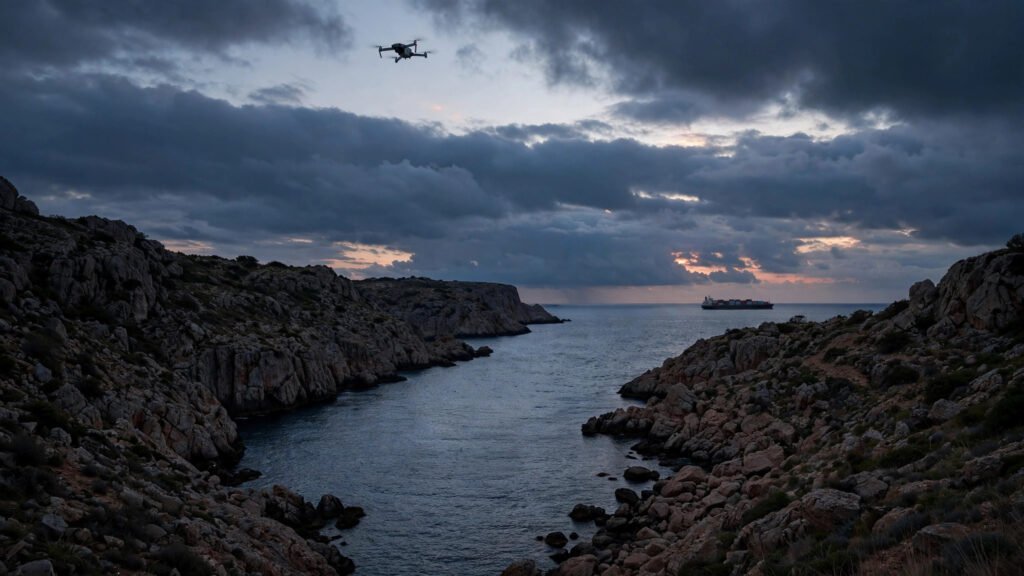
The United States military has denied an Iranian claim that it captured an American drone near the Strait of Hormuz, setting off a familiar contest of competing accounts over one of the world’s most sensitive waterways. Iran’s state television reported on Thursday, October 29, that the Islamic Revolutionary Guard Corps (IRGC) had seized control of an MQM-170 Outlaw drone in what it described as an electronic warfare operation, and had landed the aircraft intact in Iranian territory. United States Central Command (CENTCOM) said the report was false.
The claim, as reported, was specific about the method but thin on the details that would allow it to be checked independently. Iranian state television said the IRGC’s electronic warfare unit detected and identified the drone west of the Strait of Hormuz, took over its control systems, and brought it down inside Iran. The broadcast did not say when the alleged seizure took place, did not identify where the drone had launched from, and provided no independently verifiable evidence of the operation beyond video it said showed the aircraft being tracked and then recovered.
Key Takeaways
- Iran’s state television reported on October 29 that the IRGC captured a US MQM-170 Outlaw drone near the Strait of Hormuz through an electronic warfare operation.
- US Central Command said the report was false, with spokesman Captain Tim Hawkins dismissing it as another unreliable claim from the IRGC.
- The broadcast did not say when the alleged seizure happened, and no outside party has independently confirmed Iran’s account.
What Iran Claimed
According to the Iranian account, the drone was conducting reconnaissance on Iranian air defences positioned along the country’s Persian Gulf coast when the IRGC Navy’s electronic warfare unit intervened. The IRGC described the operation as an offensive electronic warfare action, and said its fighters took control of the aircraft’s guidance and control systems before landing it. Iranian reports identified the aircraft as an MQM-170, known as the Outlaw, and said it had been brought down intact rather than shot down.
That distinction matters, because an intact recovery would, if confirmed, be a more significant claim than a shoot-down: it would suggest not only detection but control. But the claim remains, for now, a claim. No wreckage has been displayed to independent observers, no flight data has been published, and the timing of the alleged incident has not been given. Defence publication The War Zone, which examined the footage circulated with the claim, noted that the video looked credible at first glance while cautioning that footage and claims of this kind should be treated with care, given a record of exaggerated and unverified claims.
What the US Said
Central Command rejected the Iranian version of events. Spokesman Captain Tim Hawkins said in an email that the report was false, adding a blunt assessment of the source.
In the past weeks and months, the IRGC has repeatedly lied out of desperation, and today is no different.
There is, however, a nuance in the American response that careful readers should note. When asked specifically whether Central Command could confirm or deny the loss of an MQM-170-series drone for any reason, Hawkins declined to engage further, saying the command was not going to waste its time and that US forces remained vigilant and focused on their assigned missions. In other words, the command called the capture claim false without offering a separate, detailed denial about the loss of that particular drone type. That gap is why the episode remains unresolved rather than settled: one side has made a claim it has not proven, and the other has dismissed it without closing every question the claim raises.
Why the Drone Type Matters
The aircraft at the centre of the dispute is itself part of the story. The MQM-170 Outlaw is a relatively low-cost, recoverable aerial target drone used in military training to help simulate potential airborne threats. That description, reported by The War Zone, sits uneasily alongside the Iranian account of a reconnaissance mission against coastal air defences, and it is one reason analysts have urged caution: a target drone lost during training and a surveillance drone captured by electronic warfare are very different events, and the public evidence so far does not settle which, if either, happened here.
Iran has made a similar claim before. In 2011, it said it had captured an American surveillance drone, a claim that became a long-running propaganda and intelligence episode of its own. The parallel does not prove anything about this week’s claim, but it explains why both governments’ statements are being read against a history of disputed drone incidents rather than taken at face value.
A Strait Full of Competing Claims
The drone dispute did not arrive alone. On the same day, Iran said three oil tankers struck mines and caught fire while trying to leave the Strait of Hormuz by an unauthorised route. That claim, too, has not been independently confirmed and came with no vessel names or casualty details, although the British maritime agency UKMTO reported a ship on fire about nine nautical miles north of Khasab, Oman, without giving a cause. The two claims point in the same direction for shipping: a waterway where the safety of the route itself is now part of the argument.
The wider backdrop is a region braced for escalation. The United States and Israel’s war on Iran, which began in late February, is approaching its ninth month, and the CENTCOM chief has briefed President Donald Trump on military options for Iran as Washington weighs a possible resumption of major combat operations. American officials have also been reported as warning allies to prepare for possible strikes after the November 3 midterm elections, while moving air defences, munitions and troops across the Middle East. In that atmosphere, every claim about a drone, a mine or a tanker is read not just as news but as a signal.
- Iran claimed on October 29 that the IRGC captured a US MQM-170 Outlaw drone west of the Strait of Hormuz.
- CENTCOM spokesman Captain Tim Hawkins said the report was false.
- The Iranian broadcast gave no date for the alleged seizure and no independently verifiable evidence.
- The MQM-170 is a recoverable aerial target drone used in military training, according to defence reporting.
- Iran made a similar drone-capture claim in 2011.
- On the same day, Iran also claimed three tankers struck mines in the Strait of Hormuz, a claim that remains unconfirmed.
What to Watch Next
What to watch next is only what this article has already set out: whether Iran publishes verifiable evidence of the drone it says it captured, whether the United States offers any further clarification about the MQM-170, whether any independent maritime or military source confirms the tanker-mine claim, and whether the dispute over the drone hardens into a wider confrontation in the Strait of Hormuz. Until one of those things happens, the verified picture is narrow but clear: Iran has claimed a capture, the United States has called that claim false, and the evidence that would settle the argument has not yet been shown.