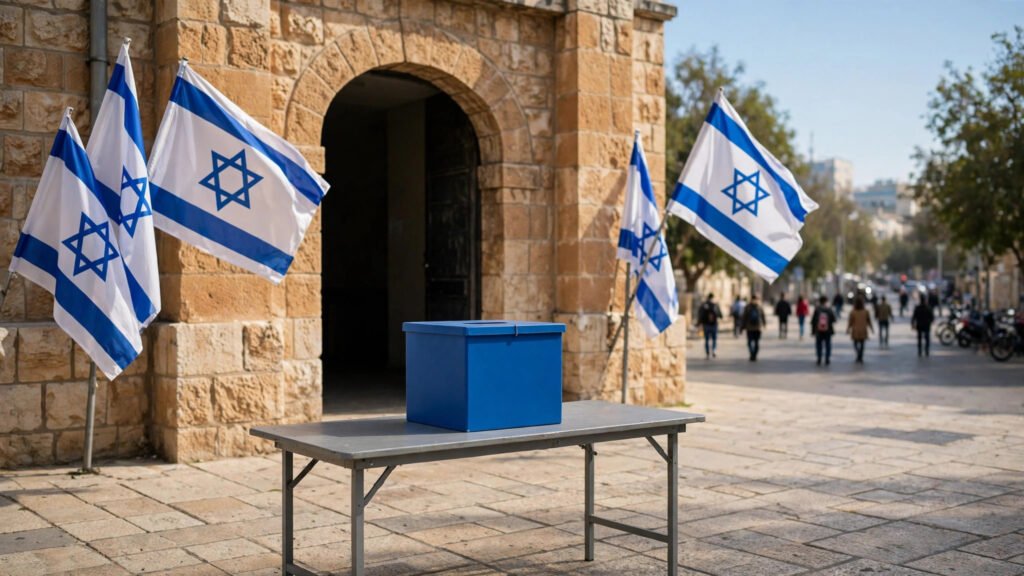
Israelis are voting on Tuesday, October 27, 2026, in the country’s first election since the October 7 attacks, choosing all 120 members of the 26th Knesset in a contest widely described as a referendum on Prime Minister Benjamin Netanyahu’s long tenure. Polls opened at 7 a.m. local time and are due to close at 10 p.m., with exit polls expected shortly after closing and the final tally expected by October 30, ahead of official results on November 4.
Key Takeaways
- Israelis are voting on October 27, 2026, for all 120 Knesset seats, with 61 seats needed for a governing majority.
- Final pre-election polls put neither Netanyahu’s bloc nor the opposition bloc on course for 61 seats, pointing to difficult coalition talks.
- Exit polls are expected after polls close at 10 p.m. local time, but they are estimates, not official results, and the next prime minister will only emerge from coalition negotiations.
The election is the first since the October 7 attacks and the subsequent Gaza war, and it follows a period marked by mass protests over judicial reform and recurring coalition crises over Haredi military conscription. The outgoing 25th Knesset became the first Israeli legislature to complete its full four-year term without early dissolution since 1988, ending the prolonged political crisis of 2018 to 2022 that saw five consecutive snap elections.
What The Final Polls Showed
Final television polls published on October 23 each put Netanyahu’s bloc on 50 seats, 11 short of the 61 needed to govern, with the opposition on 52, 56 and 54 seats across the three polls from Kan 11, Channel 12 and Channel 13. In all three, Gadi Eisenkot’s Yashar party was ahead of Netanyahu’s Likud. A final Maariv poll put the opposition’s change bloc at 54 seats against 48 for Netanyahu’s bloc.
Among individual parties, Eisenkot’s Yashar was put at 21 to 22 seats, Likud at 19, and former prime minister Naftali Bennett’s B’Yachad party at 14 to 15. The Democrats, led by Yair Golan, were put at 10 seats, and Avigdor Lieberman’s Yisrael Beytenu at eight. Parties must clear a 3.25 percent electoral threshold to enter the Knesset, and the final polls put Ofer Winter’s People of Israel party at around 3 to 3.1 percent, just below that threshold.
Israelis are voting on Tuesday, October 27, 2026, in the country’s first election since the October 7 attacks.
Polls are estimates, not results, and the figures differed between pollsters. That uncertainty is itself part of the story of this election: a party can finish first without having enough support to form a government, and a leader whose party does not win the most seats can become prime minister if they successfully assemble a government that secures the Knesset’s confidence.
Netanyahu, Eisenkot And The Iran Question
Netanyahu, who has been in office for nineteen years in total across his terms, is fighting to preserve his political survival against a fractured yet energised opposition. He is on trial for corruption and is wanted under an International Criminal Court arrest warrant, according to live election coverage, and the vote has been framed as a referendum on his leadership after October 7.
The Iran question has run through the final days of the campaign. On the eve of the vote, Netanyahu said he had the support of United States President Donald Trump and suggested Trump was ready to finally remove the Iranian threat, but only if Netanyahu stays in power. The White House has said the United States will not attack Iran before the midterm elections in November. That context links directly to Netanyahu’s earlier warning that Iran may try to disrupt the October 27 election, and to reports that United States forces were ready to strike Iran within 96 hours of an order.
Regional diplomacy has also continued in parallel, with officials from Saudi Arabia, Türkiye and Pakistan holding talks in Tehran on October 26, a reminder that the election is taking place against a wider regional contest over Iran, not in isolation from it.
How The Next Government Is Formed
Once voting ends, the process has two distinct stages: counting, then coalition-building. Exit polls are expected shortly after 10 p.m. on October 27, but they are estimates based on voter surveys and should not be treated as official results. Preliminary counting figures are expected overnight and during the following day, with the final tally expected by October 30 and official results on November 4.
After official results, the president consults every list and hands one leader the mandate to form a government, with 42 days to do so. In the interim, Netanyahu’s government would continue in a caretaker capacity until a successor government takes office. If the government-formation process fails within the prescribed procedures, the country may ultimately have to hold another election, a prospect Israel knows well after five elections between 2019 and 2022.
- Israel is electing all 120 members of the 26th Knesset on October 27, 2026, with 61 seats needed for a majority.
- Polls opened at 7 a.m. and close at 10 p.m. local time, with exit polls expected at close.
- Final television polls put Netanyahu’s bloc on 50 seats, 11 short of a majority, with Yashar ahead of Likud.
- Parties must clear a 3.25 percent threshold to enter the Knesset.
- The final tally is expected by October 30, with official results on November 4.
- The president then gives one leader a mandate, with 42 days to form a government.
What to Watch Next
What to watch next is only what this article has already set out: the exit polls after 10 p.m. local time, the preliminary counting figures overnight and the following day, the final tally expected by October 30, and the official results on November 4. After that, the test will be whether any leader can assemble 61 seats within the 42-day mandate period, or whether Israel faces another round of coalition failure and, ultimately, another election. Until the votes are counted and the negotiations are done, Israel’s next political leadership remains undecided.