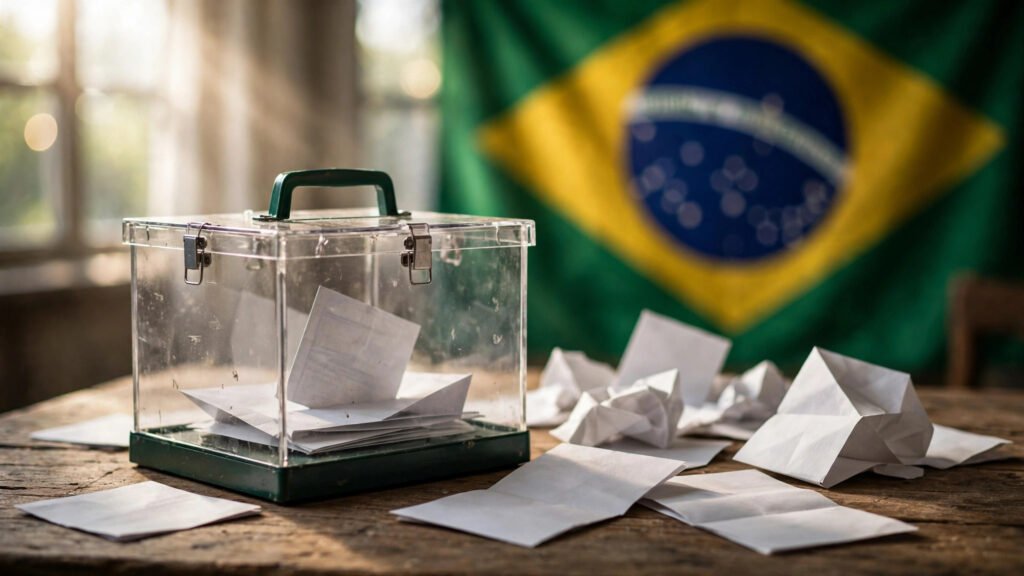
US President Donald Trump said on Monday that Brazil’s presidential election looked rigged, a day after Luiz Inácio Lula da Silva won a fourth term by beating Flávio Bolsonaro in Sunday’s runoff. Trump offered no evidence for the claim, and within hours the defeated candidate’s own party said it recognised the result, even as Bolsonaro himself refused to concede and said he would seek to annul it.
The clash between Trump’s words and the formal position of Bolsonaro’s party captures the strange position Brazil is in after a dramatic runoff. The result itself was clear: Lula won about 51.8 percent of the vote, defeating Bolsonaro by more than four million votes. Yet the argument about how the vote was run, and in particular about a two-hour extension of polling ordered by Brazil’s Supreme Court, has become the centre of the dispute.
Key Takeaways
- Trump said Brazil’s runoff ‘looked like another rigged election’ and called the two-hour voting extension ‘very strange’, without providing evidence.
- Lula beat Flávio Bolsonaro by more than four million votes, winning about 51.8 percent of the vote in the October 25 runoff.
- Bolsonaro’s Liberal Party later said it recognised the result, while Bolsonaro himself has refused to concede and says he will seek annulment.
What Trump Said
Speaking to reporters on Monday, October 26, before travelling to a campaign rally, Trump said: ‘I didn’t take sides, but it looked like another rigged election.’ He added: ‘It looked very bad to me.’ In fuller remarks reported from the same exchange, he said the election had a terrible look, that elections have to be indisputable, and that the way the vote was tabulated looked corrupt and terrible to him.
Trump also focused on the extension of voting hours, saying: ‘The extension given was very strange.’ At the same time, he drew a line around what he would do about it. ‘I’m not running Brazil, I’m running the USA,’ he said, adding that he likes Lula and gets along with him very well. He did not say he would intervene in Brazil’s political affairs, and he did not formally endorse a candidate ahead of the vote, according to Reuters reporting.
I didn’t take sides, but it looked like another rigged election.
That combination — a sweeping claim about the election, no evidence offered alongside it, and a disclaimer that he would not act on it — is important to keep together. Reuters reported Trump’s remarks without evidence, and the claim itself is not a finding by any electoral authority. Brazil’s electoral court confirmed Lula’s victory after all votes were counted, and the dispute now turns on legal and political arguments inside Brazil, not on a ruling that the result was invalid.
The timing also matters. Trump made the remarks on the same day he announced a separate voter-fraud reward in the United States, covered in our earlier report on Trump’s $1 million reward for voter-fraud tips ahead of the November 3 midterm elections. The Brazil comments therefore landed in a week when election integrity is already a live political argument in Washington, as well as in Brasília.
The Two-Hour Extension at the Centre of the Dispute
The specific fact at the heart of the argument is a decision by Brazil’s Supreme Court to keep polling stations open for an additional two hours on Sunday. Supreme Court Justice Cristiano Zanin ordered the extension, according to reporting on the vote, after requests linked to transport problems and weather.
The accounts of why the extension was sought are not one-sided. Lula’s campaign requested more time after reporting bus shortages in at least nine states, including São Paulo and Salvador, areas that tend to favour the incumbent. Bolsonaro’s campaign also sought more time, citing heavy rain in southern Brazil, where its candidate was favoured. The timing of the court’s decision, however, meant that some polling stations had already closed and started counting ballots when they were suddenly ordered to reopen, a sequence that sowed confusion at polling stations across the country, according to USA Today reporting.
That confusion is the basis for Bolsonaro’s challenge. He has refused to concede defeat and said he would seek the annulment of Lula’s victory, pointing to the extension as the reason. His argument is a legal and political one about process: that a late change to voting hours, applied unevenly because some stations had already closed, undermines confidence in the count. It is not, in the reporting so far, an argument backed by a published finding that votes were falsified or that the count itself was altered.
Bolsonaro’s Challenge, and His Party’s Answer
Later on Monday, Bolsonaro’s Liberal Party took a different position from its candidate. In a statement signed by the party’s head, Valdemar Costa Neto, the party said: ‘We recognize the presidential election results.’ The same statement added: ‘But we believe the issues raised need to be properly clarified.’
That two-part position — recognition plus a demand for clarification — leaves the party formally accepting the outcome while keeping the questions about the extension alive. Bolsonaro himself has not commented publicly since his party’s statement, according to Reuters. He said earlier on Monday that he would comply with a federal police order to hand over his passports following a visit to his father, former President Jair Bolsonaro, who is under house arrest, and he denied that he was planning to flee Brazil.
The split between candidate and party is politically significant. A challenge to an election result is much harder to sustain when the candidate’s own party has recognised the result, and when the margin is as large as it is here. It also changes what the coming days are likely to be about: not a reversal of the result, but an argument over whether the extension and the confusion around it should be investigated, clarified, or treated as a lesson for future elections.
Why the Margin Matters
The numbers put the extension argument in perspective. Lula’s victory margin was more than four million votes, and reporting put the figure at nearly 4.4 million votes. By contrast, fewer than 35,000 votes, or about 0.03 percent of the total, were cast in the extra two hours of voting ordered by the Supreme Court, according to an analysis of electoral records by Insper professor Pedro Burgos cited by Reuters.
That comparison does not by itself settle every procedural question, but it does set a high bar for any annulment case. Even if every vote cast in the extra two hours were set aside, the margin would remain in the millions. That is why Reuters described the result as a clear one that it will be challenging for Bolsonaro to overturn.
The wider context also matters. Lula, an 80-year-old leftist, staged a comeback in the runoff after Bolsonaro had emerged as the leading candidate in the first round earlier in October, in a race that had been described as tight before the runoff, as covered in our earlier report on the tight Brazil runoff race. His win gives him a historic fourth term, with his next term set to begin on January 5, 2027, according to reporting on the result. Our full report on the result itself is here: Lula wins a historic fourth term, defeating Flávio Bolsonaro.
- Lula won about 51.8 percent of the vote in the October 25 runoff, beating Flávio Bolsonaro by more than four million votes.
- Trump said the election ‘looked like another rigged election’ and called the two-hour extension ‘very strange’, without providing evidence.
- Fewer than 35,000 votes, about 0.03 percent of the total, were cast in the extra two hours, according to an analysis cited by Reuters.
- Bolsonaro’s Liberal Party said it recognised the result, while asking for the issues raised to be properly clarified.
- Bolsonaro himself has refused to concede and says he will seek annulment of the result.
- Lula’s next term is set to begin on January 5, 2027.
What to Watch Next
What to watch next is what the article has already set out: whether Bolsonaro follows through on his promise to seek annulment, and what, if anything, an annulment case argues beyond the two-hour extension; whether the issues the Liberal Party says need clarification are clarified by the electoral authorities, and in what form; and whether Trump says or does anything further about Brazil beyond his Monday remarks, given that he said he is not running Brazil and would not intervene. The other test is the transition itself: whether Lula’s fourth term begins on January 5, 2027 as reported, with the result recognised by the party that lost, even as its candidate continues to dispute it.