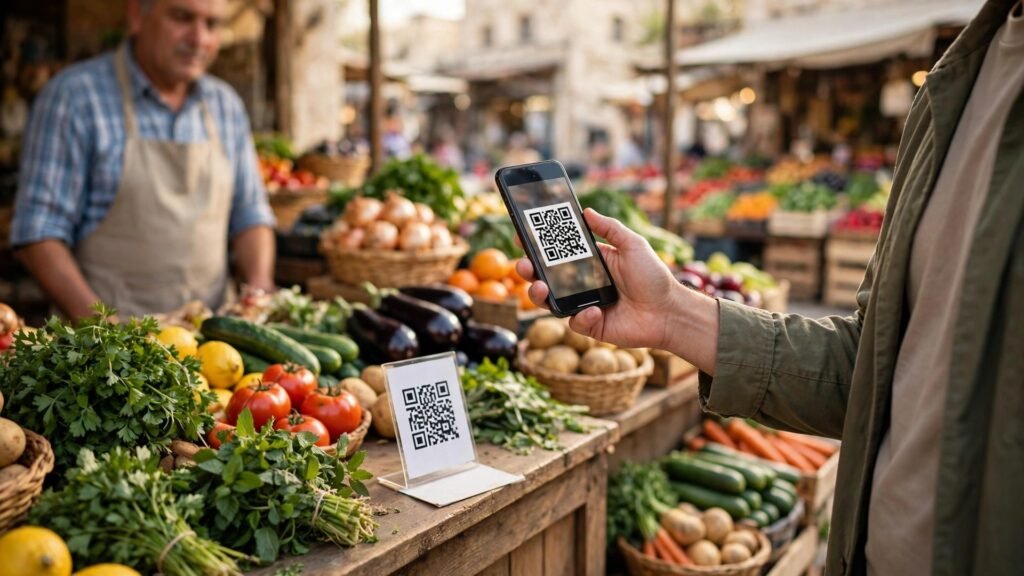
In Jordan, paying for groceries, settling a bill with a friend, or sending money to family often starts with a phone rather than a wallet. Instead of counting out banknotes or handing over a card, many Jordanians open their bank’s mobile app and send the payment through CliQ, the country’s instant payment system. For a visitor, it can look remarkably simple: a phone number or a QR code, a quick confirmation, and the money is on its way.
The habit is not really about one single app. It is about a shared system that connects banks, so money can move from one person’s bank account to another person’s account at a different bank, in moments, at any time of day. That simplicity is the whole point, and it explains why CliQ has become part of everyday spending for many people in Jordan.
Key Takeaways
- CliQ lets people send money between bank accounts in Jordan using a phone number, an alias, or a QR code, instead of a long account number.
- It works across different banks through a shared instant payment system, so splitting a bill or paying a small seller does not need cash or a card machine.
- Cards and cash have not disappeared, but instant phone payments are now a normal everyday option for many Jordanians.
What Is CliQ?
CliQ is Jordan’s instant payment service, built so that payments between people and businesses can move directly from one bank account to another. In practice, a person uses their own bank’s mobile app, where CliQ is available as a payment option. They do not need to download a separate wallet or open a new kind of account just to use it.
Once a person has registered for CliQ through their bank, other people can send money to them using a simple identifier, such as their mobile phone number or a chosen alias, rather than a full account number. The sender enters that identifier and the amount, checks the details shown on screen, and confirms the payment. The money then moves to the recipient’s bank account through the shared system behind the service.
For a small business, the same idea works at the till. A shop can display a QR code linked to its account, and a customer can scan that code with their bank app, enter the amount, and pay. There is no need for the customer to carry exact change, and no need for the shop to handle notes and coins for that sale.
Why a Phone Number or QR Code Is Enough
Phone numbers are easy to remember, easy to share, and almost everyone already has one. That makes them a natural shortcut for payments between people who know each other. Asking a friend for their full bank account details feels formal and fiddly, while asking for their number feels normal.
QR codes solve a similar problem at a shop counter. A printed code can sit beside the till all day, ready for any customer with a bank app. The customer does not need to know the shop’s bank or account number, and the shop does not need to read out long details for every sale. The code carries the payment destination, and the app handles the rest.
Asking a friend for their full bank account details feels formal and fiddly, while asking for their number feels normal.
This is the same reason phone-based payments have caught on in other countries too. In Thailand, PromptPay grew around a phone number or ID as a simple payment address, and in Cambodia, one shared QR code made phone payments easier across banks and wallets. Jordan’s version is bank-based, but the appeal is similar: less friction, fewer details to get wrong, and a payment that can be confirmed on the spot.
Why It Works for Everyday Life in Jordan
Everyday payments in Jordan are often small, frequent, and social: sharing the cost of a meal, paying a delivery rider, sending money to a relative, or buying from a neighbourhood shop. Cash works for these, but it needs change, it needs a trip to an ATM, and it leaves no simple record of who paid whom.
An instant bank-to-bank payment fits that pattern well. The sender can pay from the account they already use, the recipient can see the money arrive in their own bank account, and both sides have a record in their banking app. That record matters for small businesses too, because it helps them keep track of sales without sorting through paper receipts at the end of the day.
Timing matters as well. Because the system is designed for instant transfers, a payment does not have to wait for the next working day to clear. A friend can be repaid on the spot, a family member can receive help when it is needed, and a shop can be paid before the customer leaves the counter. For people who are used to doing most things on their phones, that immediacy feels natural rather than new.
- CliQ payments start inside a person’s existing bank app, not a separate wallet.
- A phone number, alias, or QR code replaces a long account number.
- Payments can move between different banks, so the sender and recipient do not need the same bank.
- Small, everyday payments — meals, deliveries, and shop purchases — are where the simplicity shows most.
What About Cards and Cash?
Cards and cash have not gone away in Jordan, and CliQ does not need them to disappear to be useful. Cards still make sense for many purchases, especially where a card terminal is already in place, and cash still works everywhere, including places with no phone signal or no bank app to hand.
What has changed is that people now have a third everyday option that sits between the two. For a payment to someone they know, or to a small seller, a phone transfer can be quicker than finding an ATM or waiting for a card machine. For a larger or more formal purchase, a card may still feel more familiar. In Saudi Arabia, card and phone payments have grown in a similar way, alongside cash, rather than replacing it overnight.
The result is a mix, not a single winner. Jordanians choose the method that fits the moment: cash for a quick stall purchase, a card at a larger store, and CliQ when a phone number or a QR code is the easiest way to get the money to the right person.
What to Watch Next
CliQ’s story in Jordan is really a story about simplicity winning over habit. A phone number or a QR code is easier to share than an account number, a bank app is already in most pockets, and an instant transfer removes the wait that used to come with sending money between banks.
As more shops display QR codes and more people grow comfortable paying friends and sellers by phone, instant payments are likely to stay a normal part of daily life in Jordan, alongside cards and cash, chosen case by case for whatever is simplest in the moment.