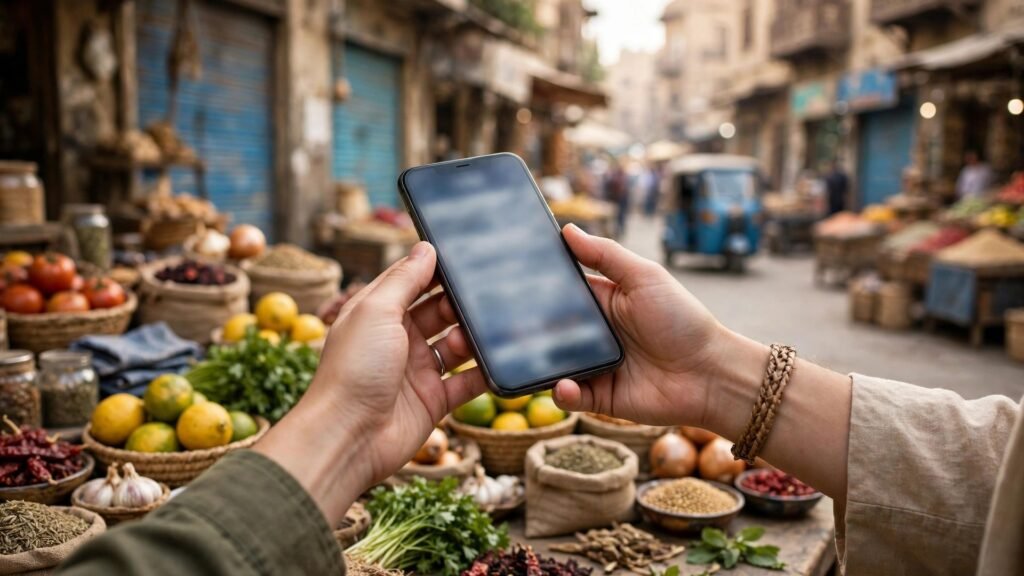
In Egypt, paying someone does not always mean counting out banknotes or handing over a card. For rent, a payment to a small business, a bill shared between friends or money sent to family, many people now open a banking app on their phone and send the money straight from one account to another. Behind a growing share of those transfers is InstaPay, Egypt’s instant payment network.
InstaPay is built around a simple idea: money should move between bank accounts quickly, at any hour, without the sender and the recipient needing to use the same bank. Instead of carrying cash to a meeting or waiting for a traditional transfer to clear, the sender uses a phone number or a payment address linked to an account, checks the details, and confirms. The recipient’s bank account is credited, and both sides keep a record of the payment in their banking apps.
Key Takeaways
- InstaPay is Egypt’s instant payment network, letting money move directly between bank accounts at different banks.
- People choose it because it is direct and available around the clock, without cash, a card terminal or a shared bank.
- Cash and cards still have a place, but transfers suit planned, person-to-person and small-business payments best.
What InstaPay actually is
Think of InstaPay as the connection between Egyptian banks for everyday transfers. When a sender starts a payment in a bank app, the instruction travels through the network to the recipient’s bank, which credits the recipient’s account. Because the system is shared, it does not matter whether the two people bank with the same institution or with two completely different ones.
To send money, the sender usually needs a simple identifier for the recipient, such as a mobile phone number linked to an account or an instant payment address, rather than a long account number copied from a statement. The exact options depend on the bank app, but the principle is the same: the money travels account to account, not through a card network and not in an envelope of cash.
The other important feature is timing. InstaPay is designed to work around the clock, including evenings, weekends and public holidays, when bank branches are closed. For someone waiting on a payment before delivering goods or confirming a booking, that matters: the money does not have to wait for the next working day.
Why transfers beat cash for so many payments
The first reason is reach. Not every seller in Egypt takes cards. A market trader, a freelance worker, a landlord or a small workshop may not have a card terminal, and may not want the cost or paperwork that comes with one. A bank account, on the other hand, is enough to receive a transfer, so InstaPay opens up electronic payment to people and businesses that cards never reached.
The second reason is control. A transfer is a deliberate payment: the sender chooses the amount, checks the recipient and confirms. For rent, a deposit, a payment to a supplier or money sent to support family, that sense of control matters. There is a clear record in both banking apps, which makes it easier to prove a payment was made and to keep track of monthly spending.
The third reason is convenience. Cash has to be withdrawn, carried and counted, and change has to be found. A transfer needs only a charged phone and a connection, and it can be sent from home, from work or from a shop. For regular payments that repeat every month, that convenience quickly becomes a habit.
A transfer is a deliberate payment: the sender chooses the amount, checks the recipient and confirms.
How people use it in everyday life
InstaPay transfers show up in all kinds of ordinary situations. Friends split a restaurant bill by sending a transfer instead of settling in cash. Families send support to relatives in another city without visiting a branch. Small businesses ask customers to pay by transfer for orders, bookings and services, then check their account to confirm the money arrived before handing anything over.
It also fits how many Egyptians already bank. If the banking app is already on the phone for checking a balance, sending a transfer from the same app is a small step. There is no new wallet to top up and no separate account to open: the money simply moves from one bank account to another.
- Bank-to-bank: InstaPay works across different banks, so sender and recipient do not need the same institution.
- Around the clock: transfers can be sent outside branch hours, including evenings and holidays.
- No terminal needed: sellers can be paid without card machines or extra hardware.
- Clear record: both sides keep a bank statement entry showing the payment.
- Phone-first: most transfers are started and confirmed inside a regular bank app.
Where cash and cards still win
None of this means cash has disappeared. For a quick purchase at a small kiosk, a tip or a payment in a place with weak connectivity, cash is still faster and simpler. A transfer needs a charged phone and a data connection, and that is not always guaranteed. Cash also remains the default for people who do not have a bank account or who prefer to keep some spending outside their banking apps.
Cards, too, keep their edge in larger stores and for online shopping, where tapping a card or entering card details is quicker than opening an app, typing an identifier and confirming a transfer. Cards also carry protections and instalment options that a plain transfer does not offer, which matters for bigger retail purchases. The sensible picture is not one payment method replacing the others, but each one fitting the situation it suits best.
How Egypt compares with its neighbours
Egypt is not alone in moving towards instant bank transfers. In Jordan, CliQ has made phone-based bank transfers part of everyday paying, while in Morocco cash still dominates even as mobile wallets grow. In Saudi Arabia, mada and Apple Pay show how cards and phones can work together. The pattern across the region is the same: people want money to move directly, quickly and without depending on cash alone.
What makes Egypt’s version distinctive is that InstaPay sits underneath the banks themselves. It is infrastructure rather than a single consumer brand, so the experience can look slightly different in each bank app while the underlying transfer works the same way.
What to Watch Next
InstaPay already fits the payments Egyptians make most often between people and small businesses, and its bank-to-bank reach and around-the-clock availability are the reasons it keeps growing as a habit. Cards will keep their edge for fast retail purchases and cash will remain useful where connectivity is weak or for small everyday spending, but for planned, person-to-person and business payments, the transfer has become the natural default. The next thing to watch is how smoothly transfers work alongside newer options such as QR-based payments, and whether everyday shopping follows the same direct, account-to-account path that transfers have already made normal.