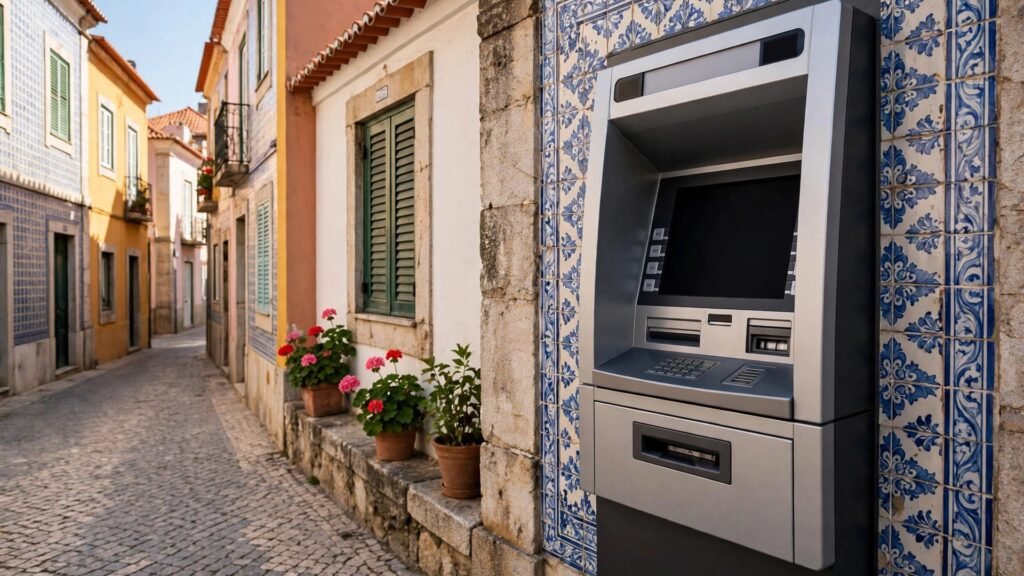
In most countries, an ATM does one job: it gives you cash. In Portugal, that was never the whole story. Walk past a bank branch, a shopping centre or a quiet street in a small town and you will often see someone standing at a Multibanco machine doing something that has nothing to do with withdrawing notes. They may be paying an electricity bill, topping up a mobile phone, or settling a payment that, in another country, would need a visit to a counter or a separate app.
That habit did not appear overnight. Multibanco grew up as a shared national ATM network, so a card from one bank worked at machines run by others. Over time, the machines gained more functions, and people built those functions into their routines. For many Portuguese, the ATM became the place where everyday money tasks got done — familiar, quick and close to home.
Key Takeaways
- Multibanco machines in Portugal do far more than dispense cash — they also handle bills, top-ups and everyday payments.
- The habit stuck because the machines are familiar, widely available and work without a smartphone or a separate app.
- Phones and mobile wallets are growing, but the ATM still suits people who prefer a simple, physical way to pay.
What Is Multibanco?
Multibanco is Portugal’s shared ATM network. Instead of each bank running a closed system of machines that only served its own customers, the network brought banks together, so cardholders could use machines across the country. That shared approach matters: it means the machine on your street is useful even if it does not belong to your own bank.
The other thing that sets Multibanco apart is the range of services on the screen. Alongside cash withdrawals and balance checks, the machines offer payment services — the option often labelled as payments for services. Through that menu, a person can pay a utility bill, a phone bill or another regular charge by entering a reference number printed on the bill. The machine prints a receipt, and the job is done.
Why the ATM Became a Bill-Payment Machine
The simplest explanation is convenience. Before paying bills online became common, the alternatives were queues at counters, trips to different offices, or sending payments by post. A machine that could settle a bill in a few minutes, in the same place where you already withdrew cash, was an obvious improvement.
Trust played a part too. A Multibanco machine gives an immediate, printed receipt. For someone paying a bill that must not be missed, that piece of paper is reassuring in a way a silent screen tap sometimes is not. People could see the amount, confirm it, and walk away with proof.
Availability helped as well. Because the network is shared, machines appeared in places beyond big-city bank branches — in shopping areas, smaller towns and neighbourhoods. When the machine that pays your bills is on your normal route, using it becomes a habit, and habits are hard to shift.
For many Portuguese, the ATM became the place where everyday money tasks got done — familiar, quick and close to home.
Why People Still Trust It
One reason the ATM habit survives is that it asks very little of the user. You do not need a new app, a charged smartphone, a data connection or a password you set up last year and forgot. You need a bank card and a PIN, and the machine guides you through the rest, step by step.
That simplicity matters most for people who are less comfortable with digital banking. Older customers, in particular, may prefer a machine they have used for years over an app that changes its layout with every update. For them, the ATM is not old-fashioned — it is dependable.
There is also a practical side. Not every everyday task fits neatly into an app, and not every small business or household bill is set up for automatic payment. The ATM fills the gap: one machine, many kinds of payment, no need to learn a new system for each one.
- Multibanco machines handle cash withdrawals plus bill payments, phone top-ups and other everyday services.
- The shared network means one bank’s card works at machines across Portugal.
- A printed receipt gives immediate proof that a payment went through.
- No smartphone or separate app is needed — just a bank card and a PIN.
What About Phones and Cards?
Portugal has not stood still. Contactless cards are now common, and mobile wallets have grown quickly. Many Portuguese pay with MB WAY, the mobile payment service that lets people send money and pay with their phone, and younger users in particular often reach for their phone first. The ATM has not replaced those options, and those options have not fully replaced the ATM.
The same pattern shows up elsewhere in Europe, where local payment habits sit alongside cards. In Italy, for example, many people pay with Satispay instead of cash or cards. Each country keeps the system its people learned to trust, and adds new ones on top rather than wiping the old ones away.
For Portugal, that means two worlds running side by side. A younger city worker might tap a phone for lunch and never think about an ATM all week. A parent in a smaller town might still pay the electricity bill at the machine on the way home. Both are normal, and both are part of the same payments landscape.
What to Watch Next
The ATM will not disappear from Portugal overnight, because the reasons people use it — familiarity, a printed receipt, and a machine that needs nothing more than a card and a PIN — have not gone away. At the same time, phones and mobile wallets will keep growing, especially among younger users who already pay with MB WAY and contactless cards.
The likely future is a gradual one: fewer routine trips to the machine for people who move fully to their phones, and a lasting role for Multibanco among those who value its simplicity. The machine that taught a country to pay its bills may slowly become a backup rather than a first choice — but for now, it remains a familiar part of everyday life in Portugal.