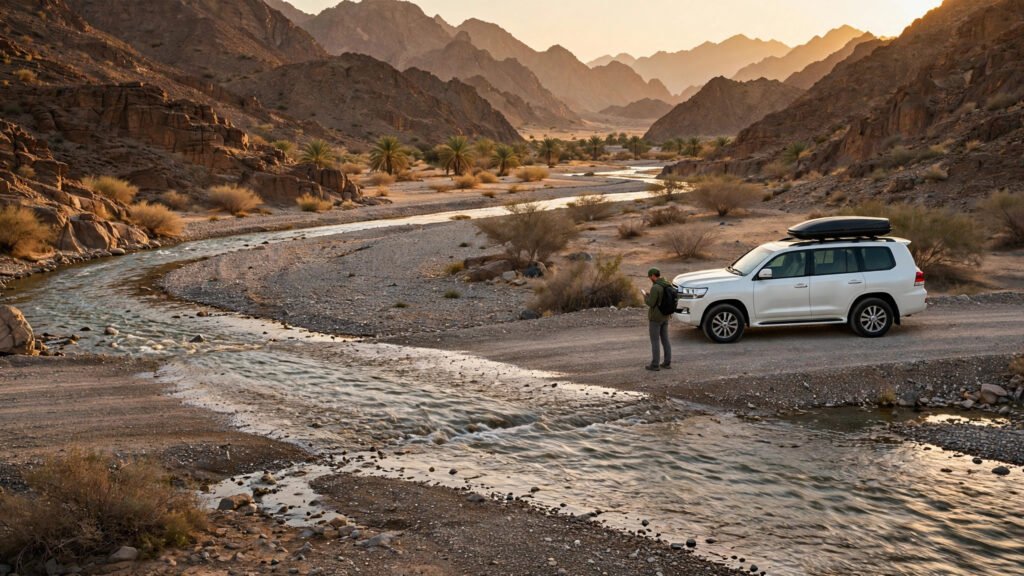
In Oman, a road that looks completely dry in the morning can turn into a flowing stream by the afternoon. That is why, before crossing a wadi, many drivers pause, take out their phones, and check the latest weather and road updates. It is a small habit, but in a landscape shaped by mountains, gravel valleys and sudden rain, it can make the difference between a safe journey and a dangerous one.
A wadi is a valley or dry riverbed that carries water only after rain. For most of the year, many wadis in Oman are dry, and roads cross them on gravel tracks or low concrete crossings. People use these routes every day to reach villages, farms, beaches and mountain viewpoints. When there is no rain nearby, the crossing can look harmless. The danger is that the water in a wadi does not always come from rain falling where you are standing.
Key Takeaways
- A wadi can flood from rain falling far upstream, even when the sky above the crossing looks clear.
- Drivers check their phones for weather forecasts, official alerts and road updates before deciding whether to cross.
- If water is flowing strongly, the safe choice is to wait or turn back rather than drive through it.
What Is a Wadi, and Why Does It Change So Fast?
Oman’s mountains and valleys channel rainwater downhill. When heavy rain falls in the hills, the water collects quickly in narrow valleys and rushes downstream. Because the ground in many places is rocky and dry, it does not soak up the water slowly. Instead, the water can gather speed and depth in a short time, turning a quiet gravel bed into a fast-moving flow.
This is also why a wadi can look different from one hour to the next. A crossing that was dusty at breakfast may carry a shallow stream by lunch, and a stream can grow deeper as more water arrives from upstream. Depth alone does not tell the whole story either. Moving water pushes against a vehicle with surprising force, and a flooded crossing can hide dips, loose gravel and debris under the surface. For all these reasons, experienced drivers treat every wadi crossing as something to assess first, not something to rush through.
Why the Phone Check Has Become Part of the Journey
For many Omanis, checking a phone before a wadi crossing is now as routine as checking fuel before a long drive. Weather forecasts give a first clue: if rain is expected in the mountains upstream, a driver knows the route may be affected even if their own location stays dry. Official warnings and road updates add another layer, because authorities may advise against using certain crossings when conditions are risky.
Drivers also look at maps and messages from other road users. A photo or short update from someone who crossed earlier can show whether water is present, while a warning about a closed road can save a long detour. In remote areas, where help may be far away and mobile signal can vary, this kind of shared information matters even more. Just as people in other countries rely on their phones when coverage is patchy, as in the case of why mobile signal disappears on Namibia’s desert roads, Omani drivers know that a quick check before entering a valley is better than discovering a problem in the middle of one.
A wadi can flood from rain falling far upstream, even when the sky above the crossing looks clear.
What Drivers Actually Look For
The phone check is not about one single app or one single forecast. It is a quick round of questions. Is rain forecast for the catchment area above the wadi, not just for the town where the driver is? Have there been any warnings about flash floods or road closures? Has anyone reported water at this crossing today? Is there an alternative route that avoids the wadi altogether?
Timing matters too. A driver who plans to cross in the morning may face different conditions by late afternoon, when rain that fell earlier in the day has had time to reach the valley floor. That is why the check is often repeated, especially on days when clouds are building over the mountains. The phone does not remove the risk, but it helps a driver make a decision based on more than what can be seen from the driver’s seat.
- Wadis are dry for much of the year, but can fill quickly after mountain rain.
- Rain upstream, not local rain, is often the reason a wadi starts flowing.
- Forecasts, alerts and driver updates together give a fuller picture than any one source.
- Flowing water can be deeper and stronger than it looks from the bank.
- Waiting or turning back is a normal, sensible response to a flooded crossing.
Why This Habit Matters Beyond One Crossing
The habit of checking before crossing reflects a wider change in how people travel. Phones now carry weather information, maps, alerts and messages from other drivers in one place, and in countries where daily life already runs through the phone, that change is easy to adopt. In Nepal, for example, many people pay with wallet apps such as eSewa and Khalti, as explained in why Nepalese pay with eSewa and Khalti instead of cash, while in Malawi, solar kiosks keep phones charged where mains power is limited, as described in why Malawians charge phones at solar kiosks. In Oman, the same device that handles everyday tasks has become a practical safety tool on the road.
There is also a community side to the habit. When one driver shares a warning, others can change their plans before they reach the wadi. When a family checks the forecast together before a weekend trip, children learn early that a dry riverbed is not always a safe road. Over time, these small checks build a culture of caution that protects visitors as well as residents, because a visitor may not know how quickly an Omani wadi can change.
What to Watch Next
The next time you travel in Oman, watch for the pause before a wadi crossing. Drivers check their phones for weather forecasts, official alerts and road updates, because a wadi can flood from rain falling far upstream even when the sky above the crossing looks clear. If water is flowing strongly, the safe choice remains the same: wait, or turn back, rather than drive through it.