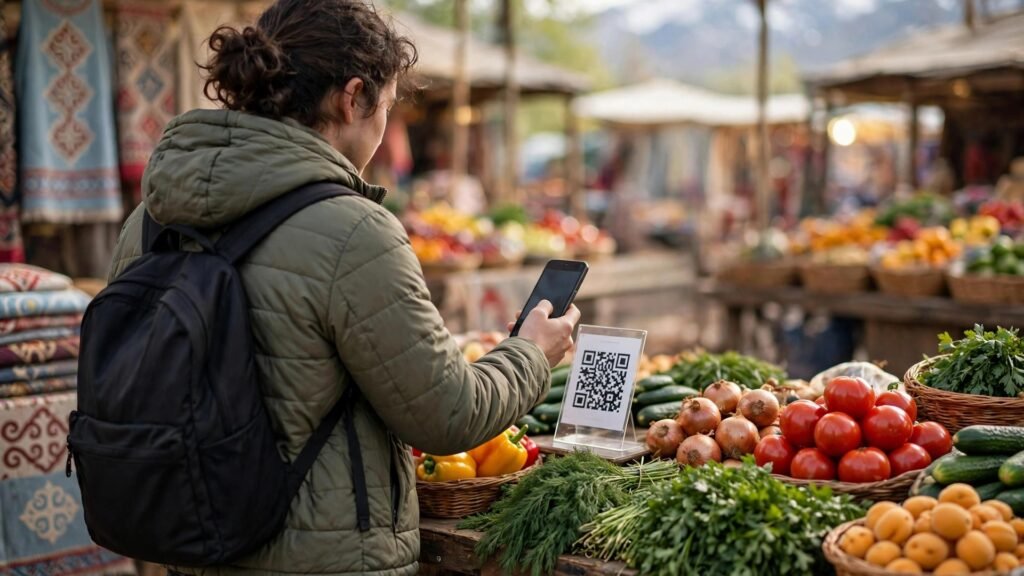
In a busy bazaar in Almaty, the payment takes only a few seconds. The seller points to a small printed square on the counter, the buyer holds up a phone, and the sale is done — no banknotes counted out, no coins hunted for change, no card terminal passed back and forth. That little square is a Kaspi QR code, and for many people in Kazakhstan it has become the most ordinary way to pay.
Kaspi QR is part of the Kaspi.kz app, run by Kaspi Bank, one of Kazakhstan’s best-known banks. The app brings together banking, shopping and everyday payments in one place, and its QR payment feature is the part most people meet first — at market stalls, corner shops, cafés, taxi rides and small service businesses across the country. So why did a QR code, of all things, win over so many Kazakhstanis?
Key Takeaways
- Kaspi QR lets buyers pay by scanning a printed code with a phone, so small sellers do not need a card terminal.
- One app covers banking, shopping and payments, which makes the QR habit easy to pick up and hard to drop.
- Cash and cards have not disappeared — QR simply fits the small, everyday purchases where speed matters most.
A payment method built for small sellers
The first reason Kaspi QR spread so fast is that it works for the smallest businesses. A market trader, a florist or a neighbourhood café does not need to buy, charge or maintain a card terminal. A printed QR code on the counter is enough. The buyer scans it, enters the amount or confirms the sum shown, and both sides see the payment go through on their phones.
That matters in a country where so much daily trade still happens in bazaars and small shops. For a seller handling dozens of small sales a day, taking payment by phone is quicker than counting cash and safer than keeping a full till. For the buyer, it means one less reason to visit an ATM before shopping.
It also lowers the barrier for people selling informally or just starting out. Someone selling home baking, handmade goods or a few crates of produce can accept phone payments from the first day, without signing up for expensive payment hardware. In that sense, Kaspi QR did not just change how people pay — it changed who can easily take a payment at all.
One app, many everyday jobs
The second reason is convenience. Kaspi.kz is not only a payment app. People use it to check a balance, move money, pay bills, shop in its marketplace and manage a Kaspi Gold card, among other things. Once the app is already on a person’s phone for one of those jobs, paying by QR is a small extra step rather than a new habit to learn.
That all-in-one design is a big part of the appeal. Instead of juggling a banking app, a shopping app and a separate wallet, many Kazakhstanis do all three in the same place. A QR payment at lunch, a bill paid in the evening and an online order on the weekend can all live in one app, with one login and one transaction history to check.
Trust plays a role here too. Because Kaspi QR sits inside a bank’s app, rather than a standalone wallet from an unknown company, many users treat it as an extension of their bank account. The payment shows up alongside their other banking activity, which makes it feel familiar rather than experimental.
For a seller handling dozens of small sales a day, taking payment by phone is quicker than counting cash and safer than keeping a full till.
Why QR beat the card terminal for everyday buys
Cards are widely used in Kazakhstan, especially in cities and larger stores. But for small, everyday purchases, QR has a few practical edges. There is no card to insert, no PIN pad to share and no terminal to wait for. The buyer scans, confirms and walks away. In a crowded bazaar queue, those saved seconds add up.
QR also solves the small-change problem. Anyone who has paid cash for a coffee or a bunch of herbs knows the awkward pause while change is found. A phone payment is exact to the tenge, every time. Sellers like that too, because it means less cash handling at the end of the day.
Similar QR habits have grown elsewhere for the same reasons. In Laos, shoppers scan QR codes instead of cash, and in Poland, phone-based payments have become an everyday alternative to cards. The details differ from country to country, but the logic is the same: the phone people already carry becomes the payment tool.
Where cash and cards still win
None of this means cash or cards have vanished from Kazakhstan. Cash is still common in rural areas, for very small sums and wherever phone signal is weak. Cards still dominate in supermarkets and larger stores, where terminals are already installed and checkout is already fast. Many people simply use all three, switching by situation.
QR payments also depend on two things cash does not: a charged phone and a working connection. If the phone battery dies or the network drops, a QR payment has to wait. Older shoppers, or anyone uncomfortable with banking apps, may still prefer notes and coins — and many sellers are happy to take them.
There is also a learning curve. First-time users sometimes worry about scanning the wrong code or sending money to the wrong person. In practice, the app shows the seller’s name before the payment is confirmed, which gives the buyer a moment to check. That confirmation step is one reason people grow comfortable with it quickly: the payment is not finished until the buyer says so.
- No terminal needed: a printed QR code lets even the smallest seller accept phone payments.
- Exact amounts, every time: no hunting for small change at bazaars, cafés and corner shops.
- One app for daily life: banking, bills, shopping and QR payments sit in the same place.
- Instant confirmation: buyer and seller both see the payment on their phones straight away.
What QR changed about shopping itself
Beyond speed, Kaspi QR changed the feel of everyday shopping. Paying by phone is quiet and private — there is no counting of notes in a queue, and no need to announce the amount out loud. For sellers, the end of the day is simpler: takings are already recorded in the app, rather than counted by hand.
It has also made small businesses more visible to the formal economy. A seller who takes QR payments leaves a digital record of sales, which can help with bookkeeping and, over time, with access to banking services. That is a quiet but real change for traders who once dealt only in cash — similar to how mobile money has changed small trade in Rwanda, where phones became the till.
None of this happened overnight. QR payments grew because the app was already popular, the codes were cheap to print, and the experience was simple enough for a first-time user to manage in seconds. Technology alone rarely changes a habit; a tool that fits the way people already shop does.
What to Watch Next
Kaspi QR is unlikely to replace cash and cards outright — each still fits some situations better than the others. What is worth watching is how far the QR habit spreads: into more rural areas as connectivity improves, into more services beyond shops and cafés, and into the routines of older shoppers who still reach for cash today. The QR code on the counter started as a convenience for small sellers. In Kazakhstan, it has quietly become part of how everyday life is paid for.