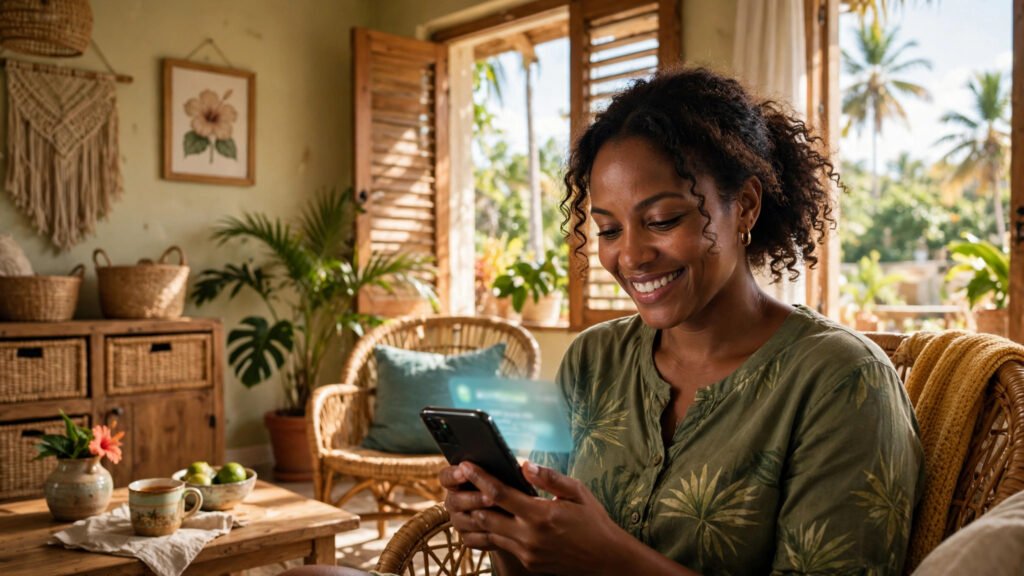
For many Jamaican families, a message on a phone can matter more than a trip to a bank branch. A relative working abroad sends money home, a notification arrives, and the amount can be collected or spent without a long journey into town. That simple flow explains why phones have become the first stop for money sent from abroad, rather than a last resort.
Jamaica has a large diaspora, with many Jamaicans living and working in countries such as the United States, the United Kingdom and Canada. When those workers support parents, children, partners or extended family back home, the money they send is often used for everyday needs: food, school costs, rent, bills, medicine and small business expenses. Because the support is regular and practical, the way it arrives matters just as much as the amount.
Key Takeaways
- Many Jamaicans receive support from relatives abroad, and that money often covers everyday household needs.
- Phones let recipients get a notification, check the transfer and collect or spend the money without travelling to a distant bank branch.
- Speed, convenience and lower effort — not technology for its own sake — are what make phone-based transfers the preferred route for many families.
Why the Phone Beats the Bank Queue
The traditional route still exists: a sender visits an agent abroad, the recipient visits an agent or a bank at home, shows identification and collects cash. For people who live near a town centre and have flexible hours, that route works. For many others, it costs time, transport money and a wait in line — all to collect money that was already sent.
A phone-based transfer changes the order of events. The sender starts the transfer from abroad, often through an app or an online service. The recipient gets a notification and can see that the money is on its way or has arrived. In many cases the funds land in a mobile wallet or an account that can be used for payments, or they can be collected at a nearby agent when cash is needed. The journey shrinks from a day out to a few taps and, when cash is required, a short local stop.
That convenience also helps the sender. Someone working long hours abroad may not be able to visit an agent during opening hours, but can send money from a phone in the evening. The transfer can be timed to a bill, a school fee or a family emergency, rather than waiting for a free morning. When support is needed urgently, that timing can matter more than any other feature.
The journey shrinks from a day out to a few taps and, when cash is required, a short local stop.
How the Money Travels
Most phone-based transfers follow the same broad pattern, even though the exact apps and agents differ. The sender enters the amount and the recipient’s details, chooses how the recipient will get the money, and pays from a bank account or a card abroad. The service converts the amount when a different currency is involved and sends the recipient a notification with a reference or a confirmation.
On the receiving side, the money may arrive in a mobile wallet, a bank account or as a cash pickup. A wallet balance can often be used to pay bills, buy phone credit or send money onward to another person. A cash pickup still needs a visit to an agent, but the recipient can usually choose a closer location and a better time, because the money is already waiting. This pattern is familiar in other countries too: many Nepalese families receive money from abroad straight into a mobile wallet, and Tongans receive money from abroad on their phones instead of at banks for similar reasons of distance and convenience.
Identification and security checks remain part of the process. Recipients are usually asked to confirm who they are before collecting cash or withdrawing funds, and services keep records of transfers. The phone does not remove those checks; it moves them into a shorter, more flexible process that fits around work and family life.
- Senders abroad can start a transfer from a phone, even outside agent opening hours.
- Recipients get a notification when money is sent, so they know it is on its way.
- Wallet balances can pay bills and buy phone credit, while cash pickup stays available nearby.
- Shorter trips and fewer queues are the main gain for families outside town centres.
What Families Watch Out For
Convenience does not mean the cheapest option in every case. Fees and exchange rates vary between services, and the same transfer can cost a different amount depending on the route chosen, the payout method and the timing. Families who send regularly often compare the total the recipient actually receives, rather than the advertised fee alone, because a low fee can sit alongside a less favourable exchange rate.
Scams are another reason for caution. A genuine transfer notification comes through the service itself, and no legitimate provider asks a recipient to pay a fee to unlock money that has supposedly arrived. Messages that pressure someone to act quickly, share a code or pay an unexpected charge should be treated with suspicion and checked directly with the provider. Keeping transfer codes private and confirming details with the sender before collecting is a simple habit that prevents many problems.
Access still matters. A phone-based system only helps if the recipient has a charged phone, mobile signal and a way to use the balance — whether that is a wallet, an agent or a bank account. In rural areas, that last step can still require travel, which is why agents and cash pickup remain important even as wallets grow. Hondurans receiving money from abroad on their phones face a similar mix of digital convenience and local cash needs.
What to Watch Next
Phone-based transfers are likely to stay the first choice for many Jamaican families as long as they remain faster and easier than a bank visit. The questions to watch are practical ones: whether fees and exchange rates become clearer to compare, whether wallet balances become usable in more everyday places, and whether rural agents stay within easy reach for the cash pickups that many households still need. The phone has not replaced trust in the system — it has simply made the trusted route shorter, and that shorter route is why it wins.