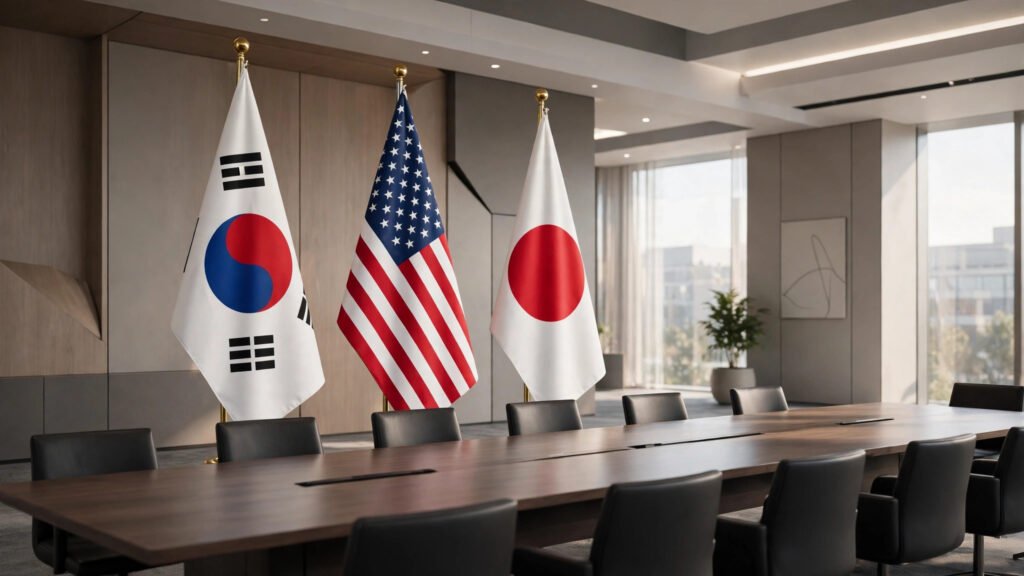
South Korea, the United States and Japan have reaffirmed their commitment to the complete denuclearization of North Korea, after trilateral talks on the sidelines of the G20 foreign ministers’ meeting in Atlanta. The meeting on Friday, October 30, brought together South Korean Foreign Minister Cho Hyun, United States Secretary of State Marco Rubio and Japanese Foreign Minister Toshimitsu Motegi, at a moment of heightened tension following Pyongyang’s latest ballistic missile launches.
The three ministers agreed to expand maritime and economic cooperation, and to strengthen cooperation against North Korea’s malicious cyber activities, which help finance its nuclear and missile programmes. Tokyo also welcomed continued support from Seoul and Washington for resolving the issue of Japanese nationals abducted by North Korea.
Key Takeaways
- South Korea, the United States and Japan reaffirmed their commitment to the complete denuclearization of North Korea at trilateral talks in Atlanta on October 30.
- The talks followed North Korea’s launch of around 10 short-range ballistic missiles from the Wonsan area into the East Sea on October 29.
- The three allies also agreed to strengthen cooperation against North Korea’s malicious cyber activities and to keep sharing information rapidly during missile launches.
What Happened on Thursday
South Korea’s Joint Chiefs of Staff said North Korea fired around 10 short-range ballistic missiles from the Wonsan area toward the East Sea, the body of water also known as the Sea of Japan, at approximately 12:30 p.m. on Thursday, October 29. Each missile flew about 250 kilometres. The launches were Pyongyang’s first ballistic missile test in 17 days, and they came less than a week after Seoul proposed military talks aimed at easing border tensions.
Japan’s Defence Ministry said North Korea had launched an object that could be a ballistic missile, and that it appeared to have landed outside Japan’s exclusive economic zone. Japan’s Coast Guard urged ships in the area to be vigilant, and said that as of 12:55 p.m. on Thursday, no damage to vessels at sea had been confirmed. The Japanese government set up a crisis management centre at the prime minister’s office and convened an emergency meeting of related ministries to assess the landing point and any damage.
The launches were Pyongyang’s first ballistic missile test in 17 days, and they came less than a week after Seoul proposed military talks aimed at easing border tensions.
The Diplomatic Response Within a Day
The diplomatic response began within a day. On October 30, South Korea’s Director General for Korean Peninsula Peace Policy, Baek Yong-jin, spoke by phone with David Wight, Deputy Assistant Secretary for Japan and Korea at the United States State Department, and Takashi Ariyoshi, Director of the Asian and Oceanian Affairs Bureau at the Japanese Ministry of Foreign Affairs. South Korea’s foreign ministry said the three officials shared information about the launch, assessed the situation and discussed future response measures, and noted that the three countries operate a channel for the rapid sharing of information and assessments during North Korean ballistic missile launches.
South Korea’s military said it had stepped up surveillance and readiness against possible additional launches, while closely sharing information with the United States and Japan. Military authorities are analysing the exact specifications of the missiles, with the focus on the possibility that they were the 600mm super-large multiple rocket launcher known as KN-25. That assessment is still an analysis, not a confirmed identification.
Seoul’s National Security Office said the launches violated United Nations Security Council resolutions. The launches also followed a series of recent weapons tests by Pyongyang, including a new precision-guided torpedo system and an intermediate-range hypersonic missile, both of which were said to employ AI technology.
Why the Timing Matters
The timing is part of the story. The launches came days after Pyongyang threatened to resume propaganda loudspeaker broadcasts and deploy new weapons along the heavily fortified inter-Korean border, and ahead of an end-of-month deadline to activate propaganda loudspeakers. That sequence — a proposal for military talks from Seoul, threats about the border from Pyongyang, and then a missile barrage — is why the Atlanta meeting carried more weight than a routine sideline conversation.
The cyber discussion points to a second pressure point. That cyber focus connects to wider concerns about North Korea-linked cyber activity and how illicit revenue can support weapons programmes. The ministers’ agreement to cooperate more closely on that front shows the response is not limited to tracking missiles: it also covers the money and networks behind them.
- Trilateral talks held in Atlanta on October 30, on the sidelines of the G20 foreign ministers’ meeting.
- Around 10 short-range ballistic missiles fired from Wonsan on October 29, each flying about 250 kilometres.
- First ballistic missile test in 17 days, following a launch on October 12.
- Japan said the object appeared to land outside its exclusive economic zone; no vessel damage confirmed as of 12:55 p.m. Thursday.
- Seoul said the launches violated United Nations Security Council resolutions.
- The three allies agreed to expand maritime and economic cooperation and to strengthen cyber cooperation.
What to Watch Next
What to watch next is only what this story has already set out: whether North Korea carries out further launches, whether the three allies’ information-sharing and surveillance posture deters or merely documents the next test, and whether the border tensions that preceded this barrage ease through the military talks Seoul proposed or worsen through the loudspeaker and weapons threats Pyongyang has raised. The Atlanta week also brought other G20 business in Atlanta, but for the Korean peninsula the test remains the same: whether denuclearization talks, deterrence and diplomacy can move faster than the next launch.