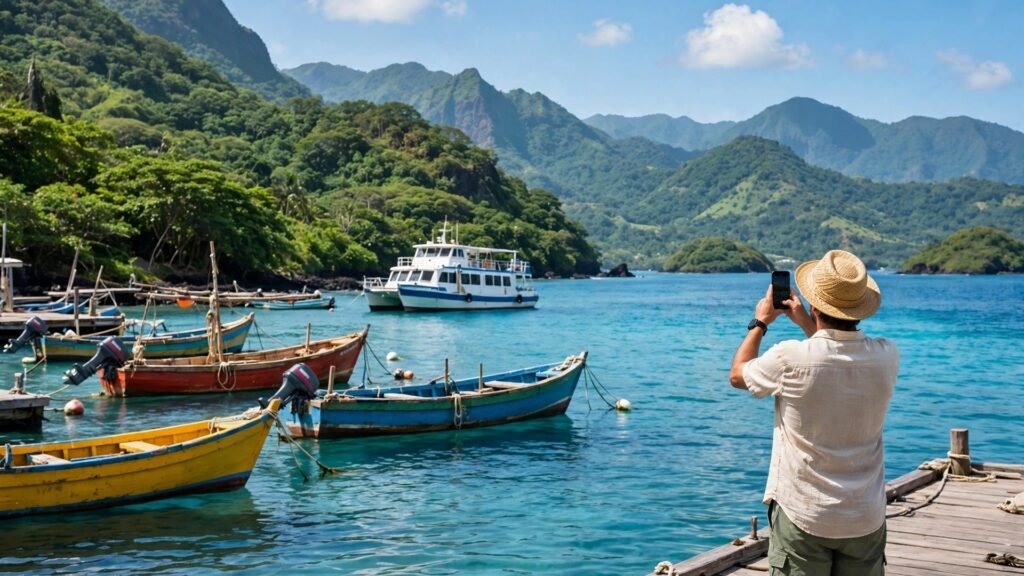
In Saint Vincent and the Grenadines, the sea is never far away, and neither is the phone. The country is made up of the main island of Saint Vincent and a chain of smaller Grenadine islands stretching south across turquoise water, including Bequia, Mustique, Canouan and Union Island. Between those islands lie open sea, ferry timetables and weather that does not always cooperate. In that setting, the smartphone has quietly become the most practical tool for everyday life: the way people bank, work, learn, travel and stay in touch.
Visitors often notice the phone first at a harbour or a beach, where someone is checking a ferry time, confirming a guesthouse booking or sending a photo home. For residents, the phone matters far more than that. It is the office for a small business owner, the classroom link for a student, the weather check for a fisherman and the family chat that crosses the water in seconds. Life here is island life, and island life runs on connection.
Key Takeaways
- In Saint Vincent and the Grenadines, the phone bridges the sea between the main island and the Grenadine islands, replacing trips that would take hours by boat.
- Banking, bookings, schoolwork and small-business sales increasingly happen on one small screen.
- Weather, signal and power still set the limits — the phone helps most where it is backed by planning and patience.
The Sea Makes Distance Real
Distance works differently in an island country. On a mainland, a trip to a bank, an office or a market might mean a bus ride or a drive. In Saint Vincent and the Grenadines, the same errand can mean a ferry crossing, a wait at the harbour and a day shaped around the timetable. When the sea is rough, plans change. A phone call or a message avoids that journey altogether, and that simple fact explains much of the phone’s importance here.
Families feel this most. Relatives may live on different islands, and children may study or work away from home. A short video call, a voice note or a photo keeps those ties close without a crossing. In the same way, a shopkeeper on one island can answer a customer on another, and a guesthouse owner can confirm a booking while the guest is still abroad. The phone turns a scattered country into a closer one.
The same logic applies wherever distance is the main obstacle. In Botswana, people bank and pay on their phones across long distances because a trip to a branch costs time, and in Nepal, people run daily life on their phones across the mountains because steep terrain makes travel slow. In the Grenadines, it is the sea, rather than distance on land or height, that makes the phone indispensable.
One Screen for Banking, Business and Bookings
For many Vincentians, the phone is now the nearest bank branch. Checking a balance, moving money between accounts and paying a bill can all be done without travelling to a branch and queuing. That matters most for people on smaller islands, where a banking trip is a real expedition, and for workers whose day does not leave room for a long errand.
Small businesses benefit in the same way. A fisherman can tell regular customers what the catch is. A craft seller can post a photo of new work and take orders by message. A taxi driver, a tour guide or a guesthouse host can manage bookings, answer questions and confirm arrivals from a single chat thread. None of this needs a shopfront system or a desktop computer. The phone, a camera and a messaging app are often enough to run a small livelihood.
Tourism, one of the country’s best-known industries, runs on the phone too. Visitors plan trips, compare stays, book ferries and find guides online long before they land. For local hosts and guides, a quick reply on a phone can be the difference between a booking and a lost guest. The phone is not just a convenience for tourism here; it is part of how the business is won.
Weather, Fishing and the Daily Check
For people who work on the sea, the phone is a safety tool as much as a business tool. Fishermen check the forecast before setting out, watch for wind changes during the day and stay in contact with others on the water. A phone cannot calm the sea, but it can help someone decide whether to go, when to return and who to call if plans change.
This habit is familiar across island and coastal communities. In Chile, for example, people check earthquake alerts on their phones first, because the phone is the fastest way to learn what is happening. In the Grenadines, where weather can shift quickly and distances between islands are real, that morning check is part of the routine, not an extra.
Weather shapes life on land as well. Heavy rain can disrupt travel, and a storm warning can change a whole day’s plans. Messages from family, employers and community groups travel faster than word of mouth, and a phone alert can reach someone at home, at work or on a boat. In a country where everyone is close to the sea, that speed matters.
School, Family and Everyday Talk
The phone also carries learning and family life. Students use it to follow lessons, look things up, share notes and keep in touch with classmates. Parents use it to check on children, coordinate pickups and talk to teachers. When a family is spread across islands, the group chat becomes the family room — the place where news, photos, jokes and practical decisions all live.
Voice notes deserve a special mention. They let people speak in the language of everyday life without wrestling with a small keyboard. A spoken message carries tone and warmth that a typed line cannot, and it works for older relatives as well as younger ones. For many households, the voice note is the most natural way to talk, and the phone is what makes it possible across the water.
Entertainment follows the same pattern. Music, videos, news and sport all arrive on the phone, often shared through the same apps people use for chatting. The phone has become the shared screen of the household, even in homes where a larger screen is also present, because it is the device that is always at hand.
What Still Gets in the Way
The phone-first life has real limits, and Vincentians know them well. Signal is not the same everywhere. On the main island, coverage is part of daily life; on smaller or more remote islands, it can be patchier, and a message may take its time. Power matters too: a phone is only useful while it is charged, and a long day out on a boat or away from home needs planning.
Cost is another limit. A good phone, a data plan and regular top-ups are a real household expense, and not every family can afford the newest device or the largest plan. People adapt — sharing a phone within a household, using free wireless spots where they are available, keeping messages short, or waiting until they are home to download something large. The phone is central, but it is not free, and households budget around it like any other necessity.
- The sea between islands makes the phone the fastest, cheapest link for banking, business and family.
- Tourism, fishing and small trade all run on bookings, forecasts and messages handled by phone.
- Voice notes keep family talk natural across islands, ages and distances.
- Signal, power and cost still limit phone-first life, especially on smaller islands.
There is also a simpler limit: the phone cannot replace everything. A face-to-face conversation, a visit to family, a day at the market and a crossing to another island still matter in their own right. The phone makes those things easier to arrange, but it does not remove the desire to be there in person. Island life is social life, and the phone serves it rather than replacing it.
Why the Phone Stays Central
So why do Vincentians do almost everything on their phones? Because the alternative is usually a journey. A phone saves a ferry trip, a queue and a day lost to travel. It puts the bank, the classroom, the market and the family chat in a pocket, and it works in the places where people actually live and work — at home, at the harbour, on a boat or in a small shop.
A phone saves a ferry trip, a queue and a day lost to travel.
That practicality is the real answer. Saint Vincent and the Grenadines did not adopt phone-first life because of a single app or a single trend. It adopted it because the country is spread across the sea, families are spread across the islands, and the phone is the thread that keeps them together. The islands are separate, but the conversation never stops.
What to Watch Next
As connections between the islands improve, the phone’s role is likely to grow rather than shrink. Better coverage on smaller islands would make remote learning, telemedicine and online trade easier for people who currently travel furthest for services. More reliable inter-island information would help travellers, fishermen and traders plan with greater confidence.
What will not change is the reason behind it all. Vincentians rely on their phones because their country is spread across the sea, their families are spread across the islands, and the phone is the thread that keeps them together. The islands are separate, but the conversation never stops.