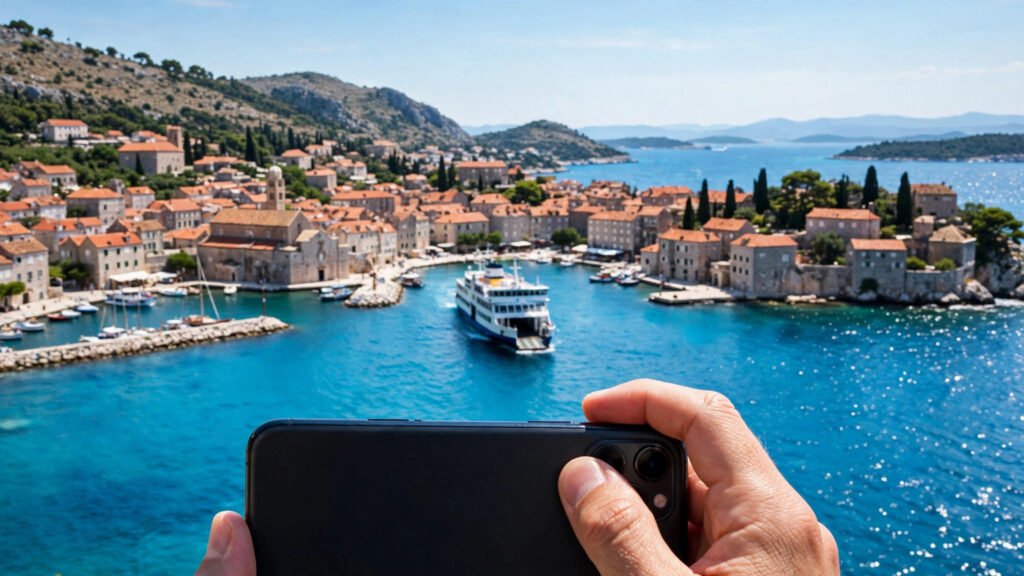
Croatia is a country shaped by water. A long Adriatic coastline, hundreds of islands, and towns that fill with visitors in summer all make daily life a question of timing: which ferry is leaving, which road is busy, which apartment is free, and which payment will work at the till. For many Croatians, the phone has become the tool that holds all of those answers together.
This is not only a story about technology. It is a story about geography. When home, work, family, and the sea are spread across islands and coastal towns, a device that carries timetables, maps, messages, and money in one place saves the kind of trips and waiting that used to eat up the day.
Key Takeaways
- Croatia’s island geography makes timetables, ferries, and travel plans central to everyday life.
- Phones bring ferry times, maps, messages, and payments together in one place.
- Tourism, seasonal work, and island living all push Croatians to organise more of life on a phone.
An island country needs a pocket timetable
For people who live on an island, the ferry is not a holiday extra. It is the school run, the commute, the shopping trip, and the way to reach a doctor, a bank, or a family gathering on the mainland. Ferry times change with the season, weather can disrupt a crossing, and a missed sailing can mean a long wait at the port.
Checking a sailing on a phone before leaving home therefore feels less like a convenience and more like common sense. The same habit applies to bus connections on arrival, to finding a parking space near a busy harbour, and to letting family know that a boat is delayed. In a country where so much movement depends on the sea, the phone has quietly become the first place people look.
Tourism turned the phone into a workplace
Summer changes Croatia. Coastal towns and islands welcome large numbers of visitors, and many Croatians work in tourism, hospitality, transport, and short-term rentals. For a host, a driver, a restaurant worker, or a boat operator, the phone is often the workplace itself.
Bookings arrive by message, guests ask questions before they arrive, reviews are read and answered, and calendars are updated on the move. A small business that once relied on a fixed telephone and a paper diary can now manage much of its season from a pocket device, even while standing at a harbour, a market, or a beach bar.
Visitors benefit too. They search for places to stay, check menus, follow walking routes through old towns, and translate a phrase or a sign. That shared reliance on the phone — by both hosts and guests — is one reason mobile habits feel so visible along the coast in summer.
In a country where so much movement depends on the sea, the phone has quietly become the first place people look.
Payments, maps, and everyday errands
Beyond travel and tourism, phones have changed ordinary errands. Contactless payment and mobile banking mean that many Croatians no longer need to carry large amounts of cash for a coffee, a market shop, or a tank of fuel. Splitting a bill with friends, sending money to family, or paying a bill online can all be done without a trip to a branch.
Maps matter just as much. Narrow old-town streets, one-way systems in historic centres, and winding coastal roads are far easier to navigate with live directions than with a folded map. For delivery drivers, couriers, and tradespeople working across towns, the phone is both the route planner and the link to the next customer.
The pattern is familiar elsewhere. In other countries, people have also moved everyday payments onto their phones, as shown by how Indonesians pay with QR codes instead of cash and cards, and by how Nepalese run daily life from phones across mountains.
- Ferries, buses, and island connections are checked before travelling, not at the port.
- Tourism work — bookings, messages, and calendars — is managed on the move.
- Contactless payments and mobile banking reduce the need to carry cash.
- Maps and live directions help drivers, couriers, and visitors navigate coastal towns.
- Family contact stays close even when relatives live on different islands.
Staying close across the water
Family is another powerful reason for the phone-first habit. Relatives may live on different islands, in Zagreb, or abroad, and video calls, voice messages, and group chats keep those ties warm between visits. Photos of a catch, a christening, a harvest, or a new grandchild travel instantly across water that once made communication slow.
For older relatives, a simple call or video chat can matter more than any app. For younger Croatians, the same phone carries study, work, news, and entertainment. The device adapts to each generation, which is part of why it has spread so widely.
Phones also play a practical role in safety and information. Weather warnings, road updates, and emergency information reach people quickly, a habit seen in other coastal countries too, including how Chileans check earthquake alerts on their phones first.
Digital services are catching up with daily life
Croatia has also built public digital services that let residents handle many administrative tasks online rather than queuing in an office. That shift fits a population that already uses phones for banking, travel, and work: if a form, an appointment, or a certificate can be reached from home, there is little reason to spend a day travelling to get it.
The change is gradual, and not everyone moves at the same pace. Paper, in-person help, and local offices still matter, especially for people who are less comfortable with technology. But the direction is clear: more of everyday administration is becoming something that can start on a screen.
What to Watch Next
Watch how island transport, tourism, and digital services continue to come together on the phone. Ferry information, bookings, payments, and public services are already linked in daily routines, and each summer season tests how well that system copes with crowds, weather, and changing timetables. For Croatians, the question is no longer whether the phone matters — it is how smoothly it can keep an island country moving.