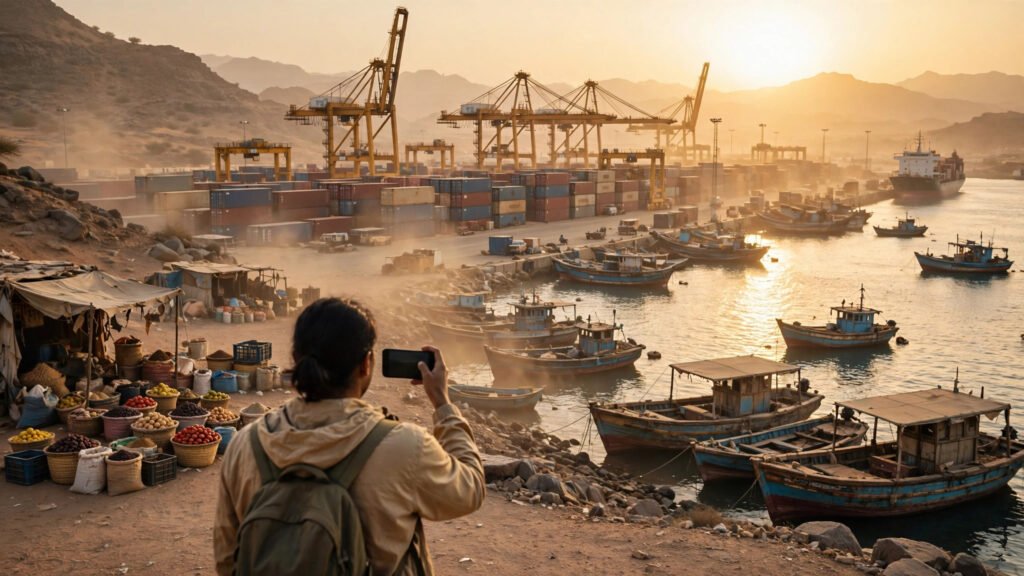
In Djibouti, the phone is rarely just a phone. For people living in a small, hot country built around one of the world’s busiest shipping chokepoints, it is a work tool, a bank counter, a weather check and a family lifeline, all carried in one pocket. That is why visitors often notice how much of daily life here runs through a small screen, from the quayside in Djibouti City to traders and drivers working far inland.
Djibouti sits where the Red Sea meets the Gulf of Aden, at the narrow Bab el-Mandeb strait. Ships passing between Europe, Asia and the Middle East sail close by, and the country’s ports handle cargo for the region, including trade bound for landlocked Ethiopia next door. In a place where so much work depends on arrivals, departures and timing, being reachable matters. A missed call can mean a missed delivery, a delayed truck or a lost day’s work.
Key Takeaways
- Djibouti’s port economy makes timing and contact essential, so the phone has become a core work tool.
- Heat, desert distances and scattered settlements make phone-based messages, money transfers and weather checks part of everyday planning.
- For families spread across borders, the phone keeps remittances, news and daily contact moving.
A port city at a crossroads of shipping
Djibouti City is the country’s economic centre, and its port shapes the rhythm of working life. Dock workers, drivers, customs brokers, warehouse staff and small traders all depend on knowing when a ship has arrived, when cargo is ready and when a truck can move. Much of that coordination now happens by phone: a message confirms a load, a call rearranges a pickup, a photo settles a question about goods without a wasted trip across town.
That matters even more because Djibouti is small but strategically placed. Goods do not only serve local shops; they move onward by road into Ethiopia and across the region. For a trader, the phone shortens the distance between the port and the customer. Instead of waiting at a gate or an office, a supplier can check on a shipment, agree a handover and keep the next job moving while still on the road.
Small businesses feel the same effect. A shopkeeper can reorder stock, a fishing-boat owner can find a buyer before landing, and a market seller can tell regular customers what has arrived. In each case the phone replaces a journey, and in a hot climate where every unnecessary trip costs time and energy, that saving is real.
Heat, distance and why timing matters
Djibouti’s climate is another reason the phone earns its place. Much of the country is desert, and daytime heat can be fierce for much of the year. People plan around it: early starts, shade at midday, and work fitted into the cooler hours. A phone helps with that planning, from checking conditions before setting out to rearranging a meeting when the heat makes travel impractical.
Distance plays a similar role. Outside the capital, settlements are scattered, and roads cross long stretches of dry land. When signal can fade on desert roads and journeys take hours, a message sent before departure is worth more than one sent too late. Drivers, herders and field workers use their phones to confirm routes, water stops and meeting points before they leave, rather than discovering a problem halfway there.
That habit extends to safety. Fishermen heading out to sea, drivers crossing remote routes and families waiting at home all rely on the phone as a check-in tool. A short call or message — “we have arrived”, “we are delayed”, “the road is closed” — keeps people informed without anyone having to travel just to ask.
In a hot climate where every unnecessary trip costs time and energy, the phone replaces a journey.
Trade, money and family across borders
Money is one of the strongest reasons Djiboutians keep their phones close. Many families have relatives working abroad, in France, elsewhere in Europe, the Gulf states or neighbouring countries, and money sent home supports households, school costs and small businesses. Phone-based transfers and messages let families confirm that help has arrived, discuss how it should be used, and stay in touch across time zones.
The same pattern shows up in trade. Djibouti’s markets mix local produce, imported goods and cargo passing through the port, and payments increasingly move through phone-based payments and transfers rather than only cash carried in person. For a small trader, that means less risk on the road and a clearer record of who paid what. For customers, it means buying from a seller in another town without travelling there first.
Language also shapes phone use. French and Arabic are the country’s official languages, while Somali and Afar are widely spoken at home and in daily life. Phones bridge those worlds: voice notes carry tone and detail that typed messages miss, calls work for people who prefer speaking to writing, and multilingual chats let families and work teams switch languages as easily as they switch topics.
- Port and logistics work runs on arrival times, cargo updates and driver coordination — all handled by phone.
- Phone-based money transfers connect Djiboutian families with relatives working abroad.
- Heat and desert distances make advance messages, weather checks and check-ins part of safe travel.
- Voice notes and calls suit a multilingual daily life where French, Arabic, Somali and Afar all have a place.
Everyday life on a small screen
Beyond work, the phone has become the noticeboard of Djiboutian life. News, football results, religious observances, school announcements and community events all travel through chats and social feeds. In a country where people are spread between the capital, port towns and remote settlements, the phone is often the fastest way for news to reach everyone at once.
Young Djiboutians, like young people everywhere, also use their phones for music, video, study and staying in touch with friends. Students look up lessons, jobseekers follow openings, and families share photos across distances that would otherwise keep them apart for months. The device is not a luxury add-on to life here; for many households it is the main connection to work, money and each other.
None of this means the phone has replaced face-to-face life. Markets still buzz, coffee houses still fill, and family gatherings still matter. What the phone has done is stretch those connections further: a trader can be at the port and in touch with a customer inland, a parent abroad can join a family decision at home, and a driver can cross a desert knowing someone knows where he is.
What to Watch Next
Watch how Djibouti’s port work, phone-based money and cross-border family ties keep shaping each other. As shipping through the Bab el-Mandeb strait, regional trade and digital payments all evolve, the phone is likely to stay at the centre of how Djiboutians work, travel and stay close — not because the technology is new, but because in a hot, scattered, port-driven country, being reachable has always mattered.