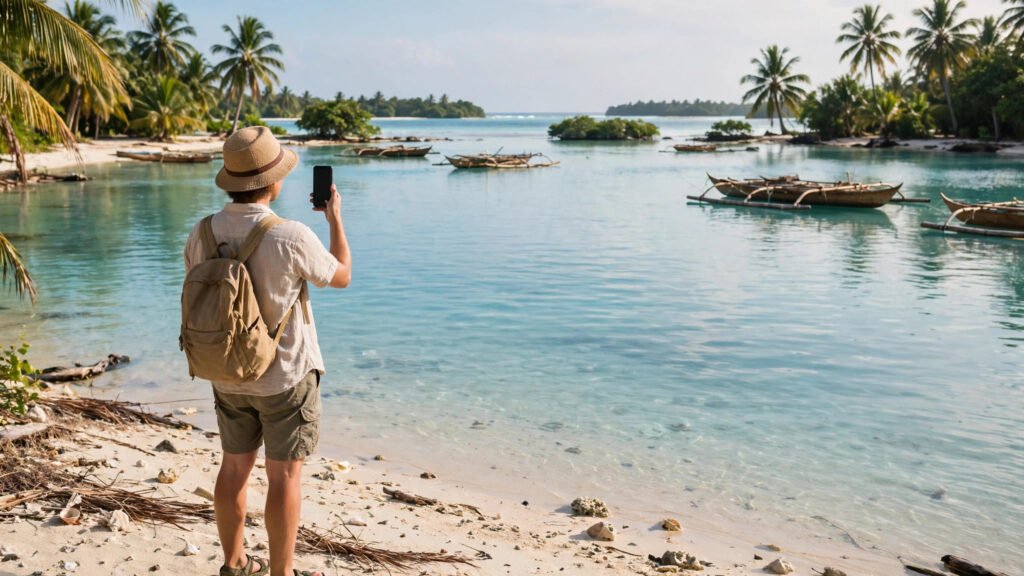
For many Marshallese families, home is not one place. Parents, children, grandparents, and cousins may live on different atolls, or an ocean apart, with some family members working abroad while others stay on the islands. Keeping that family together takes more than a letter or an occasional visit. It takes a phone call, a message, a photo, and, when help is needed, money sent home quickly and safely. That is why, for Marshallese living abroad, the phone has quietly become the main way to look after family back home.
The Marshall Islands are made up of scattered atolls in the central Pacific, separated by long stretches of open water. Travelling between islands can take time, and reaching a bank branch in person is not always simple, especially for families on smaller or more remote atolls. A phone changes that distance. It lets a worker abroad check in with family, hear how everyone is doing, and send support without waiting for a trip home or for someone else to carry money by hand.
Key Takeaways
- For Marshallese families spread across atolls and abroad, the phone is the main link between earners overseas and family at home.
- Sending money by phone avoids long journeys to a bank branch and long waits for help to arrive.
- Messages, calls, and photos keep family decisions shared, so support goes where it is most needed.
Why distance makes the phone essential
Island life has always meant distance. Even within the Marshall Islands, families can be separated by sea, weather, and boat schedules. When a family member moves abroad for work, that distance grows much larger, but the responsibilities at home do not shrink. School needs, household costs, medical needs, and community obligations still have to be met, and someone has to meet them from far away.
The phone helps because it does several jobs at once. It is a way to talk, a way to plan, and a way to send money. A worker can call home in the evening, learn that a roof needs repair or that a child needs school supplies, and act on that same day. Without the phone, that same exchange could take much longer, and the help might arrive after the need has passed. Similar patterns appear wherever mobile money helps families across scattered islands, because the problem is the same: water between people, and a need that cannot wait for a boat.
For a family spread across an ocean, a phone is not a luxury; it is the thread that holds the household together.
For a family spread across an ocean, a phone is not a luxury; it is the thread that holds the household together.
How money travels home now
In the past, sending money home often meant relying on someone travelling in the right direction, or on a process that took several steps and several days. The phone has shortened that chain. A sender can use a bank app or a mobile money service to move money to a family member, who can then use it, withdraw it, or pass it on. The details vary by service and by island, but the basic idea is the same: fewer journeys, fewer middlemen, and a clearer record of what was sent.
That record matters. When money is sent by phone, both sides can usually see that it was sent and received. That reduces confusion about whether help arrived, and it lets families plan around it. A parent at home does not have to guess whether support is on its way, and a worker abroad does not have to worry that the money has gone missing somewhere in between. For households that depend on regular support, that certainty is almost as valuable as the money itself.
The phone also lets families decide together. A message can explain what the money is for, and a reply can confirm what is most urgent. That conversation keeps support practical rather than generic. Instead of sending help blindly, a worker abroad can respond to a real need, whether that is food, transport, school costs, or help for an older relative. It is the same kind of everyday coordination that shapes how island families stay connected across separate islands, where the phone carries both the message and the money.
What families check before they send
Sending money by phone still needs care. Families usually check a few simple things before they press send: that they are using the right number or account, that they understand any charges involved, and that the person receiving the money knows it is coming. A short message before or after the transfer can prevent most mix-ups, and it costs almost nothing compared with the confusion of a payment sent to the wrong place.
Security matters too. A phone used for money should be protected, just like a wallet. Keeping the device locked, keeping login details private, and being wary of unexpected messages asking for money or codes are habits that protect the whole household, not just the sender. Families often pass these habits on to each other, especially to older relatives who may be newer to banking by phone. That shared caution is part of why phone-based support works: the tool is only as safe as the habits around it.
There are limits as well. A phone cannot replace a visit, and it cannot solve every problem from a distance. Connections can drop, services can be unavailable, and some needs still require someone to be there in person. Families know this, and they use the phone for what it does best — staying close, sharing news, and moving support quickly — while still valuing the times they can be together in person. Island households elsewhere face the same balance, as seen in how scattered island communities use phones for daily life.
- Phones let Marshallese abroad stay in daily contact with family across atolls and oceans.
- Mobile transfers shorten the journey money takes from a worker abroad to family at home.
- A message alongside a transfer helps both sides agree on what the support is for.
- Simple checks — the right recipient, understood charges, and a locked phone — keep transfers safer.
- Calls and photos keep family bonds strong between visits, even when travel is not possible.
What to Watch Next
For Marshallese families, the phone will likely keep its central place in how support travels home. As mobile services reach more islands and more people grow comfortable using them, the conversation between workers abroad and families at home will only get easier. The habits that matter most will stay the same: check the recipient, keep the phone secure, talk about what is needed, and confirm that help arrived. Distance may separate Marshallese families, but the phone keeps the household connected, and keeps support moving to where it is needed most.